Get Full Government Meeting Transcripts, Videos, & Alerts Forever!
Get email alerts on the Carbon Dioxide Eor Stimulus topic
No spam. Unsubscribe anytime.
Committee backs carbon-dioxide stimulus to encourage enhanced oil recovery; $10/ton state top-up, $10M seed from LSRA
Summary
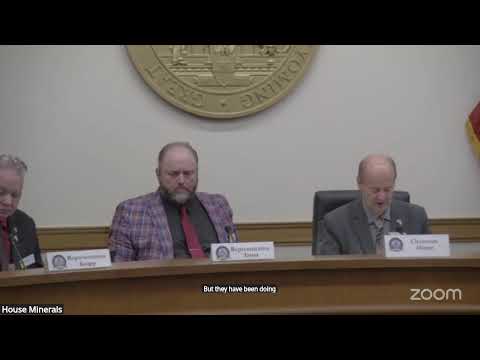
The Minerals, Business & Economic Development Committee on Friday recommended due pass for Senate File 17, a bill creating a state stimulus that adds $10 per ton to CO2 used in enhanced oil recovery projects and seeds a self‑funding account with a $10 million LSRA transfer.
The Minerals, Business & Economic Development Committee on Friday recommended due pass for Senate File 17, a bill that would create a state stimulus to narrow the federal tax-credit gap between permanent CO2 sequestration and the use of captured CO2 for enhanced oil recovery (EOR).
Senate File 17 would direct the Wyoming Energy Authority (WEA) to administer a grant-style stimulus that adds $10 per ton to CO2 used for qualified EOR projects in Wyoming. The bill seeds an “enhanced oil recovery stimulus account” with a $10 million one-time transfer from the Land and Water/LSRA account and then directs that 3% of severance tax revenue produced by EOR projects be credited back into the account as projects begin producing, making the program self-funding over time, according to bill proponents.
Sponsor and purpose
Pete Obermueller, president of the Petroleum Association of Wyoming, told the committee the bill is designed to “equalize” a federal tax‑code incentive known as 45Q. Obermueller said Congress pays a higher per‑ton credit when CO2 is permanently sequestered than when it is used for EOR, and that difference discourages CO2 owners from selling CO2 for EOR. “The federal government has said they prefer that CO2 be sequestered permanently and not used for productive purposes,” Obermueller said. “This bill equalizes that so a CO2 owner is not incentivized to do permanent sequestration over EOR.”
How the program would work
Under the bill, a CO2 provider that captures CO2 using CCUS technology, delivers Wyoming‑sourced CO2 to a Wyoming‑based EOR project, and qualifies under the IRS requirements for 45Q would be eligible to receive the $10‑per‑ton Wyoming stimulus. The Energy Authority would determine eligibility, work with the state auditor to issue payments, and report back to the legislature. The bill includes an off‑ramp: if the federal 45Q structure is changed to equalize EOR and sequestration, the state program is designed to phase out or reduce proportionally.
Proponents said $10 was chosen after economic review. “The University of Wyoming School of Energy Resources economists … worked on this … and 10 is where that landed,” Obermueller told the committee.
Funding, timeline and risks
The bill requires an initial $10 million seed from the LSRA so the stimulus account can make its first payments. Proponents said that when projects begin producing, the severance taxes generated by EOR production should repay the LSRA within several years and then continue to replenish the account. Obermueller told the committee that project timing varies; in one scenario the initial LSRA replacement could take about eight years, but long‑term returns to the state could be substantial. He cited School of Energy Resources estimates of a 30–33% return over time from expanded EOR activity.
Witnesses and technical issues
Rob Krieger, executive director of the Wyoming Energy Authority, told the committee WEA is prepared to administer the program and that its smaller staff can work with partners to assemble required data and manage the process. Matt Sache (Mineral Tax Division, Department of Revenue) flagged a reporting timing issue: language in the bill required the Department of Revenue to report an amount the Energy Authority will actually hold. The committee amended the reporting language on the floor so the authority produces the program‑level report while the Department of Revenue remains the source of verified severance‑tax receipts.
Project pipeline and infrastructure
Lon Whitman, director of the Enhanced Oil Recovery Institute, described multiple Wyoming EOR projects in development, including a cluster project near Gillette and a “big muddy” project near Glenrock. Whitman told the committee that pipeline spur costs are a major barrier — roughly $1 million per mile — and that many candidate projects are being advanced by small companies rather than majors, which increases sensitivity to costs and incentives.
Committee action and vote
Committee action was moved by Vice Chair Tarver and seconded by Representative Lolli. The roll call produced eight ayes with one member excused. The committee recommended Senate File 17 be given a do‑pass recommendation and discussion closed with notification that the bill’s sponsor and WEA would continue to refine technical language and reporting details.
Votes at a glance
- Senate File 17 — Carbon Dioxide Enhanced Oil Recovery Stimulus: Committee recommendation — do pass. Roll call: 8 ayes, 0 no, 1 excused.
Ending
Proponents said the bill is a targeted, state‑level complement to federal 45Q credits intended to spur otherwise uneconomic EOR projects while limiting long‑term state exposure through the severance‑tax repayment design. The committee forwarded the bill with the do‑pass recommendation.