Get Full Government Meeting Transcripts, Videos, & Alerts Forever!
Get email alerts on the Greater Minnesota Housing Infrastructure topic
No spam. Unsubscribe anytime.
Senate hearing urges expansion of Greater Minnesota housing infrastructure grants to unlock workforce housing
Summary
Stakeholders told the Minnesota Senate Housing and Homelessness Prevention Committee on March 1 that public investments in infrastructure are critical to unlocking workforce and affordable housing across Greater Minnesota.
Stakeholders told the Minnesota Senate Housing and Homelessness Prevention Committee on March 1 that public investments in infrastructure are critical to unlocking workforce and affordable housing across Greater Minnesota.
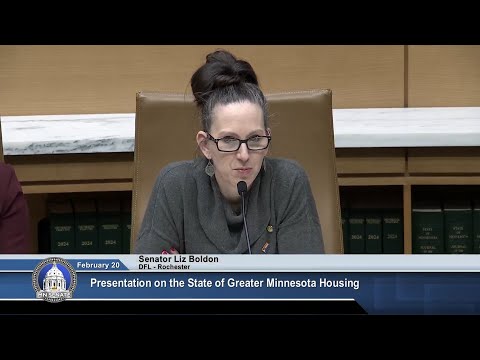
The testimony focused on the Greater Minnesota Housing Infrastructure Grant Program, established in 2023, and two bills before the committee: Senate File 906, which would appropriate $5 million to the program, and Senate File 1339, a bill to provide an additional $20 million in bonding authority. Senator Putnam presented SF 906; Senator Hochschild presented SF 1339 and that bill was recommended to pass and referred to the Committee on Capital Investment by a voice vote.
"Over the last 3 years ... we've had over 35 candidates reject jobs solely because they were unable to find a home in the Twin Ports," said Dante Tomassoni, director of corporate affairs at Cirrus Aircraft, describing recruitment barriers in Duluth and the Twin Ports region. Tomassoni said high construction costs, elevated interest rates and limited land are deterring developers and preventing employers from relocating or retaining workers.
City officials and housing providers described similar barriers statewide. Nate Keller, community development director for St. Joseph, said "areas that would be primed for growth require lift stations with 7 figure price tags," and added that infrastructure costs can halt otherwise viable housing projects. Ted Bridal, public works director for International Falls, told the committee that developing a single 300‑foot block of infrastructure can cost $870,000 in his city compared with $450,000 in other places, a difference that makes affordable development infeasible.
Nonprofit housing providers and regional groups also urged sustained funding and program design tailored to small cities. Bob Hawley, executive director of Goodhue County Habitat for Humanity, described a planned 26‑home development in Red Wing (Hope Heights) where the city agreed to apply for a Greater Minnesota Housing Infrastructure Grant on the project's behalf. Kristen Encity, CEO of Habitat for Humanity of Minnesota, said infrastructure costs are often passed through to affordable homeowners and that state investment would "have positive ripple effects" across communities.
Darielle Dannen of the Greater Minnesota Partnership explained program mechanics to the committee: "The grants actually go to cities — cities, counties — it's a program that's kind of built on a similar program that runs at another agency." Dannen outlined grant limits as stated in her testimony: "$40,000 per lot for 1 to 4 units, dollars 180 per lot for multifamily housing, 5 or more units, and then $60,000 per manufactured housing unit," and noted a cap of $500,000 per grantee or project.
Senators and testifiers repeatedly told the committee that Greater Minnesota faces a structural market failure in places where the cost to build (including public infrastructure) exceeds what local markets can support. Senator Hochschild, author of SF 1339, said the proposed funds would reduce the overall cost of housing in those communities and act as a tool for towns that need state assistance to build new lots.
Action: The committee recommended Senate File 1339 to pass and referred it to the Committee on Capital Investment. Senate File 906 was laid over for possible inclusion in a future omnibus.
The committee heard broad agreement among local officials, nonprofit developers and business representatives that additional funding, simpler application processes for small cities and an earlier program rollout would improve access to the grants and help move stalled projects forward.
Looking ahead, senators said they will work on program implementation details and targeted outreach to small cities to reduce application burdens and make funds more accessible.