Get Full Government Meeting Transcripts, Videos, & Alerts Forever!
Get email alerts on the Transportation Funding topic
No spam. Unsubscribe anytime.
Sacramento Transportation Authority outlines 2025 priorities, eyes future sales-tax measure and countywide planning role
Summary
The Sacramento Transportation Authority reviewed Measure A revenues and operational programs, highlighted planning needs to compete for state and federal grants, and directed staff to form an ad hoc group to study funding and planning options while prioritizing a potential county sales-tax measure.
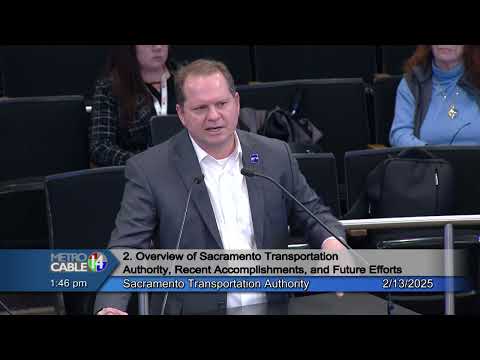
Kevin Busey, executive director of the Sacramento Transportation Authority, told the board on Feb. 13 that the agency’s core mission is to secure funding for local transportation needs and that STA operates with a small staff while administering significant programs.
“Measure A ... our mission is to secure funding for local transportation needs, and we are an independent local government,” Busey said, describing Measure A as a half-cent sales tax approved by voters in 2004 that funds transportation projects in Sacramento County. He told members Measure A revenues now track at roughly $175,000,000 per year and that development impact fees raise about $6 million to $9 million annually. He said administrative expenses are capped at 0.75 percent.
Busey reviewed STA’s three main program areas: Measure A, the Sac Metro Freeway Service Patrol and the Senate Bill 1 Local Partnership Program. He said the freeway service patrol has a fleet of about 15 trucks, performs roughly 30,000 assists a year and works with Caltrans and CHP. He also outlined SB 1 competitive and formula funds, noting the Local Partnership Program requires a one-to-one match and that some competitive funds are available every two years.
Why it matters: board members and members of the public stressed that planning and a clear, shared vision will be crucial to winning state and federal grants and to any future ballot measure. Busey and several directors said planning must come first, because many grant programs require planning documents and benefit-cost analyses before construction funds are eligible.
Board discussion focused on two linked goals: (1) preparing a viable local sales-tax measure to address large, countywide deferred maintenance and (2) improving STA’s ability to compete for state and federal grants by investing in planning and coordination. Director Rich Desmond and others urged formation of a subcommittee to study a future sales-tax measure and intra‑county STIP coordination. Director Phil Serna and several others emphasized the time and staff commitment that a ballot measure effort would require.
Public commenters pressed for safety and clarity in any funding plan. Michael Andrew Barnbaum, a member of the public, said 32 people were killed in vehicle collisions in the City of Sacramento last year that he believes “could have all been completely preventable” and urged funding for pedestrian safety measures such as delayed green signals and diagonal crossings. Dan Allison, a Sacramento resident, said any measure must present a clear vision, not just a list of projects.
Board direction and next steps: staff said they would proceed with a dual approach — prioritize development work for a possible 2026 measure while standing up an ad hoc committee to study planning, funding equity and other structural options (including the feasibility of joining a CTA/RTPA model). Busey said staff would contact interested board members to form the ad hoc group and return with options and any required funding proposals.
Context: Busey noted that Sacramento County does not receive the same noncompetitive state planning allocations that many other large California counties receive, a factor he said can disadvantage the county in competitive grant rounds. He highlighted recent staff efforts to influence SACOG’s regional funding round to protect road maintenance eligibility and other county priorities.
The meeting did not adopt any ordinance or authorize spending on planning at this session; the board agreed to pursue further study and return with recommendations.