Get Full Government Meeting Transcripts, Videos, & Alerts Forever!
Get email alerts on the Office Of Inspector General topic
No spam. Unsubscribe anytime.
Senate committee advances bill to create independent state inspector general, debates data‑privacy rules for abandoned probes
Summary
A bipartisan Senate committee on Monday advanced legislation to create an independent Office of the Inspector General to investigate alleged fraud, waste and abuse across state government, while deferring final decisions about how much investigative information should become public when probes are abandoned.
A bipartisan Senate committee on Monday advanced legislation to create an independent Office of the Inspector General to investigate fraud, waste and abuse across state government, while delaying a final decision on how much investigative information should become public when probes are abandoned.
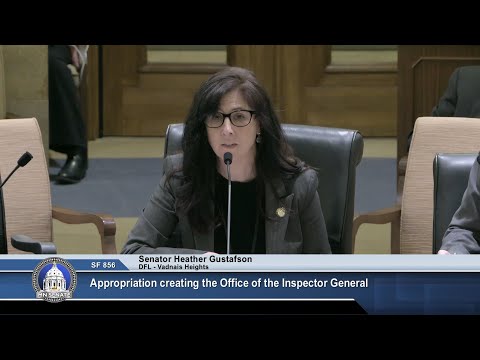
Senate File 856, sponsored by Sen. Ann (Senator) Gustafson, directs the creation of a centralized, nonpartisan inspector general’s office to investigate alleged misuse of public funds and to refer criminal or civil matters to the Bureau of Criminal Apprehension (BCA) or the attorney general as appropriate. “The bill establishes an independent office of the inspector general to strengthen accountability, transparency, and oversight across state government,” Gustafson told the Senate Judiciary and Public Safety Committee.
The committee unanimously or by voice vote adopted the chief authors’ A19 amendment before moving the bill forward. The A19 amendment makes multiple technical and policy changes, including clarifying the office’s placement under judicial authority, revising statutory definitions of fraud and waste to align with pending whistleblower‑related language, replacing a requirement that the office employ licensed peace officers with language allowing experienced investigators, and excluding certain Department of Corrections positions from mandatory transfer into the new agency.
Why it matters
The proposal would centralize investigative authority on allegations of fraud, waste and abuse under a single entity separate from the agencies it would review. Authors said the centralization is intended to increase public trust in state government and ensure consistent investigative standards. Committee discussion focused on the bill’s data‑classification rules — specifically, what investigative information becomes public after an inquiry is closed, completed or abandoned.
Key committee discussion and testimony
Sen. Gustafson and co‑sponsor Sen. Croon (co‑presenter) described work with stakeholders including the BCA to refine the bill. “We worked hard with the BCA to address the main issue that’s in the letter from the Commissioner of Public Safety,” Croon said while explaining revisions in the A19 amendment.
A major point of debate was the amendment’s data‑practices language, which draws on Minnesota’s Government Data Practices Act (chapter 13) and on language modeled after the Legislative Auditor’s statute. Senate counsel (Ms. Primo) explained the amendment’s glide path for data classification: while an investigation is active its records are treated as confidential or nonpublic; when an investigation is completed most records become public except where other statutes classify them as not public, or when disclosure would jeopardize another active investigation or ongoing litigation.
Open‑government advocates pressed for broader public disclosure in the case of investigations that are not completed or are abandoned. Matt Ehling of Minnesotans for Open Government and Rich Neumeister, an open‑government advocate, urged the committee to require release of at least basic information — such as the existence of the inquiry and the identity of the non‑government entity investigated — when investigations are not pursued to completion. Ehling warned that limiting disclosure for abandoned investigations could leave the public without important context about governmental activity; Neumeister suggested adding a “general description” or the “nature” of the allegation to the public record in those cases.
By contrast, Legislative Auditor Judy Randall described practical constraints that justified protecting certain intake materials. Randall said the Office of the Legislative Auditor (OLA) receives hundreds of allegations and performs cursory screening on many matters; making unvetted allegations public could unfairly harm individuals or entities named in complaints that are never substantiated. "We almost have a database of allegations and complaints that aren't vetted," Randall said, arguing for a balance between transparency and protecting unproven allegations.
Committee response and next steps
Committee members and the bill’s authors repeatedly framed the data‑classification issue as a balance between transparency and privacy. Several senators said they supported further review of the provisions addressing abandoned investigations; Chair Sen. Latz said the committee would continue to consider the matter formally or informally before the bill reaches the full Senate.
The committee adopted a technical change requested by Sen. Limmer to cross‑reference the bill’s reporting requirement so that the phrase “completion of the investigation” more clearly ties to the inspector general’s duty to issue public reports under a later section of the bill.
Formal actions
- The A19 amendment was placed before the committee, offered and described by the bill authors and adopted after discussion. Senator Clark moved adoption of the A19 amendment; the amendment was adopted.
- The committee then considered the bill as amended. Senator Croon moved that Senate File 856 as amended be recommended to pass and be referred to the Senate Committee on Education Finance; that motion prevailed and the committee reported the bill to the next committee. A motion to amend the committee recommendation to "without recommendation" was withdrawn.
Items retained for further consideration
Committee members and testifiers agreed to continue vetting the statute’s classification of data from investigations that are "no longer actively pursued" (the "abandoned" or paused investigation category). The committee asked authors and stakeholders to work on possible revisions and to provide additional analysis before final floor action.
Details and clarifications from the hearing
- The A19 amendment revises definitions of "fraud" and "waste" to align with related whistleblower bill language; under the amended text fraud is described in part as an "intentional or deceptive act to gain an unlawful benefit," per counsel’s description of the harmonized language.
- The amendment removes a requirement that the new office employ licensed peace officers, replacing that requirement with authority to employ experienced investigators at the inspector general’s discretion.
- Subdivision language clarifies that data provided by other government entities retains its original classification unless another statute requires otherwise; some special categories (for example, complainant or whistleblower identities) retain protection under the amendment.
- The amendment specifies that employees and positions within the Department of Corrections are excluded from mandatory transfer into the new office; the Department of Corrections' Commissioner Paul Schnell explained his office’s current internal inspector‑general‑style functions are largely internal and operational and not equivalent to the new agency’s statewide fraud‑and‑waste investigative role.
What the committee did not decide
The committee did not adopt a new requirement that the inspector general announce abandoned investigations or make the "nature" of those allegations public. Several members asked for additional analysis and safeguards and requested that the issue be revisited as the bill moves through further committees.
Next steps
With the A19 amendment adopted, the Judiciary and Public Safety Committee recommended Senate File 856 to pass and be re‑referred to the Senate Committee on Education Finance. Committee members said they will continue working with the bill authors, the Office of the Legislative Auditor and open‑government stakeholders on the data‑classification issue for abandoned investigations before the bill proceeds further.