Get Full Government Meeting Transcripts, Videos, & Alerts Forever!
Get email alerts on the Lake Maria Sanchez Flood Mitigation topic
No spam. Unsubscribe anytime.
St. Augustine commission approves easements to advance Lake Maria Sanchez flood mitigation project
Summary
After extensive public comment and staff presentations, the St. Augustine City Commission voted unanimously to authorize the city to obtain easements — by voluntary conveyance or, if necessary, eminent domain (quick‑take) — to build a flood wall, pump station and stormwater upgrades for the Lake Maria Sanchez drainage project.
The St. Augustine City Commission voted unanimously Feb. 24 to approve a resolution authorizing the acquisition of easements — by negotiated conveyance or, if necessary, eminent domain — for the Lake Maria Sanchez flood mitigation and drainage improvement project.
The action clears a key legal hurdle that city staff said has delayed the project for years: securing private easements along the southern edge of Lake Maria Sanchez where the city must construct a hip‑high flood wall, a pump station and other stormwater improvements. Jessica Beach, the city’s resilience lead, told the commission the project would protect about 186 flood‑prone structures and is designed to the equivalent of a 25‑year storm surge while allowing for additional protections in the future.
City staff and the project’s designer stressed the timing and scope. The project is being funded primarily through two state sources: roughly $20 million from the Resilient Florida program for construction and $10 million in state legislative appropriations for design and construction. Beach said the city originally began design work under a FEMA hazard mitigation grant program after Hurricane Matthew and has phased the work so the north portion (near City Hall) can move forward while the southern portion awaits easements.
"We estimate that 186 structures that are already flood prone and currently at risk will be protected," Beach said during the staff presentation, describing both coastal surge and rainfall benefits. Beach and consulting engineer Charles Hill of McKim & Creed presented maps showing a marked reduction in inundation depth and duration for both routine "king‑tide" flooding and rainfall‑driven street flooding if the project is completed.
Residents from the Old City South and Lincolnville neighborhoods urged the commission to approve the easement authority. "I'm in support of this resolution because quite frankly, it's the right thing for the city to do for its homeowners and residents," said Patrick Crosetta, who said his property backs onto Lake Maria Sanchez. Other speakers described repeated damage to homes, raised foundations and frequent nuisance flooding that limits vehicle access and damages landscaping.
The resolution approved by the commission (Resolution 20‑25‑07) directs staff to pursue voluntary easements and, if negotiations fail, to initiate quick‑take eminent domain proceedings to secure the permanent easement, temporary construction easement and access easement parcels illustrated in the resolution exhibits. Outside counsel Michael Cavendish explained the quick‑take process to the commission, noting property owners receive pre‑litigation offer letters and that the city must deposit at least the court‑determined appraised value into the court registry before title passes.
"In quick take proceedings, the property owners still get their standard pre‑litigation offer letters... [and] the city is required to make a good faith deposit of the appraised fair market value of the easement interest," Cavendish said, outlining due‑process protections the law provides to landowners while allowing the city to proceed with design and construction.
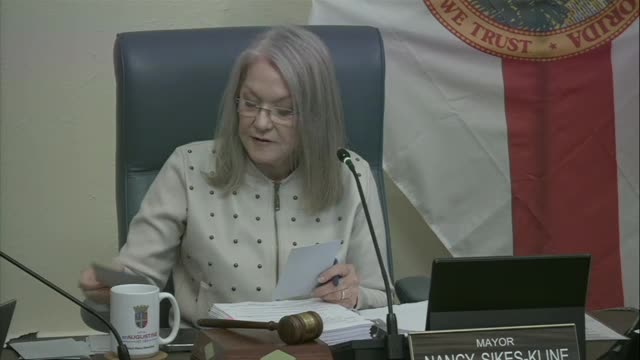
Commission debate ranged from support for the neighborhoods' outreach and the project's public benefits to caution about using eminent domain. Commissioners repeatedly praised the work of planning and resilience staff, the neighborhood associations and city consultants. After discussion, the commission approved the resolution by roll call vote: Nancy Sykes Klein, Barbara Blonder, John DePrater, Cynthia Garris and Jim Springfield voted yes (5–0).
Staff said the city will continue to pursue voluntary easements as its preferred route. Beach told the commission that phasing the project will allow the north segment — primarily city right‑of‑way improvements around Granada, Cordova and the City Hall area, including undergrounding utilities and drainage upgrades — to complete final design and reach bid readiness in 2026, with south‑end construction timing contingent on securing easements and completing permitting.
The commission action does not itself start construction; it authorizes the legal steps to obtain property rights needed to finish design and build the southern flood wall and pump station components that staff say are essential to reducing coastal surge infiltration into the downtown basin. City staff said they will return to the commission with specific easement exhibit descriptions, appraisals and any negotiated settlement offers as those items develop.
The approval drew broad neighborhood support at the meeting: petition deliveries, multiple resident testimonies and numerous speakers wearing Old City South identifiers. Residents and staff said the project also includes streetscape and utility work intended to reduce the duration of rainfall flooding on downtown streets, improve pedestrian access and protect historic properties.
Commissioners and staff said they will continue public outreach as design advances and noted grant reporting and construction schedules will be shared during future commission and CRA meetings.