Get Full Government Meeting Transcripts, Videos, & Alerts Forever!
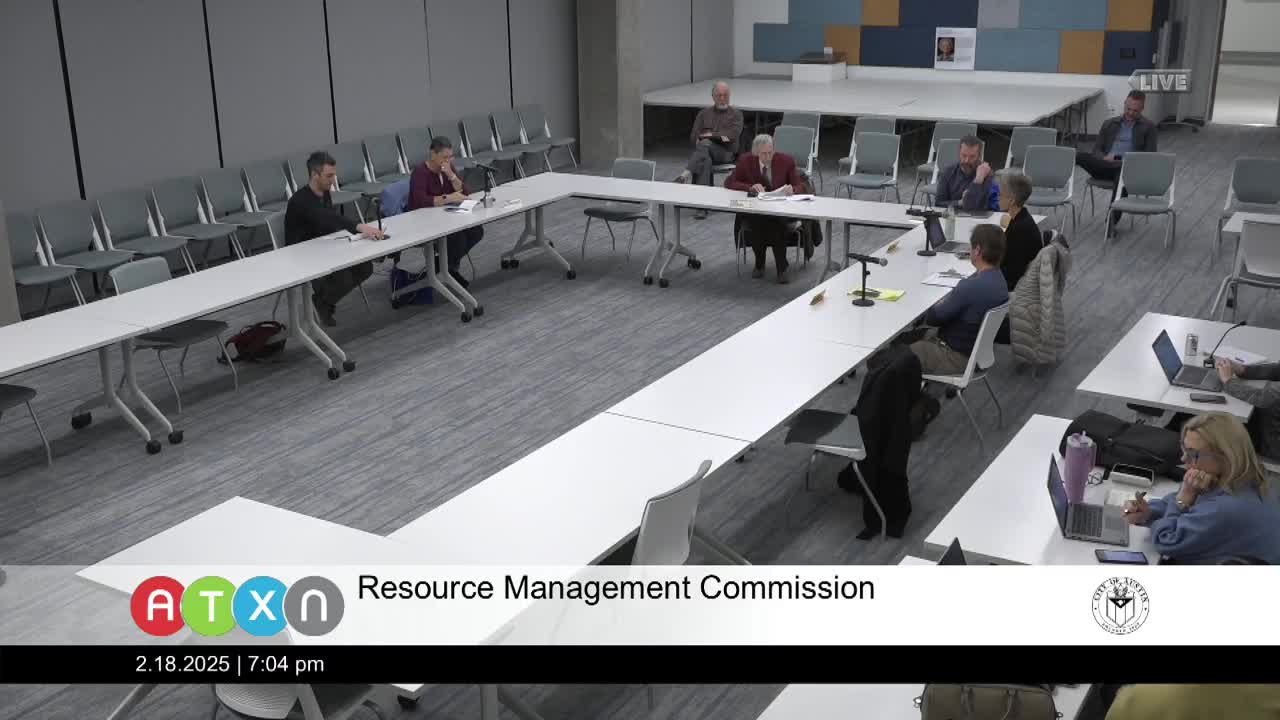
Austin Energy staff brief commissioners on virtual power plant, battery program and solar program changes
Summary
Austin Energy presented plans to build a virtual power plant (VPP) using customer-owned batteries, thermostats and EVs, described technical steps, customer incentives and program constraints, and answered commissioners’ questions on cost-effectiveness, inspections and non-wires alternatives.
Austin Energy staff briefed the Resource Management Commission on progress toward a virtual power plant (VPP) and a plan to expand battery programs alongside solar incentives. Staff described multiple pathways for deployment, technical and safety requirements, customer incentives and open policy questions the utility is studying.
Richard Genesee, vice president of customer energy solutions for Austin Energy, framed the presentation as an integrated effort across utility groups and said the program will pair an upfront incentive with ongoing performance payments tied to customer enrollment and event performance. Tim Harvey, customer renewable solutions manager, and Lindsey McDougall, manager of demand response and technical services, delivered the briefing and fielded commissioner questions.
Key elements explained by staff - Current assets and near-term plans: Austin Energy currently has about 15 megawatts of distributed batteries in its service territory and has an existing VPP that aggregates thermostats and EV chargers. Staff said the utility is preparing to integrate solar-coupled batteries and to move toward a central DERMS (distributed energy resource management system) that will coordinate multiple edge DERMS systems and internal utility platforms. - Customer incentives and program design: Staff described a two-part incentive model: an upfront incentive to lower the battery purchase barrier and an ongoing pay-for-performance incentive tied to how customers participate in demand-response events. Staff said upfront incentives will be conditioned on customer participation in the program. - Program types considered: Austin Energy is evaluating two models: a VPP where the utility controls batteries and pays performance incentives, and a bill-credit/rate approach in which customers retain direct control and receive credits if they meet performance parameters. Staff noted the VPP provides better telemetry and control but involves platform fees from third-party aggregators. - Cost-effectiveness and fees: Lindsey McDougall said the utility will run cost-effectiveness analyses and only propose programs that pass that test. Tim Harvey said platform fees for aggregator/DERMS providers are substantial and must be balanced against avoided costs the VPP creates. - Avoided-cost opportunities: Staff listed several avoided-cost benefits from a VPP and batteries, including energy arbitrage (charge low, discharge high), avoiding day-ahead market purchases, reducing ERCOT 4CP (peak transmission charges), potential participation in ancillary services, and non-wires alternatives that could defer distribution upgrades. - Safety, inspection and interconnection: Austin Energy described updated interconnection guidelines and in-person inspection protocols. Staff said remote-only inspections performed during COVID did not adequately identify life-safety issues and that the utility will continue on-site inspections for now. - Current programs and pilots: Staff named existing programs — Power Partner Thermostat, Power Partner EV and Power Partner programs for multifamily — and reported a recent off-season $75 enrollment bonus for thermostats and a new $25 yearly retention incentive. Staff said they are…
Already have an account? Log in
Subscribe to keep reading
Unlock the rest of this article — and every article on Citizen Portal.
- Unlimited articles
- AI-powered breakdowns of topics, speakers, decisions, and budgets
- Instant alerts when your location has a new meeting
- Follow topics and more locations
- 1,000 AI Insights / month, plus AI Chat