Get email alerts on the Virtual Power Plant topic
No spam. Unsubscribe anytime.
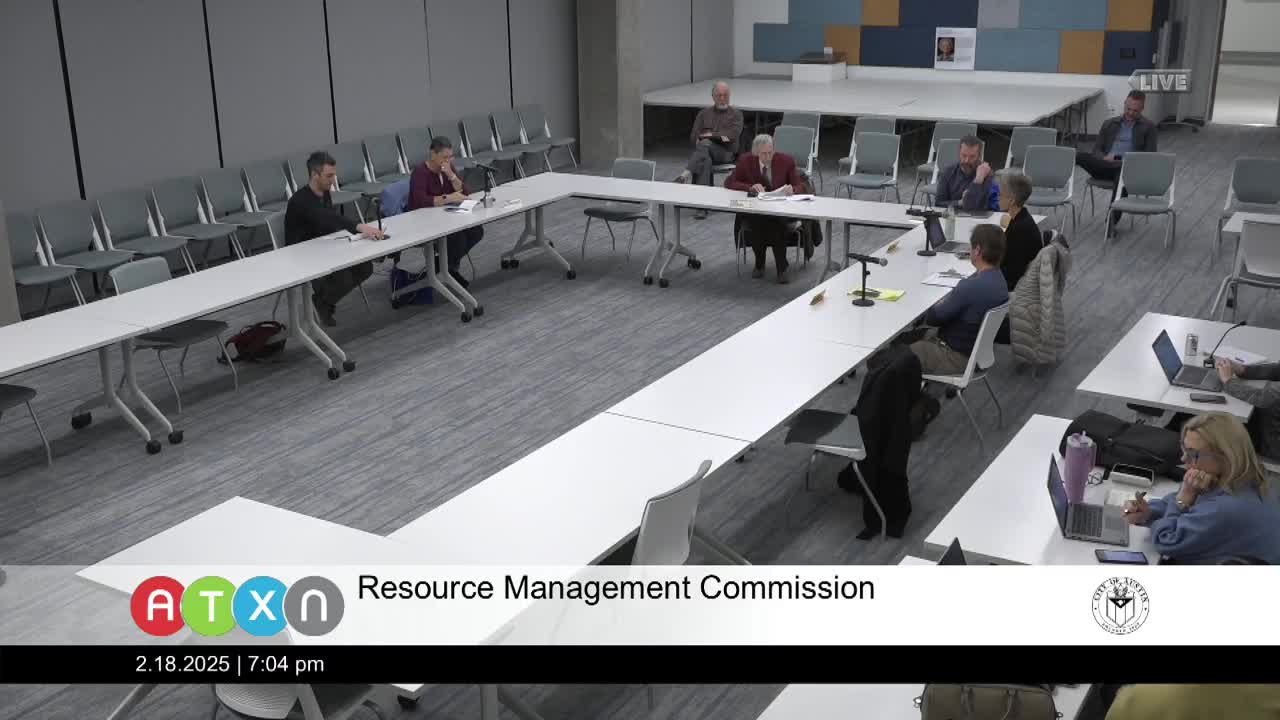
Austin Energy staff brief commissioners on virtual power plant, battery program and solar program changes
Summary
Austin Energy presented plans to build a virtual power plant (VPP) using customer-owned batteries, thermostats and EVs, described technical steps, customer incentives and program constraints, and answered commissioners’ questions on cost-effectiveness, inspections and non-wires alternatives.
Austin Energy staff briefed the Resource Management Commission on progress toward a virtual power plant (VPP) and a plan to expand battery programs alongside solar incentives. Staff described multiple pathways for deployment, technical and safety requirements, customer incentives and open policy questions the utility is studying.
Richard Genesee, vice president of customer energy solutions for Austin Energy, framed the presentation as an integrated effort across utility groups and said the program will pair an upfront incentive with ongoing performance payments tied to customer enrollment and event performance. Tim Harvey, customer renewable solutions manager, and Lindsey McDougall, manager of demand response and technical services, delivered the briefing and fielded commissioner questions.
Key elements explained by staff - Current assets and near-term plans: Austin Energy currently has about 15 megawatts of distributed batteries in its service territory and has an existing VPP that aggregates thermostats and EV chargers. Staff said the utility is preparing to integrate solar-coupled batteries and to move toward a central DERMS (distributed energy resource management system) that will coordinate multiple edge DERMS systems and internal utility platforms. - Customer incentives and program design: Staff described a two-part incentive model: an upfront incentive to lower the battery purchase barrier and an ongoing pay-for-performance incentive tied to how customers participate in demand-response events. Staff said upfront incentives will be conditioned on customer participation in the program. - Program types considered: Austin Energy is evaluating two models: a VPP where the utility controls batteries and pays performance incentives, and a bill-credit/rate approach in which customers retain direct control and receive credits if they meet performance parameters. Staff noted the VPP provides better telemetry and control but involves platform fees from third-party aggregators. - Cost-effectiveness and fees: Lindsey McDougall said the utility will run cost-effectiveness analyses and only propose programs that pass that test. Tim Harvey said platform fees for aggregator/DERMS providers are substantial and must be balanced against avoided costs the VPP creates. - Avoided-cost opportunities: Staff listed several avoided-cost benefits from a VPP and batteries, including energy arbitrage (charge low, discharge high), avoiding day-ahead market purchases, reducing ERCOT 4CP (peak transmission charges), potential participation in ancillary services, and non-wires alternatives that could defer distribution upgrades. - Safety, inspection and interconnection: Austin Energy described updated interconnection guidelines and in-person inspection protocols. Staff said remote-only inspections performed during COVID did not adequately identify life-safety issues and that the utility will continue on-site inspections for now. - Current programs and pilots: Staff named existing programs — Power Partner Thermostat, Power Partner EV and Power Partner programs for multifamily — and reported a recent off-season $75 enrollment bonus for thermostats and a new $25 yearly retention incentive. Staff said they are exploring converting some incentives to pay-for-performance models. - Customer retention and experience: Staff cited survey results showing discomfort during events as a primary reason for customer opt-out. They are testing shorter events and other control strategies to reduce discomfort and improve retention. - Resilience hubs and microgrids: Staff described resilience-hub pilots in east Austin with solar, batteries and backup generation, and a nearly ready microgrid at Camp Mabry.
Commissioner questions and staff responses - Platform and third-party strategy: Commissioners asked whether the utility would build its own systems or contract with third-party providers. Staff said multiple approaches are being evaluated and that nothing is off the table; the utility is negotiating with existing providers while keeping alternatives available. - Non-wires alternatives: Commissioners asked how Austin Energy will quantify distribution deferral value. Staff said third-party analysis and additional grid-hosting-capacity modeling are underway but the utility has not yet fully quantified non-wires avoided costs. - Inspections and failure rates: Commissioners asked about high failure rates in on-site inspections for solar installations; staff said average contractor fail rates are about 20%, attributed to installation complexity and workforce turnover. Staff said most failures can be corrected on-site and that the inspection wait time remains under two weeks.
What the commission asked for next Commissioners requested the utility return with more detailed analyses at a future meeting, including cost-effectiveness results, proposed incentive levels, clarity on platform fees and additional detail on non-wires alternatives. Staff indicated further studies and an RFP for additional analysis are underway; no formal policy action was taken at this meeting.
Provenance - Presentation introduction and scope: "Staff briefing on battery program launch update including DERMS DERMS and the use of virtual power plants by Tim Harvey... and Lindsey McDougall..." (meeting agenda excerpt introducing the briefing). - Presentation conclusion: "That wraps it up." (Tim Harvey concluding remarks and commissioners’ questions that followed.)
Speakers - Richard Genesee — Vice President, Customer Energy Solutions, Austin Energy (government/staff). - Tim Harvey — Customer Renewable Solutions Manager, Austin Energy (government/staff). - Lindsey McDougall — Manager, Demand Response and Technical Services, Austin Energy (government/staff). - Commissioner Schwartz — Commissioner, Resource Management Commission (government). - Commissioner Silverstein — Commissioner, Resource Management Commission (government). - Commissioner Davis — Commissioner, Resource Management Commission (government).
Clarifying details - Current distributed battery capacity in Austin service territory: ~15 megawatts (Tim Harvey). - Pilot incentives: recent one-time $75 off-season enrollment bonus for Power Partner Thermostat and a proposed $25 annual retention incentive (Lindsey McDougall). - Planned workforce/roles tied to Solar for All (separate agenda item): three grant-funded positions once funds are available (Tim Harvey). - Inspection fail rate: average contractor fail rate roughly 20% across recent periods; typical reinspection turnaround under two weeks (Austin Energy staff).
proper_names - Austin Energy (agency) - DERMS (technology/platform) - Power Partner Thermostat (program) - Power Partner EV (program) - Camp Mabry microgrid (facility)
searchable_tags":["virtual_power_plant","batteries","DERMS","demand_response","Austin Energy"],"provenance":{"transcript_segments":[{"block_id":"s2690.19_e2712.5","local_start":0,"local_end":180,"evidence_excerpt":"Staff briefing on battery program launch update including DERMS DERMS and the use of virtual power plants by Tim Harvey, manager, customer, renewable solutions, and Lindsey McDougall, manager, demand response in technical services.","reason_code":"topicintro"},{"block_id":"s6906.245_e6946.09","local_start":0,"local_end":75,"evidence_excerpt":"So in summary, we are exploring Smart inverters, a virtual power plant and battery incentives...That wraps it up.","reason_code":"topicfinish"}]},"salience":{"overall":0.72,"overall_justification":"The briefing addresses utility-scale planning for distributed batteries, customer incentives, and operational integration—areas that could affect rates, grid operations and resilience locally.","impact_scope":"local","impact_scope_justification":"Measures will affect Austin Energy customers and distribution planning in the city." ,"attention_level":"high","attention_level_justification":"Commission devoted a substantial portion of the meeting to the briefing with multiple follow-up questions." ,"novelty":0.60,"novelty_justification":"Austin Energy is shifting toward integrated VPP/DERMS approaches; some pilots and incentives are new or evolving.","timeliness_urgency":0.60,"timeliness_urgency_justification":"The briefing relates to near-term program development, procurement and upcoming incentives; commissioners asked for further analysis at a next meeting.","legal_significance":0.20,"legal_significance_justification":"No new rules or ordinances proposed at the meeting; regulatory interactions (ERCOT, interconnection) are relevant but not decided.","budgetary_significance":0.50,"budgetary_significance_justification":"Program incentives and platform fees influence utility budgets; Austin Energy cited platform fees as a material factor.","public_safety_risk":0.10,"public_safety_risk_justification":"Safety issues influence inspection policy but no active safety emergency was reported.","environmental_impact":0.30,"environmental_impact_justification":"Wider battery and solar adoption influences carbon outcomes but not addressed as a quantified metric in the briefing.","affected_population_estimate":150000,"affected_population_estimate_justification":"Broadly affects Austin Energy customer base though direct VPP participation will be a subset; numeric estimate is a high-level city customer base proxy.","affected_population_confidence":0.20,"affected_population_confidence_justification":"Participation levels are program-dependent and not specified at the meeting.","budget_total_usd":0.0,"budget_total_usd_justification":"No single program budget figure was finalized in the briefing.","decision_deadline":"not specified","decision_deadline_justification":"Staff requested time to conduct analyses; no formal deadline set at this meeting.","policy_stage":"proposal","policy_stage_justification":"Utility is studying program design and costs; commissioners requested further analysis.","follow_up_priority":7,"follow_up_priority_justification":"Commission requested additional details, cost-effectiveness results and non-wires analysis at a future meeting.","fact_check_risk":0.15,"fact_check_risk_justification":"Staff provided technical claims (e.g., 15 MW existing batteries); these are reportable but should be confirmed in written materials.","uncertainty":0.40,"uncertainty_justification":"Many items are under study, including pricing, platform fees and non-wires analysis.","source_diversity":0.60,"source_diversity_justification":"Presenters included senior utility staff and managers; commissioners contributed oversight questions.","stakeholder_balance":0.50,"stakeholder_balance_justification":"Briefing reflected utility perspectives and policy options; customer advocates, contractors and third-party aggregators were not present in the recorded discussion.","alert_flags":[],"alert_flags_justification":"No immediate flags beyond normal program uncertainty."},"engagement_forecast":{"newsworthiness":{"national":0.03,"regional":0.08,"local":0.80,"justification":"High local relevance; limited regional/national appeal absent major funding or controversy."},"notify_recommendation":{"audience":"city","reason":"Local policymakers, Austin Energy stakeholders and community energy advocates should be notified; the briefing informs near-term program design.","audience_regions":["Austin"],"justification":"Programs will affect Austin Energy customers and may be referenced in council or budget discussions."},"notify_thresholds":{"local_min":0.4,"regional_min":0.7,"national_min":0.9},"predicted_interest":{"national":0.03,"regional":0.10,"local":0.78,"justification":"High local readership expected; specialists regionally may follow devleopments."},"predicted_interest_justification":"Program design could affect local resilience and rates, leading to local interest.","predicted_click_through":0.20,"predicted_click_through_justification":"Technical audience and interested customers likely to click for details.","predicted_read_time_minutes":8,"predicted_read_time_minutes_justification":"Complex program details and Q&A warrant extended read time.","predicted_shares":40,"predicted_shares_justification":"Likely to circulate among local energy policy and community groups."},"graph_signals":{"jurisdictions":["US-TX-AUS"],"jurisdictions_justification":"Austin Energy jurisdiction.","ontology_topics":["distributed_energy_resources","virtual_power_plant","demand_response"],"ontology_topics_justification":"Primary technical areas of the briefing.","naics_codes":[],"naics_codes_justification":"Not specified.","sdg_tags":["SDG7"],"sdg_tags_justification":"Energy access and sustainable energy.","entities":[{"id":"tim_harvey","name":"Tim Harvey","type":"person"},{"id":"lindsey_mcdougall","name":"Lindsey McDougall","type":"person"},{"id":"richard_genesee","name":"Richard Genesee","type":"person"}],"entities_justification":"Primary presenters and program leads."}}]} }<!-- End of JSON -->{
AI generated
The text on this page is AI generated. Summaries, highlights, analysis, and video transcripts are all produced from the original source material.
AI can make mistakes, so if you spot one, and we will fix it for everyone.
Note: the source content is unaltered by us. Any content source we link to, be it a video, an audio recording, or a document, is presented exactly as its publisher released it. That publisher is usually a government body, sometimes an individual official or another organisation.