Get Full Government Meeting Transcripts, Videos, & Alerts Forever!
Get email alerts on the Transportation Railtrail Funding topic
No spam. Unsubscribe anytime.
Council move to shift $500,000 from Rail Trail to West Side sports complex draws public criticism and conflicting staff statements
Summary
The City of Albuquerque moved $500,000 from the Downtown Rail Trail to the Ken Sanchez Indoor Sports Complex through a prior bonding “cleanup” bill, prompting public protests and conflicting statements from administration officials about whether the Rail Trail remains fully funded.
The City of Albuquerque moved $500,000 from the Downtown Rail Trail to the Ken Sanchez Indoor Sports Complex through a previous “cleanup” bonding bill, and staff later added roughly another $500,000 from bond interest, city officials said. The reallocation prompted a wave of public comment calling for the money to be returned to the rail trail and produced contradictory statements from the administration about whether the Trail remains fully funded.
Why it matters: Public speakers, bicycling advocates and several councilors said the change undermines trust, could delay the multi‑phase Rail Trail project and sends a poor signal to state funders. Administration staff said the West Side complex is now fully funded, and that no state funds were moved; the chief administrative officer said the Rail Trail still faces cost pressures and is not fully funded for all planned phases.
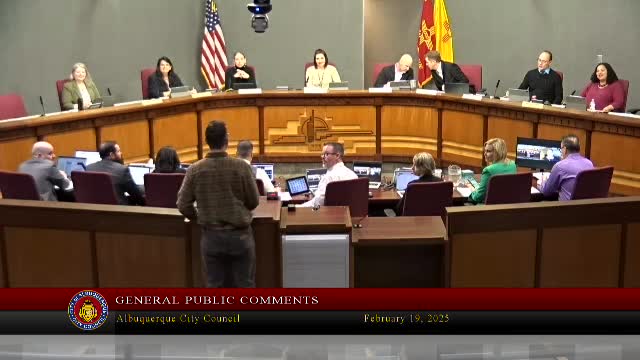
Public comment and council response came during general public comment and an exchange later in the meeting. Resident Andrew Kelleher opened the public complaints, saying, “I am speaking here today to register some disappointment in the Council’s recent decision to appropriate funds away from the veil trail in favor of the Westside Youth Sports Complex.” Several other residents and organizations echoed that concern, including Bike ABQ. Steven Pilon, speaking for Bike ABQ, said transferring money away from the veil trail “sends the wrong message” about the city’s commitment to pedestrian and bicycle safety.
Administration explanation and disagreement Mr. Motzko, representing administration project staff, told the council that the transfer happened as part of a prior cleanup bill that used the city’s gross receipts tax (GRT) bonding capacity. “So we moved a half a million from the Rail Trail to Ken Sanchez Indoor Sports Complex,” he said, adding that roughly $600,000 of bond interest allowed staff to add another half million so the indoor facility would be “fully funded” and the Rail Trail could still proceed on multiple phases.
The city’s Chief Administrative Officer (CAO) disputed the citywide assertion that both projects are fully funded. “Removing the $500,000 from that, and moving it to the Westside Sports Complex, does reduce the current available funds for the rail trail,” the CAO told the council. The CAO added that rising project costs and ongoing negotiations mean the Rail Trail “is not fully funded” for all planned work.
Council members split in tone but not in immediate action. Councilor Sanchez defended the West Side project and stressed the relatively small share of cost the $500,000 represented compared with the Rail Trail’s total multi‑year budget: “The rail trail is — I support the rail trail 100 percent — but we’re looking at a hundred million dollar project over many, many, many years. … If you actually put the percentage it’s less than 0.5%.” Councilor Baca said some of his set‑aside funds had been used previously to support the Rail Trail and that councilors routinely work together on cross‑district projects. Vice President Pena said she had voted for the prior action because councilors involved had agreed to it but acknowledged the concerns it raised.
Public reaction and concerns Multiple public speakers emphasized pedestrian and bicycle safety and downtown revitalization. Mark Bailon said the Rail Trail could help reverse the state’s poor pedestrian fatality statistics and revitalize neighborhoods. William Indelicato of Strong Towns Albuquerque warned that shifting funds mid‑project can increase costs and erode trust with contractors and the public.
Process and next steps Administration staff said the transfer did not involve state funds. The CAO and other staff urged the council that the Rail Trail remains active and that staff will continue negotiating and seeking funding. Councilors said staff should address any remaining funding gaps during the upcoming budget process and through routine capital planning. No new motion or vote to reverse the transfer was made during this meeting; public speakers urged the council to restore the funds and to be transparent about future reallocations.
Clarifying detail: the action described by staff moved $500,000 from a rail‑trail allocation into the Ken Sanchez Indoor Sports Complex via GRT bonding capacity; staff reported adding another approximately $500,000 from bond interest. The city’s CIP earlier included $1,500,000 for the Rail Trail (as described by an administration speaker), but the CAO warned costs are escalating and some phases may need additional funding.
The council did not take a formal vote on restoring the funds at this meeting; councilors and staff said they would continue to work through budget and CIP processes and discuss funding options for both projects.