Get Full Government Meeting Transcripts, Videos, & Alerts Forever!
Get email alerts on the Solid Waste Act Revision topic
No spam. Unsubscribe anytime.
Subcommittee advances bill to revise state solid-waste law, clarify local verification and public notice
Summary
The Resource Management Subcommittee voted to advance House Bill 351, which revises the state's solid waste law to remove unconstitutional language, clarify what constitutes major modifications at waste facilities, tighten requirements for local-government consistency verifications and change reporting and notice procedures.
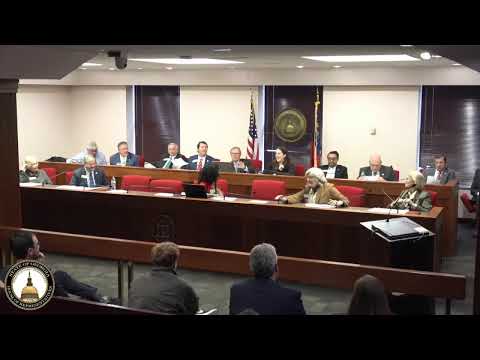
Chairman John Corbett presented House Bill 351 to the Resource Management Subcommittee of Natural Resources, saying the measure would revise the Solid Waste Management Act by removing provisions courts have found unconstitutional and by clarifying local and state roles in permitting and public participation.
"This legislation is intended to revise the solid waste act, to do several things. 1, it removes provisions courts have determined to be unconstitutional or unenforceable," Corbett said, reading from the bill text. He told the panel the bill also resolves inconsistencies in the act and specifies the Environmental Protection Division's (EPD) responsibilities for reviewing local approvals.
The bill deletes the statute's references to "special solid waste" tied to out-of-state waste and broadens and clarifies what must be treated as a "major modification" at solid-waste facilities. Corbett read the bill's definition: major modifications include changes that substantially alter facility design, management practices, the types of waste handled or methods of handling and that are likely to affect protection of human health and the environment. Examples listed include expansions of landfill capacity, lateral expansions of CCR surface impoundments, adding new handling processes such as baling, shredding, composting or liquid solidification, and changes to site-suitability determinations.
The bill also clarifies the role of local governments in issuing written verifications that proposed facilities comply with local solid-waste management plans and zoning. It sets a maximum age for such verifications at the time of application (36, as stated in the bill text) and requires informal, informational public meetings before a local government issues written verification. The bill removes references to the Department of Community Affairs (DCA) where DCA no longer has statutory authority, and moves several reporting and submission duties to EPD.
EPD staff described the measure as largely corrective. "This is a very mature act," an EPD speaker said, noting the 1990 law has seen few changes and that the bill aims to help local governments, the private waste industry and EPD get clearer, defensible permits without added state cost. Sarah Fisher, assistant chief of EPD's Land Protection Branch, told the committee the bill preserves a newspaper-of-record publication requirement for public notices and requires posting at the entrance to a proposed site; the bill does not specify a sign size.
Representative Rhonda Davis (committee member) raised local concerns based on a recycling site in her district where an EPD-issued permit conflicted with the county's waste-management plan. "Because our county government ended up spending thousands of dollars in attorney fees trying to prove that the person who went after this permit really had no right to do that," she said, praising the bill's clarification that identifies who may submit verification letters on behalf of a local government.
April Lipscomb, an attorney with the Southern Environmental Law Center, said she and clients had intervened in litigation supporting local governments and noted the bill will reduce confusion and future litigation. "I do think this bill absolutely clarifies those provisions and will help prevent litigation in the future," she said, while also urging additional environmental protections and public-participation measures she said EPD declined to add.
Committee members asked several technical questions about notice timing and administrative details. Representative Dreiner asked where meeting notices must be published; EPD staff responded that notices must be in the local newspaper of record and posted at the site entrance, and that the bill clarifies the timing requirements for a 14-day and 7-day notice prior to public hearings.
After discussion, a committee member moved that the subcommittee give the bill a favorable recommendation (a "do pass" report). The committee voice vote returned in favor and the chairman announced the measure would be reported to the full committee for consideration.
The subcommittee record shows the measure drew comment from EPD staff, the Southern Environmental Law Center and several legislators; the bill was advanced to the full committee for further action at the panel's meeting the following day.
The full committee action will determine whether the bill moves to the House floor.