
DETR presents program overview to Assembly committee; highlights UI modernization, workforce investments and disability services
Get AI-powered insights, summaries, and transcripts
Sign Up Free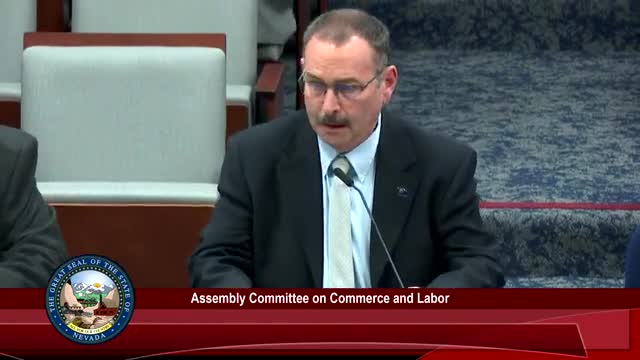
Summary
Department of Employment, Training and Rehabilitation (DETR) briefed the Assembly Committee on Commerce and Labor on workforce, unemployment insurance modernization, vocational rehabilitation and civil‑rights enforcement programs, and described planned technology upgrades and partnerships aimed at expanding services to Nevadans.
Carson City — The Nevada Department of Employment, Training and Rehabilitation (DETR) told the Assembly Committee on Commerce and Labor on Feb. 20 that it is pursuing system modernization, expanding workforce programs and increasing services to people with disabilities.
DETR Director Christopher Sewell summarized the agency’s mission as “empowering Nevadans to realize their potential through meaningful work” and said the department now operates offices and workforce hubs across the state, including recent openings in Fernley, Ely and Elko. “We are here to help Nevadans and make Nevadans enrich their lives through better jobs,” Sewell said.
The presentation delivered program details across DETR’s major divisions, and committee members heard measurable outcomes and implementation timelines that affect claimants, employers and local workforce providers.
DETR’s vocational rehabilitation programs, represented by Rehabilitation Division Administrator Drazen Ellis, served 7,339 clients in state fiscal year 2024 — an increase the presentation described as roughly 1,200 more clients than the prior year — and reported 481 individuals achieving competitive, integrated employment with an average wage of $17.74 an hour. Ellis said the division has seen new applications rise to about 229% of 2021 levels and that cases remain open for “an average of 645 days” because of the individualized nature of services. He emphasized that Pre‑Employment Transition Services for students ages 14–21 are required to reserve 15% of federal grant funds; those services served about 2,100 students in 2023, roughly double the prior year’s count. Ellis also highlighted the Nevada TRiP project — a multi‑partner website and resource map for students with disabilities scheduled for a soft launch in April 2025 in Carson, Humboldt and White Pine counties.
Christine Nelson, Administrator of DETR’s Employment Security Division (ESD), gave a programmatic overview of Unemployment Insurance (UI) and workforce development. Nelson said DETR launched the state’s new UI tax system in February 2024 and that the benefits side of the replacement system (NUI) is on track to go live in summer 2025. She described workforce obligations of federal WIOA funding and state Career Enhancement Program awards, noting roughly $40 million of federal WIOA obligations and about $22 million from the state Career Enhancement Program were used for local workforce boards, training, apprenticeships and related supports during the biennium.
Chief Economist David Schmidt described workforce data tools and partnerships, including work on the state longitudinal data system (NPWR) and a new “DETR in your district” dashboard that presents UI and workforce program data by legislative district.
DETR’s IT administrator, Carl Stanfield, said the UINV tax module migrated to the cloud and that the agency has improved its cybersecurity posture. Stanfield stated that, as of the prior week’s report, the state had collected about $61,000,000 in UI taxes through the new tax system and reiterated that the benefits module remains on schedule for summer 2025. He also said the agency is piloting artificial‑intelligence tools in the benefits appeals unit to speed internal workflows.
Patrice Perez, administrator of the Nevada Equal Rights Commission (NERC), summarized NERC’s complaint intake, mediation and investigation processes for employment, housing and public‑accommodation discrimination, and said NERC settled roughly $1.4 million for claimants in fiscal 2024.
Throughout the briefing committee members asked about phone‑line wait times and in‑person access. Director Sewell and Deputy Director Troy Jordan said the new NUI system and a recently contracted phone‑system upgrade should reduce call volumes and wait times; Jordan also noted kiosks and public computers are available at most EDD/one‑stop hubs to file claims or drop off documents.
DETR staff offered to provide committee members demonstrations of the NUI benefits system when it is ready in the summer. Sewell closed the briefing by encouraging legislators to contact agency staff for district‑specific data and assistance.
The clerk recorded no formal committee action during the briefing.