Get Full Government Meeting Transcripts, Videos, & Alerts Forever!
Get email alerts on the Parking Management topic
No spam. Unsubscribe anytime.
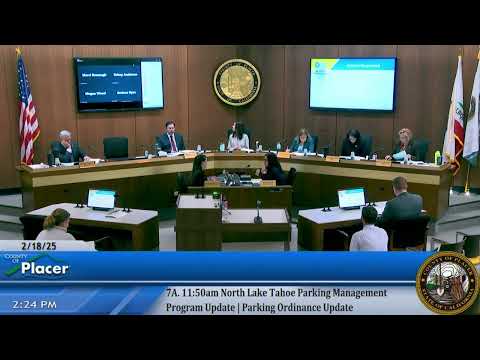
Placer County adopts parking rules and fee schedule for North Lake Tahoe to curb congestion and improve access
Summary
After a year-long pilot and community outreach, the board adopted code amendments, a parking-fee schedule and an amended fine schedule to expand parking management in Kings Beach and other Placer County lakefront areas.
The Placer County Board of Supervisors adopted amendments this week to county parking code and formalized a fee and fine schedule for parking in the North Lake Tahoe area, a step county staff said is aimed at improving vehicle circulation, reducing neighborhood spillover and funding future parking-management operations.
Why it matters: The county presented summer pilot data showing heavy peak demand around Kings Beach and nearby beaches. County staff, assisted by consultant Dixon Resources, told supervisors the changes will let the county apply short-term limits and paid parking selectively, fund parking ambassadors and enforcement, and reduce queuing and traffic on state routes near beach access points.
What the board approved: The board introduced and waived oral reading of an ordinance to amend Placer County Code Chapter 10.12 (Parking); adopted a resolution amending the parking fine schedule; and adopted a resolution establishing a parking fee schedule, all with an effective date of April 3, 2025. The board also found the actions exempt from environmental review under CEQA guidelines cited in staff materials.
Background and pilot results: County and consultant staff described outreach spanning two years: multiple community meetings, targeted meetings with the North Tahoe Business Association and key stakeholders, hand-delivered notices to businesses on Brook Avenue, and a paid-parking pilot in the county’s “Christmas tree lot” next to the State Beach. Between July 1 and Sept. 30 the county’s parking ambassadors and enforcement issued 1,266 parking citations across the basin; the paid-parking pilot in the Christmas tree lot produced roughly $9,445 net revenue during its demonstration and large use of credit-card transactions.
Staff emphasized that the first phase is not solely about raising revenue: enforcement and paid parking are designed to create turnover in premium spaces, keep cars moving to reduce congestion, and protect resident neighborhood streets from spillover. The county has installed license-plate recognition equipment and recommends a three-full-time equivalent year-round staffing model plus seasonal summer help to operate a sustainable program. The county also recommended creating loading zones on the State Highway and two-hour time limits for summer-only on certain Brook Avenue spaces to promote turnover.
Public input and next steps: Officials said the program will expand incrementally, monitor for neighborhood spillover, and pursue shared public-private parking agreements where warranted. County staff also told supervisors that revenues and costs will be tracked in a dedicated parking fund and that additional transparency reports will be provided to the board and the public. Residents and business representatives offered a mix of support and caution at public meetings — praising enforcement and volunteer support, urging swift rollout, but also stressing the need to avoid pushing parking impacts onto other beaches and neighborhoods.
Ending: Supervisors voted to adopt the ordinance amendment and the fee and fine resolutions; staff will continue phased implementation over the coming seasons and return with additional details on staffing, technology, and any shared-use agreements.