Get Full Government Meeting Transcripts, Videos, & Alerts Forever!
Get email alerts on the Curriculum Adoption topic
No spam. Unsubscribe anytime.
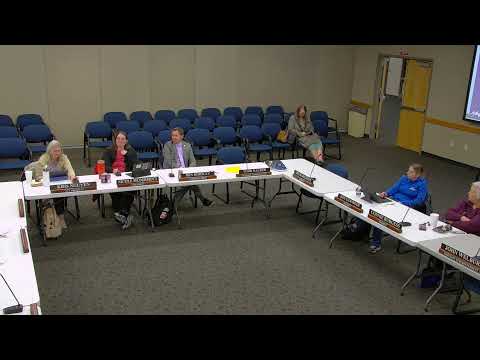
Board reviews first reading of secondary ELA adoption and district’s ‘science of reading’ rollout
Summary
At a study session the board heard the first reading of the secondary ELA request for proposals required by Senate Bill 55 and a substantive presentation on the district’s science-of-reading work, including materials adoption, LETRS training and literacy benchmarks tied to SB127.
Board members received a first-reading briefing on the district’s process to adopt secondary ELA instructional materials and a detailed presentation on the district’s implementation of science-of-reading strategies.
Dr. Converse presented the instructional materials adoption process required by Senate Bill 55 and Utah code, explaining that the district will host two public board meetings for the adoption: the current public review meeting and a second, formal adoption meeting planned for March 4. "The local board must make instructional materials that the school district uses readily accessible and available for parent review," Dr. Converse said while reviewing the RFP and public-comment process.
Dr. Converse described three categories of materials in state law — learning materials, instructional materials adopted by the local board, and supplemental materials adopted at the school or teacher level — and explained the district’s use of an RFP for major, core adoptions such as the secondary ELA package.
Amber Clayton, introduced earlier as an incoming elementary leadership director, gave a wide-ranging presentation on the “science of reading,” describing it as a body of research across multiple fields that informs instructional practice. Clayton said the district has aligned the new HMH instructional materials to those principles and described a recommended target of a 120-minute literacy block in early grades that balances “learning to read” (phonemic awareness, phonics, fluency) and “reading to learn” (vocabulary, comprehension, writing).
Board members asked clarifying questions about timelines and materials. Clayton and Dr. Converse said the recommended resources have been posted for public review, are being shared via district channels and will be discussed again at the board’s second meeting prior to formal adoption. Clayton also described the district’s training investments: earlier LETRS cohorts for K–3 teachers and in-house LETRS trainers continuing professional learning.
Clayton summarized how the state’s SB127 frames expectations for third-grade reading outcomes, noting the state goal that 70% or more of third graders read on grade level by the end of 2027 and that a third-grade benchmark composite of 405 (Acadience/DIBELS composite) is the target used to indicate reading on grade level. She said the district is tracking early milestones in kindergarten and first grade to accelerate progress into third grade.
No formal board action on the secondary ELA RFP occurred at the study session; the board will consider adoption at its next scheduled meeting following the public review period.