Get Full Government Meeting Transcripts, Videos, & Alerts Forever!
Get email alerts on the Utility Payment Assistance topic
No spam. Unsubscribe anytime.
San Marcos council advances utility-payment assistance contracts, asks staff for penalty and reconnect fee analysis
Summary
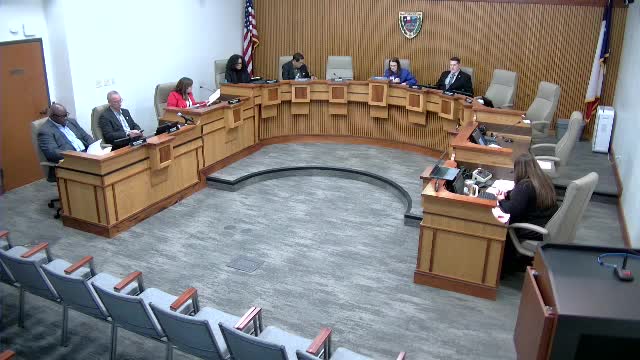
San Marcos City Council members on Feb. 18 received a follow-up presentation on the city27s utility payment assistance program and directed staff to move forward with contract negotiations for outside providers while returning with more analysis on late-payment penalties and reconnection fees.
San Marcos City Council members on Feb. 18 received a follow-up presentation on the city27s utility payment assistance program and directed staff to move forward with contract negotiations for outside providers while returning with more analysis on late-payment penalties and reconnection fees.
The council heard that the city27s request for proposals for city-funded utility-payment assistance closed and that staff recommends awarding portions of the city27s annual allocation among the current provider and three respondents. Staff described the program funding sources as a city-funded annual budget line and separate, donor-designated utility donations held for assistance; staff said the city-funded line is budgeted at about $150,000 annually and that donated funds total about $45,000.
Why it matters: Council members said faster turnaround and easier application processes are critical to getting money to households before disconnection. Changes to penalties and the structure of reconnect fees also affect the city27s rate model and, ultimately, customers27 bills.
What staff presented Staff told the council that the RFP closed with three new respondents and the incumbent provider requesting a change in administrative approach. The slide deck and discussion identified the agencies and recommended prorated initial award amounts through Sept. 30, 2025 to fit the city fiscal year. The recommended amounts as discussed in the presentation were: Community Action (initially listed at $40,000 but staff said Community Action said it can only support $30,000), BCL of Texas ($33,000), Communities in Schools ($30,000) and Salvation Army ($17,000). Those numbers came from staff scoring of proposals and internal allocation conversations; staff said the total recommended award pool equals the city27s annual budget for the program.
Staff and council emphasized operational issues in awarding funding: agencies27 application turnaround times, capacity to accept applicants, and whether agencies would use other funding before tapping city funds. Staff also said the RFP required proposals to address accessibility and outreach; one respondent proposed a three-day turnaround for approvals.
Council direction and conditions Councilmembers signaled support for moving forward with contracts while asking staff to: verify each agency27s capacity before finalizing amounts; make awards "not to exceed" so additional small reallocations need not return to council; require monthly reporting on applications approved and denied; cap administrative fees at 10% of an award (staff said that cap was already proposed as allowable); and pursue a common, simplified application for all providers so the city can reduce application friction. Council also asked staff to coordinate with the incumbent provider on billing-method changes the agency requested.
"One of the things the committee talked about was accessibility," said Lisa Perez Carey, community resource and engagement coordinator, during the presentation, describing how outreach and eligibility pathways factored into the scoring of proposals.
Application and eligibility details Staff said the current average household receiving assistance pays about $176.14 per month and that Community Action uses federal and state funds first before using city funds. Staff listed program design points discussed during the presentation: increased advertising, revised customer-service scripting, monthly reporting, and the option to use donated funds to assist customers of non-city utilities if policy and provider agreements are in place. Council asked staff to return with details and recommended standards for when donated funds may be used for customers of other electricity providers.
Late penalties, reconnect fees and rate implications The presentation moved into a data-driven review of penalties and reconnect fees. Staff reported that the city27s current late penalty is 10% and that a peer review of 12 cities showed most use 10% or lower structures. Staff showed a breakdown that separates single-family residential accounts from multi-account (apartment) customers; staff said the average late penalty per residential account was roughly $18.48 and for multi-account properties about $10.68.
Council asked staff to return with a short analysis comparing three options for residential customers: (1) a flat fee (Councilmember Scott proposed $10), (2) the existing 10% with a maximum of $15, and (3) the existing 10% with a maximum of $20. Staff agreed to model revenue impacts and distributional effects (which customer classes would pay more, which would pay less) and to provide minimum/maximum and frequency statistics before the council sets a final policy.
Council members also asked staff to reexamine reconnect fees. Staff said current reconnect charges are $40 per metered service during business hours and $170 after-hours, with remote electric reconnects estimated at lower cost (staff cited a $25 estimated cost for remote electric reconnects). Council asked for a cost-recovery review that distinguishes manual in-field reconnections from remote reconnects and identifies whether operational changes (such as consolidating crews) could reduce costs charged back to customers.
Multifamily property liens Staff introduced the idea of imposing utility liens on multifamily property owners for unpaid master-metered utility bills as a way to reduce tenant disconnections when property owners are delinquent. Council expressed interest in pursuing the idea and asked staff to prepare follow-up material showing how peer cities structure such liens and the legal and implementation specifics; staff confirmed the proposal would not affect tenant accounts where utilities are in the tenant27s name.
Other implementation items Council asked that staff: (a) require monthly or quarterly reporting from awardees that includes reasons for denials; (b) allow contract language that permits agencies to use up to 10% of awards for administration but return unused administrative funds to assistance; and (c) track and limit how many times a household can receive assistance across providers. Council discussion favored increasing the current twice-per-year rule to allow more flexibility; the council asked staff to come back with options (council sentiment favored up to four times per year) and to outline how the city will verify cross-provider usage so households do not exceed program limits.
Next steps Staff will verify capacity and turnaround commitments from the recommended agencies, model penalty and reconnect-fee alternatives (including revenue impacts and distributional consequences by customer class), draft not-to-exceed contract amendments for awardees, create a proposed common application form and reporting template, and return to council with the requested analyses and draft agreements. The council did not take a formal recorded roll-call vote in the work session on final contract amounts; instead it provided direction to proceed subject to staff verification and the return of the additional analyses.
Ending note Council members repeatedly emphasized speed of assistance and clear customer-facing communication as priorities: streamlining application steps, improving script and delinquency notice language, and ensuring language access for Spanish-speaking customers.