Get Full Government Meeting Transcripts, Videos, & Alerts Forever!
Get email alerts on the Transportation Infrastructure topic
No spam. Unsubscribe anytime.
Glendale council approves Measure R programming, $9 million appropriation and design contracts for multimodal road projects
Summary
The Glendale City Council approved Measure R programming changes, appropriated $9 million in local return funds for the North Verdugo Road multimodal project and authorized professional services agreements for design and outreach, after hours of debate on bike lanes, outreach timing and project scope.
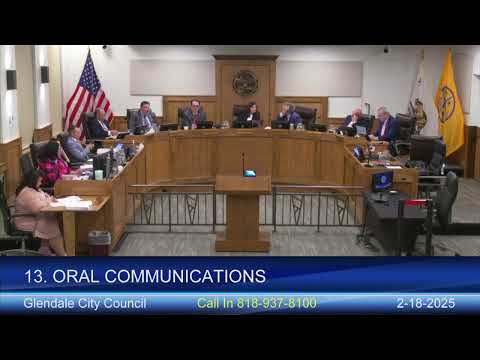
On Feb. 18, 2025, the Glendale City Council voted to approve new programming and modifications under Measure R and to authorize professional services agreements and appropriations to advance a package of multimodal street projects, including a $9 million appropriation for the North Verdugo Road Multimodal Improvements Project and a local-match appropriation of $1,216,440 for four Highway Safety Improvement Program (HSIP) projects.
The motions, carried by 3–2 roll-call votes on multiple agenda items, allow staff to execute a $1,572,625 professional services agreement with Mark Thomas and Company, Inc. for engineering on the North Verdugo corridor, amend an existing Mark Thomas agreement for additional work on the San Fernando Road Beautification Phase 2 project (an increase of $254,915 and 24 months), and to program Measure R subregional return funds for design and preliminary work. Council also approved amendments to other design contracts and funding for the city's pavement management implementation work tied to bicycle infrastructure design.
Why it matters: The votes clear the way for consultants to complete preliminary design, surveys and outreach on corridors where staff and consultants are evaluating bike facilities, traffic-safety countermeasures and signal modernization. Opponents warned that design work is proceeding before the citywide bicycle plan and broader community survey are finalized; supporters emphasized safety improvements and the need to reduce collisions while preparing projects for state and regional grant timelines.
Most important facts
- The council approved programming changes and a resolution of appropriation for a $1,216,440 local match required for four HSIP Cycle 11 projects. (Motion approved, roll call: Brotman Yes; Harpetian No; Kazakian Yes; Najarian No; Mayor Asatrian Yes; outcome: approved.)
- The council authorized a professional services agreement with Mark Thomas & Company for North Verdugo Road design in the amount of $1,572,625, a contract amendment for San Fernando Road Phase 2 ($254,915), and a resolution to appropriate $9,000,000 in Measure R subregional return funds for the North Verdugo project. (Motion approved, roll call: Brotman Yes; Garpetian No; Kazakian Yes; Najarian No; Mayor Asatrian Yes; outcome: approved.)
- Council approved amendments to other design PSAs to add community outreach and bicycle-infrastructure work (Bowman Infrastructure Engineers +$122,692; NV5, Inc. +$57,700) tied to the FY 2022-23 pavement management program and South Verdugo projects. (Motion approved, roll call: Brotman Yes; Garpetian No; Kazakian Yes; Najarian No; Mayor Asatrian Yes; outcome: approved.)
What the council debated
Councilmembers and members of the public raised three consistent concerns: timing of outreach, the scale and type of bicycle facilities to be studied (including class 4 protected bike lanes), and whether funding/contract approvals were being advanced before community review and completion of the draft Bicycle Master Plan and its environmental review.
Assistant Director of Public Works and city engineer Sarkis Oganessian described the new multimodal equipment modernization request as a $5,000,000 project "to modernize the existing equipment that exists in the city at certain locations that are substandard and need to be modernized to better detect all modes of travel." He told the council the projects will undergo preliminary design and engineering studies and that elements such as raised medians or other countermeasures will be installed only if warranted by the engineering study.
Councilmember Garpetian said he supports safety but warned against moving forward without more community input: "I'm not against all bike lanes. I'm against poorly planned bike lanes," he said, urging clearer safeguards on any technical advisory committee and earlier public involvement so design momentum does not preempt community concerns.
Public commenters reflected the same split. Alan Durham asked, "Does there really need to be such a rush to hire a consultant to design alternatives to transform North Verdugo Road into a multimodal transportation corridor given the recent failure of the Brand Boulevard demonstration project?" Other speakers, including several who cited traffic collisions and pedestrian safety, urged the city to begin design and safety work promptly.
Project and scope details cited in the meeting
- North Verdugo Road Multimodal Improvements: staff estimated an expected total project cost around $28,000,000; the council appropriated $9,000,000 from Measure R subregional return funds for the project's design and early work.
- Highway Safety Improvement Program (HSIP) Cycle 11: the council approved a $1,216,440 appropriation from Measure R funds as the local match for four HSIP projects (pedestrian crossings, medians, signal and mobility improvements). Locations discussed included Broadway/Glendale Avenue corridors, Verdugo Road, La Crescenta Avenue and other arterial segments; raised medians will be considered only where engineering warrants.
- Contract awards and amendments: Mark Thomas & Company, Inc. ($1,572,625 PSA for North Verdugo; $254,915 amendment for San Fernando Road Phase 2). Additional amendments increase design and outreach contracts by $122,692 (Bowman) and $57,700 (NV5) to include bicycle infrastructure elements.
Regulatory and planning context
Staff noted the requirement to analyze vehicle miles traveled (VMT) under recent CEQA guidance ("California CEQA changes") when evaluating project alternatives and environmental impacts. Several councilmembers stressed that final designs and any lane repurposing decisions will return to the Transportation & Parking Commission and to council after community outreach and final design stages.
Next steps and implementation
Staff said consultants will proceed with preliminary design, engineering studies, surveys and outreach. Those results, including any recommended lane repurposing, raised medians, or protected bicycle facilities, will be subject to further public outreach and return to commissions and council for approvals of final plans and construction funding. Unspent funds for infeasible projects will be returned to the funding source for reprogramming, staff said.
Ending
By narrow votes the council authorized Measure R programming changes, contract awards and appropriations to move multi-corridor safety and multimodal studies into the design phase, while several councilmembers and public speakers called for earlier and broader outreach before decisions that would repurpose travel lanes or remove parking.