Get Full Government Meeting Transcripts, Videos, & Alerts Forever!
Get email alerts on the Transportation Permits topic
No spam. Unsubscribe anytime.
Committee approves annual permits for recurring commercial loads to reduce repeat permitting
Summary
House Bill 132 allows annual permits for specified recurring commercial loads — including prefabricated buildings, panels, trusses and an annual option for baled hay — to reduce permit administration and repeated permit purchases by carriers. The committee approved the bill 5–0.
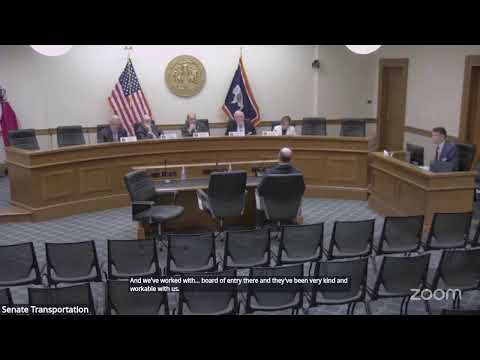
House Bill 132, intended to streamline permitting for recurring commercial loads, was reported do pass by the Senate Transportation, Highways & Military Affairs Committee on a 5–0 roll call.
Representative Scott Smith, who presented the bill, said the measure creates annual permits for certain commonly transported goods. He told the committee that existing law already allows a 90‑day permit for forest products and baled hay at $50; the bill preserves that option and adds a one‑year permit (cited in discussion at $200) for operators who transport hay year‑round. The bill also authorizes an annual permit for prefabricated buildings, panels and trusses; Representative Smith said that permit would cost about $400 annually and would reduce the need to buy multiple single‑trip permits when a truck carries varying numbers of prefabricated units.
Trooper Casey Ramsey of the Wyoming Highway Patrol testified that law enforcement had worked with sponsors and was comfortable with the statute’s language as drafted, saying the bill “gives both our agency and the constituents out there the ability to either purchase it for one year or one month or up to 90 days.” Committee members asked clarifying questions about dimensional limits (the bill lists specified measurement thresholds, including a 15‑foot height threshold), enforcement and whether the measure could be broadened later to cover recurring fixed loads in industry sectors such as oil and gas. Ramsey and sponsors said expansion could be discussed during the interim and that federal Highway Administration rules would need review for broader changes.
Marcus Lohneker, a Torrington contractor who transports portable buildings and sheds, testified in support, saying the annual permit would cover most of his loads and reduce paperwork without altering escort rules for over‑width or over‑height transports.
Committee discussion emphasized the bill’s intent to increase permitting efficiency for carriers and for WYDOT staff who process permits. The motion to advance the bill was moved and seconded; roll call showed Senators Anderson, Brennan, Cooper, Kolb and Chairman Pappas voting aye. Representative Smith said he would ask the sponsor on the floor to carry the bill when scheduled.
What’s next: HB132 was reported to the Senate floor; sponsors and WYDOT indicated they would continue to refine language if broader expansion is requested during the interim.