Get Full Government Meeting Transcripts, Videos, & Alerts Forever!
Get email alerts on the Housing topic
No spam. Unsubscribe anytime.
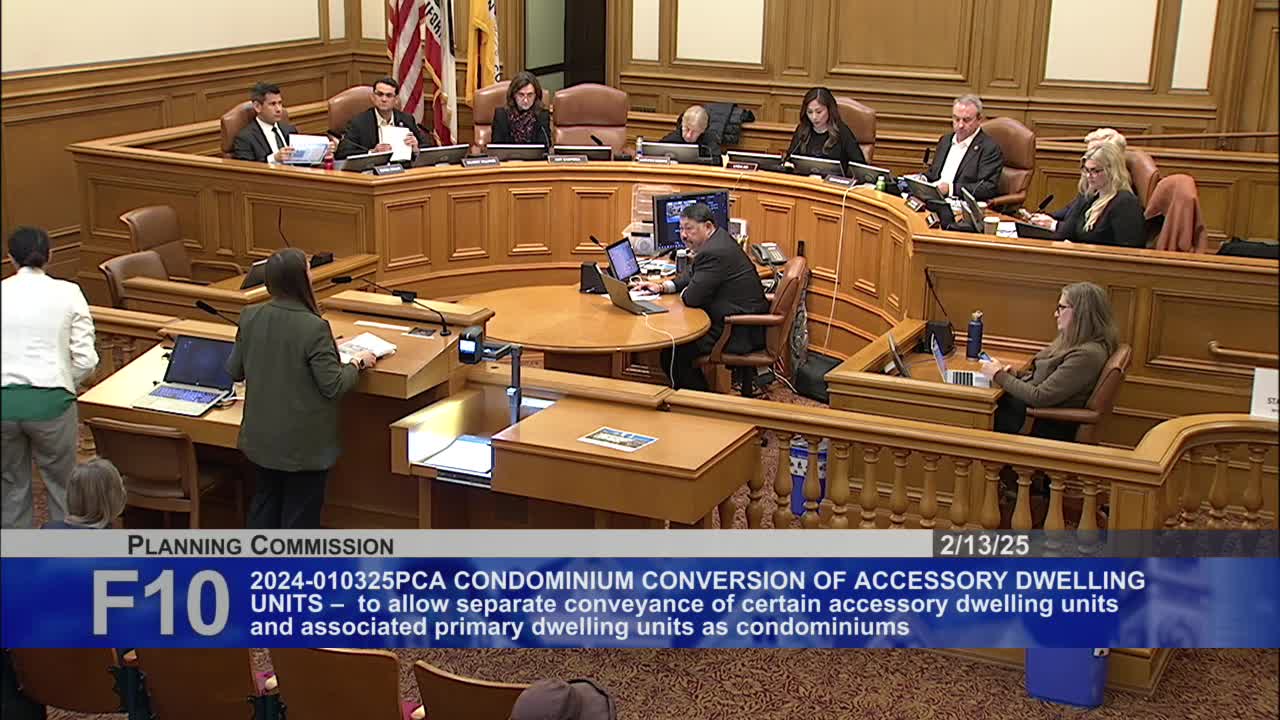
Planning Commission backs ADU-to-condo ordinance with staff modifications, 5-1
Summary
The commission voted 5-1 to recommend approval of a planning-code amendment that would let certain accessory dwelling units be converted into separate condominium units, subject to staff'recommended restrictions to protect rent-controlled housing and tenant occupancy.
The San Francisco Planning Commission on Feb. 13 recommended approval, with staff modifications, of a local planning-code amendment to allow specified accessory dwelling units (ADUs) to be converted into condominiums, voting 5-1 with Commissioner Williams in opposition.
The ordinance, sponsored at the Board of Supervisors level and informed by state law authorizing local ADU-to-condo conversions, would create a local pathway for some newly built or newly permitted ADUs to be conveyed as separate condominium units. Planning staff and the sponsor described the proposal as intended to expand homeownership options and to encourage ADU construction while limiting tenant displacement and preserving rent-controlled housing where required.
Adrien Marloney of the Planning Department gave the commission a detailed refresher on ADU pathways and how they interact with rent-control rules. Natalia Fossey, the department's ADU specialist, explained that ADUs created under the state ministerial program typically are not subject to local rent control, while ADUs created under the city's local program can trigger rent-control protections when they rely on planning-code waivers. Jonathan Goldberg of Supervisor Engardio's office (sponsor staff) and Supervisor Joel Engardio spoke in support and said the ordinance would help households access homeownership and unlock property equity.
Planning staff recommended narrowing the local program to reduce risk to tenants: proposed limits include allowing conversions only for detached ADUs on new single-family or condominium projects and for detached ADUs on existing single-family homes or condominium buildings of four units or fewer (the staff recommendation would exclude ADUs in multifamily buildings where tenant occupancy and rent-control protections are common). Staff also recommended that hybrid ADU types and junior ADUs be excluded and that state-mandated conveyance and subdivision requirements be implemented by the departments with the appropriate regulatory expertise (for example, DBI or DPW).
Public commenters included both supporters and opponents. Supporters, including the Housing Action Coalition, said the ordinance creates practical paths to first-time homeownership and encourages ADU construction. Opponents, including Affordable Housing Alliance and the San Francisco Tenants Union, argued the ordinance could lead to loss of rental units in small multiunit buildings and increase owner-move-in evictions if protections are not ironed out.
Commissioners broadly endorsed the staff modifications as a 'do-no-harm' approach that restricts eligibility and preserves rent control protections for tenant-occupied units. Commissioner Braun described the staff's set of limitations as 'belt-and-suspenders' protections. Commissioner Williams said she could not support the ordinance, citing concerns that condominium conversions remove rental units and could be inconsistent with affordability goals in the city's housing element.
Commissioner Lebron moved to adopt the recommendation with the staff'recommended modifications; the motion was seconded and passed 5 to 1 (Williams opposed). The commission's action is a recommendation to the Board of Supervisors; the Board will consider the local ordinance and any related implementing code changes.
Planning staff noted additional clarifying amendments in the staff report to move state-mandated subdivision and conveyance requirements into the appropriate code sections and to add other technical clarifications. Staff and sponsor representatives told the commission they would continue coordination with departments that oversee conveyance, subdivision and building permitting to ensure implementation.
If enacted at the Board of Supervisors, the local ordinance would be accompanied by implementing administrative steps and coordination with permitting agencies to verify tenant occupancy, apply rent-control rules where required and ensure subdivision and conveyance processes comply with state law and local oversight.