Get Full Government Meeting Transcripts, Videos, & Alerts Forever!
Get email alerts on the Firearms Policy topic
No spam. Unsubscribe anytime.
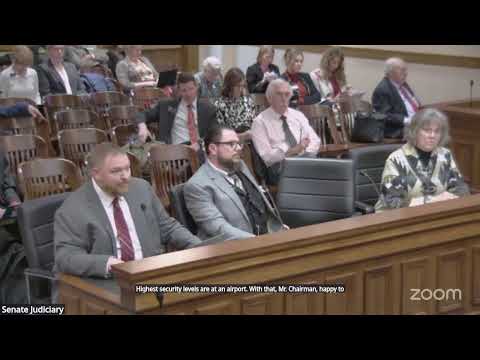
Senate Judiciary Committee hears testimony on HB 172 to remove gun-free zones, add carry exceptions for schools and state facilities
Summary
Lawmakers and witnesses debated House Bill 172, which would eliminate many gun-free zones in Wyoming, add concealed-carry exceptions for certain government and educational settings, and includes proposed amendments on airports and minimum permit-holder age. No vote was taken; the committee carried the bill over for further work.
The Senate Judiciary Committee heard testimony on House Bill 172 on HB 172, a bill that would repeal or narrow many of Wyoming's gun-free zones and clarify where people carrying concealed firearms under Wyoming permits may lawfully enter public buildings and educational facilities.
Representative Harrelson, the bill sponsor, told the committee HB 172 creates a new statutory section (6-8-105) that would allow persons lawfully carrying concealed weapons under Wyoming law to enter most meetings of government entities and many public buildings and educational facilities. "So before you guys is house bill 1 72," Harrelson said, "and what we'll do is we'll kind of walk through the couple different elements." He described three main educational categories covered by the bill: K-12 school facilities, college and university facilities, and public college or university athletic events where alcohol is not sold.
The bill also retains several carve-outs, Harrelson said: current statutory exclusions such as courtrooms and penitentiaries would remain, private property owners could still ban firearms on private premises, and federal facilities would not be affected. "Nowhere in this bill are we taking away private property rights," Harrelson said.
Why it matters: supporters argue HB 172 expands lawful self-defense options for staff and citizens and preserves decisions by local entities that have trained and armed staff; opponents say the bill would reduce local control and increase safety risks in schools, dorms and other campus spaces. The University of Wyoming, community colleges and the Department of Education urged careful, limited exceptions and noted local processes and campus-specific concerns. Mike Smith of the University of Wyoming said the bill's language that singles out a Wyoming permit derives from federal law: "The Federal Gun Free School Zone Act of 1990 ... [says] it's illegal for an individual to possess a firearm within a distance of 1,000 feet of an elementary or secondary school unless that individual possesses a permit from that state where they're at," Smith said.
Key bill details and proposed changes: committee discussion and witnesses clarified multiple provisions in the draft text. The bill as presented includes: - A civil/criminal enforcement provision described in testimony as a misdemeanor with a penalty that includes a $2,000 fine and up to one year (as described by the sponsor). Harrelson said drafters left that fine amount from earlier versions but would consider alignment if needed. - Provisions allowing concealed carry in certain state-operated Health and Human Services or Department of Corrections offices and in facilities certified by the Behavioral Health Division, with an explicit carved exception for facilities where explosive or volatile materials could cause serious harm; the sponsor said the bill narrows the definition of "volatile materials" to avoid trivial examples. - Language preserving private-property owners' rights to restrict firearms. - Text that would allow educational institutions to require firearms not on a person's person to be stored in locked or biometric lockboxes, a clause the sponsor said came from requests by colleges and universities to reduce accidental-discharge risk.
Amendments described to the committee: Representative Harrelson presented two amendments he had distributed to the committee: - Airport amendment: a draft insertion to prohibit the governing body of a public-use airport (or the city, town or county where a public-use airport is located) from restricting firearms within secured areas of a public-use airport. Airport directors asked the committee to refine the language to focus on commercial-service airport "secured areas" defined by federal law (separate from public areas before security checkpoints). Devin Brubaker, airport director and president of the Wyoming Airports Coalition, said the amendment's intent is to let local airport authorities address firearms in secured employee/airside areas and that the amendment could be edited to use "commercial service airport" for clarity. - Age/education amendment: language to align an 18-year-old concealed-carry permit pathway (existing in statute when a sheriff provides a letter) with the new educational exemptions by requiring that an 18-year-old permit applicant produce a high-school diploma or GED when applying. Harrelson said the change would prevent a high-school student from holding a concealed-carry permit that could allow him or her to bring a weapon into a K'12 campus.
Public comment and agency testimony: the hearing drew lengthy public testimony both for and against the bill. Supporters told the committee the bill protects constitutional rights and provides additional options for defending students and staff where law enforcement presence is limited. Opponents emphasized Wyoming's high suicide rate, campus suicides and accidental discharges as reasons to preserve gun-free zones; several University of Wyoming students and K'12 educators urged carve-outs for dormitories, counseling centers, childcare facilities, disciplinary proceedings and athletic venues. The Department of Education representative, speaking for the State Superintendent, urged giving school districts a choice between allowing concealed carry under the bill and the alternative of implementing prevention measures such as metal detectors and armed security, and asked for discussion of resources if districts choose the prevention route.
Procedure and next steps: committee members asked multiple technical questions about federal law interaction, the meaning of "direct control" for stored firearms, how permit reciprocity with other states would work and whether administrative proceedings on campus (disciplinary meetings) should be treated like courtrooms. No formal motion or vote was held; Chairman Olsen said the committee would carry the bill over and reconvene to continue testimony and work on amendments.
Quotes (selected, verbatim and attributed): "Nowhere in this bill are we taking away private property rights," Representative Harrelson said. "If you have a restaurant ... and you do not want a firearm on that property ... you have that right." "The Federal Gun Free School Zone Act of 1990 ... it's illegal for an individual to possess a firearm within a distance of 1,000 feet of an elementary or secondary school unless that individual possesses a permit from that state where they're at," Mike Smith, University of Wyoming, told the committee. "There is a protection aspect of armed security, but there's no prevention piece," Harrelson said when explaining the sponsor's rationale for treating athletic events where alcohol is sold differently. "I urge you to vote no on this bill," Ariel Coleman, a University of Wyoming student, said during public comment, citing the state's high suicide rate and a Harvard-cited finding about impulsive suicide attempts.
Ending: Committee members reserved additional time to refine draft language and amendments and shifted a continuation of the hearing to the committee's next scheduled meeting, giving legislators additional time to consider technical changes suggested by state agencies and airport officials. The bill remains under active consideration; no vote was taken at this hearing.