Get Full Government Meeting Transcripts, Videos, & Alerts Forever!
Get email alerts on the Animal Control Spay Neuter Ordinance topic
No spam. Unsubscribe anytime.
Abilene public raises concerns as council holds first reading of spay-and-neuter ordinance
Summary
The Abilene City Council held the first reading of an ordinance that would require dogs and cats older than six months to be spayed or neutered. Residents and breeders urged changes, and council members emphasized this is an initial public hearing with a second hearing scheduled in two weeks.
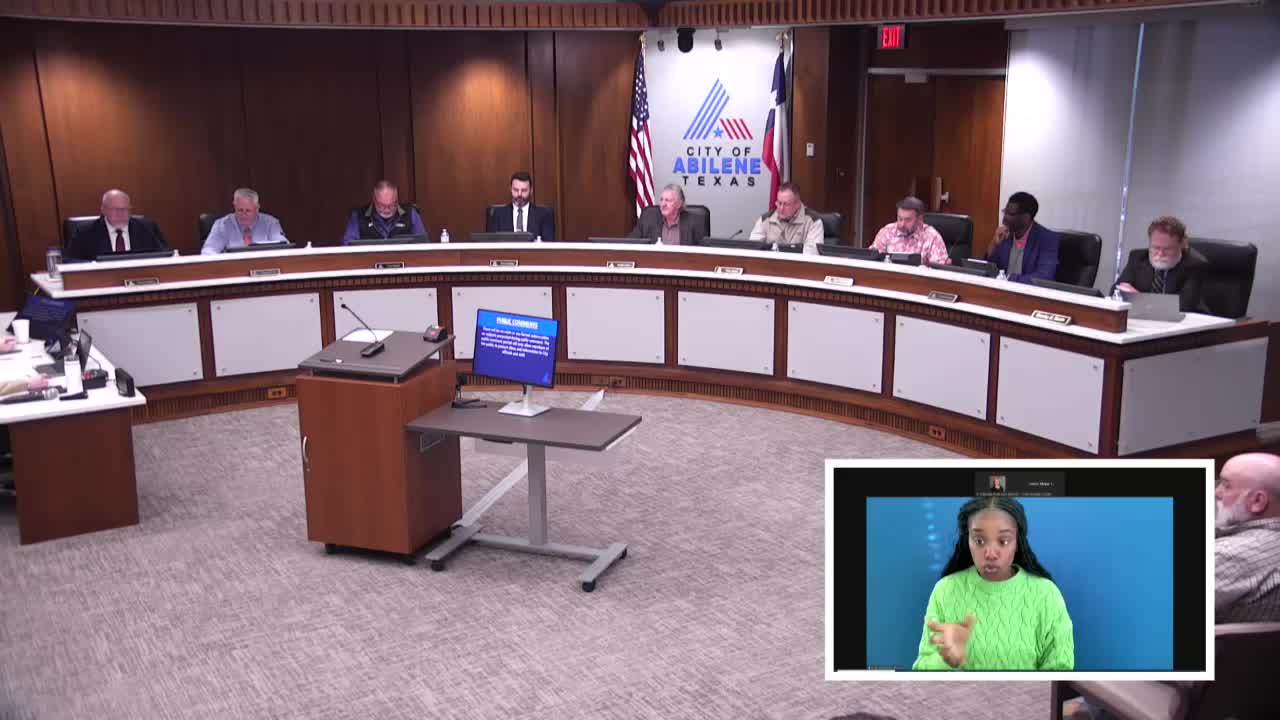
The Abilene City Council on Feb. 14 took the first public step toward a citywide ordinance that would require spaying or neutering of dogs and cats older than six months, drawing multiple speakers during the public-comment period who urged the council to revise the measure before a final vote.
The first reading is an initial step in the ordinance process, Mayor Hart said during the meeting: “This is where you start the process that gives us 2 weeks to do a deep dive into it. So what we do today is not what's gonna—this is not the final vote on this.”
Why it matters: supporters of the ordinance say stricter rules are meant to reduce shelter intake and the local shelter’s overcrowding; opponents say a blanket rule would punish responsible owners, harm dog-show participants and hobby breeders, and ignore veterinary research recommending later sterilization for some breeds.
During public comment, Erin Wiley, a resident, said the proposed mandate conflicts with research about optimal timing for sterilization in some breeds. “This ordinance is not based in the current research,” Wiley told the council, and she asked the council to consider published veterinary guidance about breed-specific timing.
Several other speakers urged flexibility or alternative approaches. One long-time exhibitor said mandatory early sterilization would bar participation in confirmation events and could drive hobbyists from local shows that bring revenue to the area: “An average dog show, which is about a thousand to 1,500 dogs, brings in about $2,000,000 to the hosting area,” a longtime competitor told the council.
Other residents suggested less punitive enforcement tools — microchipping, deposits refundable after proof of sterilization, and targeted enforcement aimed at repeat violators — rather than a blanket ordinance that applies to all pet owners.
Council and staff response: Planning staff and council members repeatedly reminded the public that the meeting item was a first reading, and that further public input and edits are possible. Councilman McAllister said the first reading only launches “the process that gives us 2 weeks to do a deep dive into it” and that the council will hold another public hearing in two weeks.
Next steps: The item remains at first reading. The council scheduled further review and a second public hearing, giving staff and council time to consider amendments and written materials submitted by residents and veterinarians.
Community context: Speakers included hobby breeders, kennel owners and residents who said they follow veterinary guidance and worry the ordinance would criminalize otherwise responsible behavior. Others noted the city’s shelter is crowded and that reducing the number of unwanted litters remains a public-policy goal.