Get Full Government Meeting Transcripts, Videos, & Alerts Forever!
Get email alerts on the Artificial Intelligence Policy topic
No spam. Unsubscribe anytime.
Austin outlines ChatGPT enterprise pilot, training and legislative preparations as Texas AI bill advances
Summary
City of Austin innovation staff described a 100-license ChatGPT Enterprise pilot, required staff training, university partnerships on curriculum and accountability research, and steps to comply with Texas House Bill 1709, which would impose requirements on high‑risk AI systems and take effect Sept. 1, 2025 if enacted.
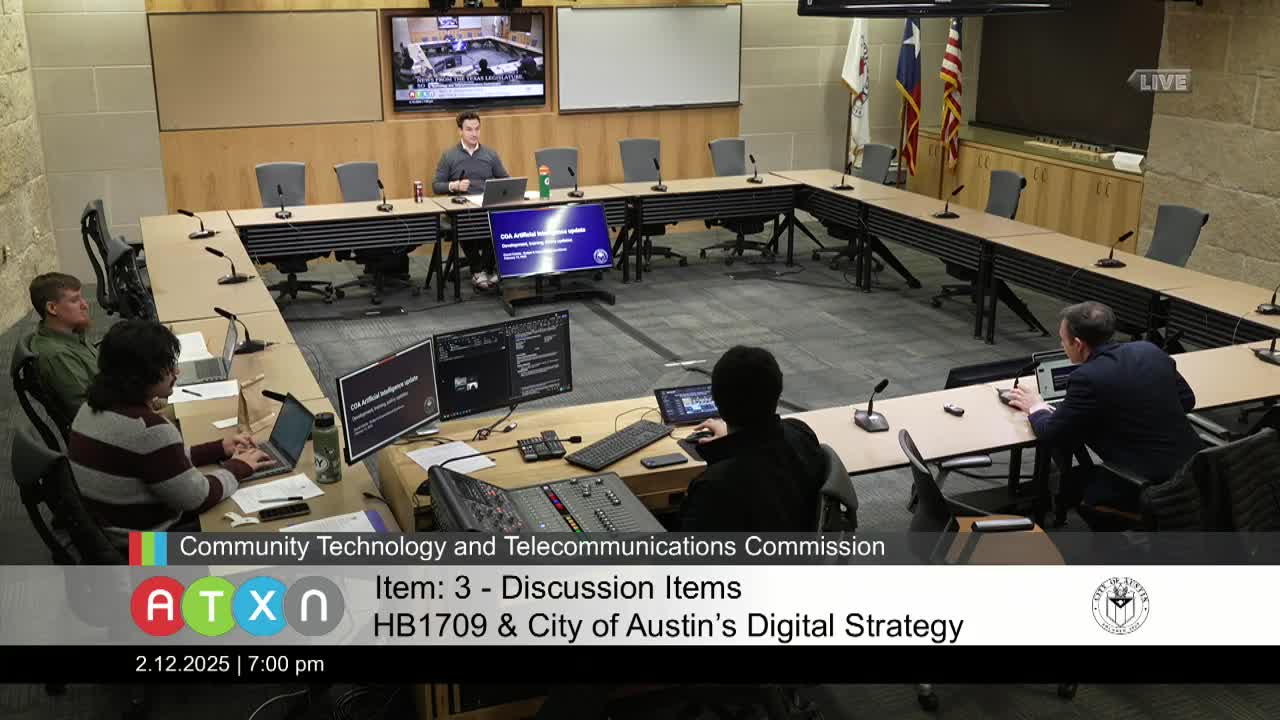
Daniel Collotta, the City of Austin chief innovation officer, told the Technology Commission on Feb. 5 that the city is running a 100‑license ChatGPT Enterprise pilot across departments and preparing to meet state-level AI requirements.
Collotta said 70 of the licenses are already in routine use and 30 are reserved for a detailed value assessment of how generative AI could change city processes. "The conclusion of this pilot, at the end of the fiscal year, and at checkpoints throughout will provide adoption and implementation guidelines to the city organization," Collotta said. He added the pilot will help the city decide whether to invest in an enterprise instance or in more specialized tools.
Why it matters: Collotta told commissioners that Texas House Bill 1709—sponsored in the Legislature by Representative Capriglione—focuses on so‑called high‑risk AI systems that affect areas including criminal justice, housing, health care and government services. If passed as written, the bill would require impact assessments before deployment, disclosures to residents, vendor risk assessments, auditing and corrective actions. Collotta said the bill currently lists an effective date of Sept. 1, 2025.
What the city is doing: Collotta described several parallel efforts: a citywide AI training program (three hours required for pilot participants), a curriculum development project with the University of Texas, an "AI accountability" research project led with UT and the Office of Equity and Inclusion, and coordination through an "emerging technology board" made up of representatives from law, human resources, equity, CTM and other departments.
On data and security, Collotta said the enterprise instance bounds prompts and inputs to the city system and that the city is capturing prompt data for evaluation. "We're capturing those prompts," he said, adding that the enterprise setup helps prevent prompts and inputs from being released into public data sets. Collotta said the pilot team is collecting surveys, usage analytics and targeted case studies to measure time savings, features used and risks.
Legal and oversight preparation: Collotta told commissioners the law department, the civil rights office and HR are involved in evaluating legal exposure and compliance. He said the city is looking to frameworks such as the NIST risk‑assessment framework to guide oversight, auditability and accountability. Collotta also said the city currently does not operate public‑facing AI services that make decisions for residents and that it intends to finish piloting and put standards in place before deploying such systems.
Timeline and reporting: Collotta said preliminary pilot findings should be available in April or May, and that the pilot licenses run through the end of the fiscal year in September. "We're hoping to have some preliminary or share some preliminary findings, probably in April," he told the commission when asked about timing.
Commission questions and next steps: Commissioners asked how prompt data is collected and whether OpenAI or other vendors can reuse the city’s prompts. Collotta replied that the enterprise contract keeps data within the city’s bounded environment. Commissioners also asked whether the AI Accountability Project would continue if the Office of Equity and Inclusion changed; Collotta said the Innovation Office, UT and the Austin AI Alliance are co‑leads and that the project is structured to continue.
Collotta said the city is coordinating with other large Texas cities and the intergovernmental relations office to give feedback to the bill author on definitions and implementation details. "Some of the foundational things that we want to make sure that, you know, terms and definitions are very clear," he said. He added the city already has templates and vendor assessment tools under development that can be adapted if the bill becomes law.
The commission’s AI working group reported later in the meeting that its discussions have emphasized human oversight for major decisions, safeguards, review and communications, and that the group will seek where it can add value to existing city policy.
Looking ahead: Collotta and staff plan at least one or two more updates before the fiscal year ends and to publish the pilot’s use cases and recommendations to help departments decide how to adopt AI safely and equitably.