Get Full Government Meeting Transcripts, Videos, & Alerts Forever!
Get email alerts on the Nonprofit Funding topic
No spam. Unsubscribe anytime.
Local nonprofit leaders warn federal funding cuts could shrink Columbus safety net
Summary
Nonprofit and city leaders at a Columbus Metropolitan Club forum warned that proposed federal executive actions and budget cuts could sharply reduce services for immigrants, refugees and people experiencing homelessness, and urged immediate local advocacy, donations and volunteer support.
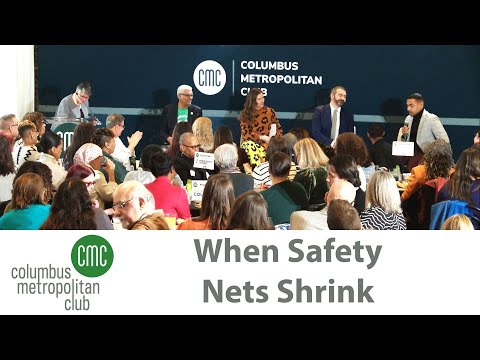
Leaders of Columbus-area nonprofits and City Council President Shannon Hardin warned at a Columbus Metropolitan Club forum that proposed federal executive actions and budget cuts could significantly reduce funding for local safety-net services, posing immediate operational and human impacts for refugee and immigrant resettlement, shelter programs and other human services.
The forum on looming federal funding cuts brought together Michael Kory, executive director of the Human Service Chamber of Franklin County; Dr. Celestia Asfau of Ethiopian Tewahedo Social Services (ETSS); Elizabeth (Liz) Brown, CEO of the YWCA of Columbus; Chad Jester of Nationwide; and Dr. Lisa Cortes, CEO of the United Way of Central Ohio, with Council President Shannon Hardin participating on the panel.
Kory said the White House has used executive orders, executive actions, agency actions and proposed legislation to target nonprofit-related funding and programs. He described an Office of Management and Budget memo that paused grant funding and said a subsequent narrowing of cuts left roughly $150,000,000 in potentially affected federal grant dollars for the Chamber's membership. "That's services to 2,400,000 people in the Central Ohio area," Kory said, citing member estimates. He added that membership organizations reported receiving "$230,000,000 in federal dollars overall." He also noted a federal court in Washington, D.C., had temporarily put a pause on some of the administration's actions.
Panelists described immediate, practical impacts for local resettlement and shelter work. Dr. Asfau said the three resettlement agencies serving Central Ohio — Jewish Family Services, ETSS and a third agency she named — together welcomed about 460 refugees and that recent federal changes had canceled flights and suspended the United States refugee admissions process. "Our refugee immigrant families live in fear," she said, adding that about 6,000 flights had been canceled and that agencies were unsure whether federal reimbursements for services already provided would be paid.
Asfau described specific short-term costs and obligations for resettlement: airport pickups, temporary housing (including hotels that can cost about $230 per week), health screenings, enrollment for children and English classes, and case management intended to make families self-sufficient within 90 days. She said agencies had been told to stop certain work and were told they might not be compensated, leaving programs with payroll and service-delivery dilemmas.
Brown said the YWCA and similar providers are deeply concerned about federal mandates that would change how they can serve clients, including restrictions on collecting demographic data or offering education on fair housing. She warned that some programs tied to federal agencies could be changed or cut. Brown said the YWCA operates an emergency family shelter and that a third of people in that shelter work for a living. She said the YWCA faces the prospect of a roughly 50% cut to its family center budget if federal support disappears.
Hardin, speaking for the city, emphasized local steps taken and urged urgency from the broader community. She reminded the audience that Columbus' recently passed operating budget totals about $1,200,000,000 and that council had identified gaps in the shelter system funding — "and nearly doubled the funding for the shelter system," she said — to avoid worsening street homelessness as federal dollars expire. Hardin also said the city and county will convene a Funding Review Advisory Committee and urged businesses, philanthropy and residents to step forward with ideas and resources.
Speakers urged civic advocacy and immediate community support. Dr. Cortes, who moderated the panel, said nonprofits should continue traditional advocacy with members of Congress — she named Senator Husted and Representative Kerry as local congressional leaders the panel planned to engage — and asked attendees to call, visit town halls and keep up public pressure. Panelists recommended three practical actions from residents and employers: advocate to elected officials, give flexible funding, and volunteer for immediate operational needs such as meal service and transportation.
Panelists and questioners stressed the local economic stakes as well as human impacts. Kory said the health and human services nonprofit sector contributes about $2,000,000,000 to the local economy and employs about 18,000 people, describing the sector as an economic engine with thin margins that is vulnerable to rapid policy change.
The forum included audience questions from agency leaders who pressed the panel for immediate funding options for families already in local care. Panelists directed community members to donate, volunteer, and follow nonprofit accounts for emergency needs listings; Hardin encouraged interested residents to apply to the city's Commission on Immigrants and Refugees, created last November, to participate in local advocacy and planning.
The panel did not propose any new federal actions; no formal motions or votes were recorded at the forum. Instead, participants emphasized local mitigation measures, urgent fundraising and advocacy to Congress and to state leaders. The panel repeatedly cautioned that many details — including which specific federal grants would be cut, the full amount of payments withheld and any final legislative outcomes — remained uncertain and dependent on federal agency and legislative actions.
Local officials and nonprofit leaders asked that community members treat these as immediate, practical needs rather than abstract policy debates: donate to local resettlement and shelter programs, volunteer for day-to-day operations, and press elected officials to protect programs that support vulnerable residents.