Get Full Government Meeting Transcripts, Videos, & Alerts Forever!
Get email alerts on the Financial Transparency topic
No spam. Unsubscribe anytime.
Finance staff previews quarterly financial forecasting tool, plans May roll-out
Summary
City finance staff demonstrated a Municast-based quarterly forecasting template with stoplight indicators, drill-down capability and plans to begin formal quarterly reporting in May; committee provided feedback on detail and access.
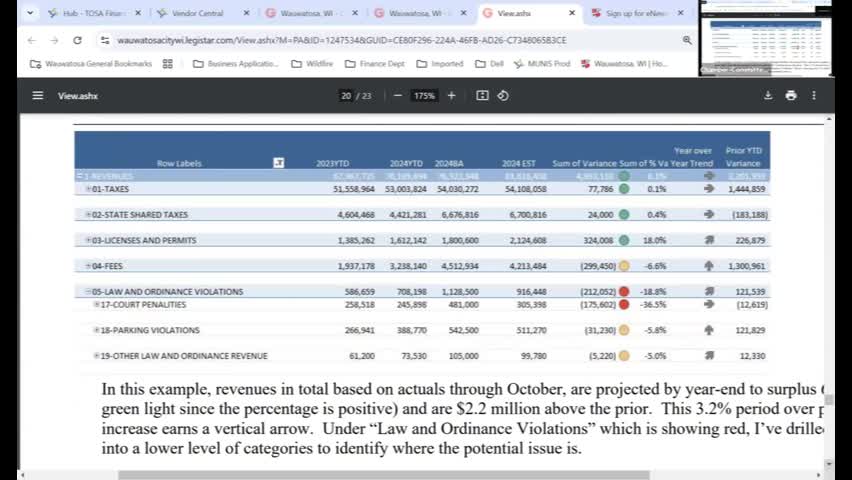
City finance staff previewed a new quarterly forecasting template and analytical tool the department plans to use to present budget-to-actual projections and early warning indicators to the Wauwatosa City Finance Committee.
John walked committee members through the Municast forecasting module the city will use to produce quarterly reports. He said the software allows a stoplight (green/yellow/red) analysis of revenue and expense categories, and the ability to drill down from high-level categories to department-level and object-level data. "We hope to begin in May of providing these quarterly reports," John told the committee, adding a goal to present within about 45 days of the close of each quarter.
The preview included examples showing revenues projecting above budget overall but specific fee and court-penalty categories projecting below budget. John described the system’s drill-down capabilities and limitations: the tool can show object-level summaries and monthly series back to 2017 for monthly data, but does not provide transaction-level detail (the ledger entries). He also noted the forecasting module links with third-party inputs — for example, a health-insurance dashboard and hotel occupancy metrics — and that staff hopes to add operational measures (ambulance trips, salt usage, etc.) in the future to connect operations and finance.
Members asked technical and access questions. Staff said the city pays about $1,900 a year for the Municast forecasting product and that internal staff will have access without additional licensing. John acknowledged some manual steps remain now — an extract from the financial system is uploaded into the forecasting tool — but said the process reduces manual time from roughly 12 hours to about 30 minutes.
Nut graf: The forecasting tool is intended to give council and staff an earlier and clearer view of budget trends, with conditional formatting and drill-downs enabling targeted questions about departments or specific revenue objects.
John emphasized that forecasts are inherently imperfect. "The only thing I can guarantee you about our forecast is they'll be wrong. Right. Yeah. But we hope that the trend is right," he said. The committee asked for the first-quarter presentation in May and encouraged staff to provide training and access for department directors.
Ending: Staff will finalize the setup and provide the committee with the first quarterly forecast and accompanying memo in May, and will continue work to integrate operational metrics and longer historical series where possible.