Get Full Government Meeting Transcripts, Videos, & Alerts Forever!
Get email alerts on the Homelessness topic
No spam. Unsubscribe anytime.
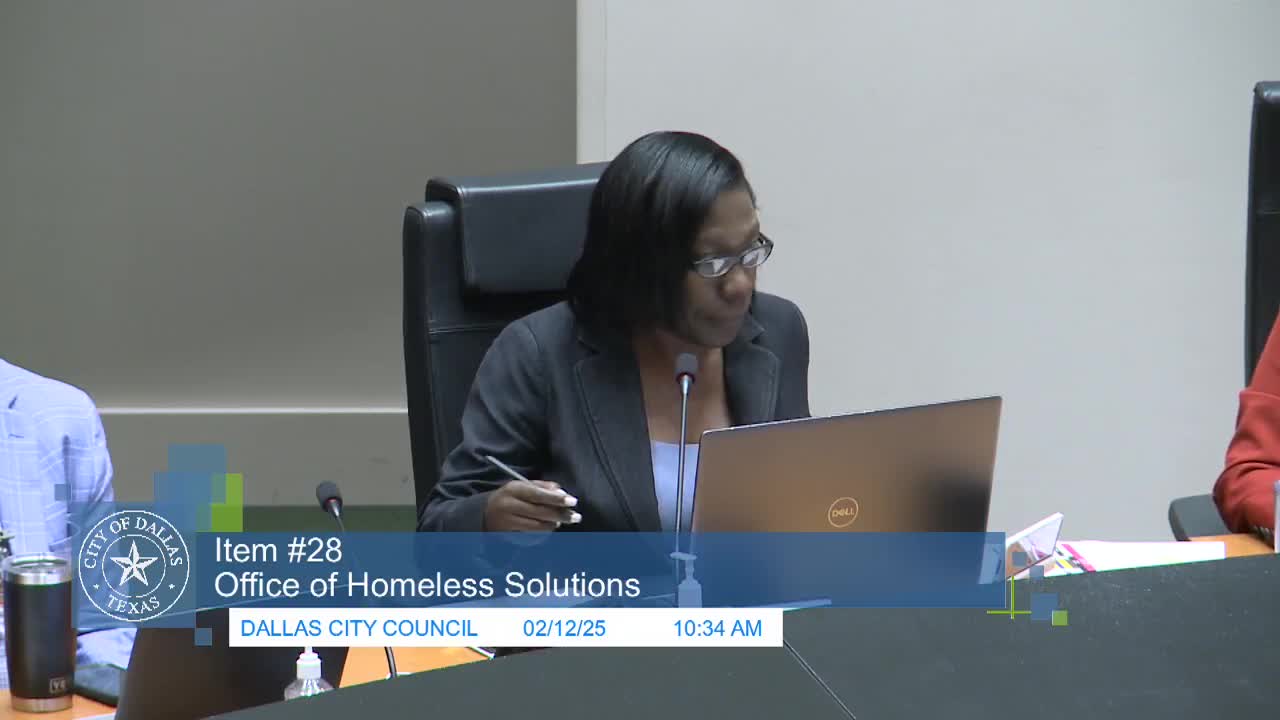
Dallas council approves $2.5 million for Street to Home, amid calls for greater accountability
Summary
The Dallas City Council voted to provide $2,500,001 to the Street to Home initiative—part of a $30 million public-private push to reduce unsheltered homelessness—after lengthy debate over program results, oversight, and other local housing priorities.
The Dallas City Council on Feb. 12 approved a $2,500,001 allocation to the Street to Home initiative, a public‑private effort led by Housing Forward to reduce chronic unsheltered homelessness across the city.
The allocation passed after an amendment by Councilmember Chad West restored the full $2.5 million outline the city manager requested; the amended item passed on a 12–3 recorded vote. The final vote made the funds immediately available to the city and its partners to expand rapid rehousing, on‑site behavioral health teams, and targeted closures of high‑concentration encampments.
Why it matters: Supporters called the funding essential to sustain the progress Dallas has made in recent years and to leverage additional federal and private commitments. Opponents and several council members pressed for stronger performance metrics, clearer accountability, and earmarking of funds for substance‑use and behavioral‑health services.
Councilmember Jesse Moreno, who led a sustained critique, said the program was failing some of the city’s most vulnerable residents: “That’s a terrible way to solve complex issues like substance abuse and mental illness,” Moreno said during debate, urging stricter oversight and clearer success measures.
Housing Forward CEO Sarah Khan, who participated remotely, described Street to Home as the next phase of earlier rapid‑rehousing work. “The Street to Home initiative is really, a $30,000,000 public and private initiative that aims to really address chronic unsheltered homelessness,” Khan said, adding the plan combines on‑site behavioral health, housing placements and enforcement to keep cleared public spaces from re‑forming encampments.
City Manager Kimberly Beiser Tolbert defended the request as part of a coordinated system, saying the city could not expect private and federal partners to scale up if local government did not continue to invest. “We are out there actively working,” Tolbert said, and the city needs local dollars to sustain and expand the approach that has been credited with reductions in unsheltered counts.
Council debate and amendment: The council first debated a motion to reduce the city’s ask; Chairman West proposed an amendment to restore the $2.5 million figure, saying the program is one of the few tools that has produced measurable reductions in street homelessness. “You don’t throw out the baby with the bathwater,” West said.
Some council members said they supported continued funding but wanted stronger, specific conditions: Councilmember Joann Mendelsohn said she would have preferred to withhold funding until staff provided a full accounting of previous rapid‑rehousing expenditures, and Councilmember Jesse Moreno offered, but could not secure, a substitute to divert $1 million to treatment and behavioral‑health programs.
What the money buys: City staff and Housing Forward officials described the funds as part of a $30 million Street to Home package (including $10 million already secured in federal resources). The city portion focuses on rapid rehousing rental subsidies, utility assistance and supportive services that accompany placements; allied funds expand outreach and behavioral‑health teams that will follow people into housing.
Oversight and metrics: City staff said the program measures success by people housed and the length of time they remain housed, and that Street to Home built on the earlier Real Time Rapid Rehousing initiative. Critics asked for clearer, public, outcome metrics tied to local funding. Tolbert said staff would continue to brief the Housing and Homelessness Solutions Committee and work to increase county and private contributions.
Next steps: The City Manager is authorized to execute the amended contract and expend up to $2,500,001 as described in the agenda item, with staff continuing to brief council committees on outcomes, behavioral‑health integration, and county coordination.
Ending: Supporters framed the vote as a continuation of a multi‑partner effort to reduce visible homelessness; critics argued for stronger measures of accountability and more local investment in treatment. Councilmembers on both sides said they would press staff and partners for regular, public progress reports.