Get Full Government Meeting Transcripts, Videos, & Alerts Forever!
Get email alerts on the Employment Speech Pronouns topic
No spam. Unsubscribe anytime.
Committee advances bill barring state from requiring use of preferred pronouns
Summary
The House Judiciary Committee voted to return Senate File 77 to the floor after debate on whether the measure improperly reaches private permits, contracts and licenses. Supporters said the bill protects government employees' speech; opponents warned it could enable harassment and create enforcement problems.
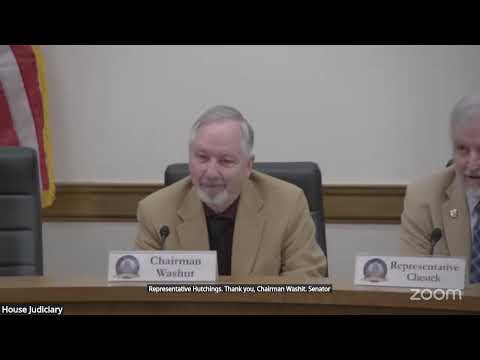
The House Judiciary Committee advanced Senate File 77 on a 8-1 vote after more than two hours of testimony and debate over how broadly the bill would apply.
Senator Hutchings, the bill sponsor, opened the committee hearing by saying the measure responds to constituent complaints about workplace pronoun requirements. "Compelled speech is not free speech," he said, describing the bill as "really, really simple" and summarizing its intent: to "prohibit the state and its political subdivisions from requiring the use of preferred pronouns, authorizing a civil remedy, and providing an effective date." The draft language prohibits the state from compelling an employee to refer to another employee by preferred pronouns and allows a person alleging a violation to file a civil action.
The bill drew sharply different testimony. Sarah Burlingame, executive director of Wyoming Equality, opposed the bill and said it would allow coworkers to refuse to use others' pronouns and could lead to bullying and harassment. "Wyoming Equality is in opposition to this bill," she said, and warned that the absence of checks such as amended birth certificates would not prevent disrespectful or harmful behavior. Sarah Beth Nolan, legal counsel with Alliance Defending Freedom, testified for the bill and cited cases in which government employees lost jobs after refusing to use particular pronouns; she argued the First Amendment protects public employees from being compelled to speak against their beliefs, quoting court language that "teachers cannot be compelled to be a mouthpiece for controversial religious, political, or ideological causes." A university student who identified herself as Sophia urged the committee to vote no, saying the bill "explicitly allows for bullying and disrespect."
Committee members focused much of their questioning on the bill's scope. Several lawmakers asked whether the language in lines referring to grants, permits, contracts, licenses or other benefits could be read to regulate private employers or condition the award of permits and licenses. Senator Hutchings repeatedly said the intent was to bar the state from retaliating against employees — for example, by denying an employee employment or grants — for refusing to use another employee's preferred pronouns. He said private employers would remain free to set their own workplace rules: "Private businesses can do what they want," he told the committee. Some members sought amendments to remove permits, contracts or licensing language; other members warned striking such language could leave state contractors and at‑will employees treated differently from full‑time state employees.
Representative Bratton offered an amendment to restore language from an earlier draft that would have expressly allowed compensatory damages, attorney fees and injunctive relief; after discussion the committee adopted language returning the measure to its original form. During markup, Representative Bratton moved the bill and Representative Webb seconded; the committee later voted by roll call with the following recorded votes: Representative Breidt — aye; Representative Brett — aye; Representative Chesty — no; Representative Feiler — aye; Representative Kelly — aye; Representative Veil — aye; Representative Singh — aye; Representative Webb — aye; Chairman Washington — aye. The clerk announced "8 ayes, 1 no." Representative Bratton was selected to carry the bill on the floor.
Statements at the hearing encapsulated the competing rationales: supporters described the bill as protecting public employees from compelled speech and seeking to preserve First Amendment and religious‑liberty protections; opponents said the language risks authorizing disrespect, enabling harassment, and could produce awkward or intrusive enforcement questions if officials attempted to police pronoun usage. Several committee members asked the sponsor to work with Legislative Services Office attorneys and stakeholders on narrow drafting clarifications before floor action.
The committee did not adopt a directive for additional reports or a requirement for department guidance; the bill will move to the full chamber with the committee's recommendation that the original version be reported out.
Votes at a glance
- Senate File 77 — advanced out of the House Judiciary Committee on a voice roll call (8 ayes, 1 no).