Get Full Government Meeting Transcripts, Videos, & Alerts Forever!
Get email alerts on the Municipal Finance topic
No spam. Unsubscribe anytime.
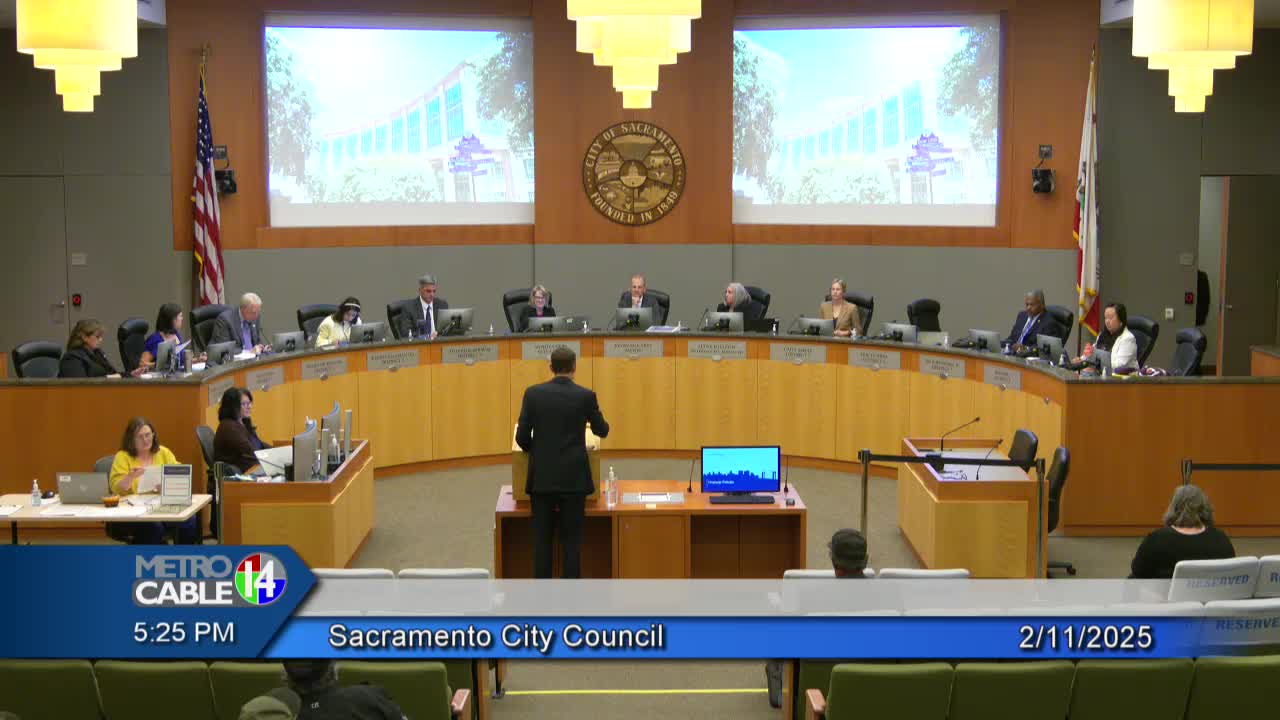
Sacramento council adopts prior-year savings policy to prioritize budget balance, reserves and liabilities
Summary
The City Council approved a new policy directing one-time prior-year savings first to budget shortfalls, then to restore the economic uncertainty reserve, with remaining funds split to pay pensions, capital needs and one-time projects.
The Sacramento City Council voted to adopt a prior-year savings policy that would direct one-time savings first to any projected budget shortfall, then to restoring the city’s economic uncertainty reserve, with remaining funds split evenly among pension paydown, capital and deferred-maintenance needs, and one-time uses.
Finance Director Pete Coletto, who presented the proposal, told the council the policy is intended to align one-time funding sources with one-time uses and to help stabilize the city’s long-term fiscal position. “What we’re proposing is a policy to use one-time prior year end savings to pay down our unfunded liabilities, but really balancing that with our need to balance our budget,” Coletto said.
Coletto outlined the city’s large unfunded liabilities and current payments: he told the council the city faces roughly $1.4 billion in unfunded pension liabilities, about $200 million in unfunded retiree health (OPEB) liabilities, and significant unfunded capital needs; he also said the city currently is making roughly $108 million in pension payments this year compared with an estimated $70 million in normal pension costs. Under the new policy, one-time savings would first fill a projected budget gap, second restore the economic uncertainty reserve to its minimum, and any remaining dollars would be placed one-third each into a pension-paydown fund, a capital/deferred-maintenance fund and a fund for strategic one-time investments.
Council members discussed wording and flexibility for potential one-time investments. A council member moved to approve the resolution with a change in Section 3.2 clarifying that council “may consider strategic one-time investments” (rather than a prescriptive formulation); the motion was seconded and the council approved the policy 8-0, with one member absent. The council directed staff to implement the policy as amended and to continue discussing budget strategies through the budget process.
Council members and staff noted the policy is limited to one-time prior-year savings and does not change how ongoing revenue surpluses will be treated in the budget process. The resolution passed with the stated aim of improving fiscal flexibility and supporting credit ratings that could lower borrowing costs.