Get Full Government Meeting Transcripts, Videos, & Alerts Forever!
Get email alerts on the Building Decarbonization topic
No spam. Unsubscribe anytime.
Cambridge updates net‑zero buildings plan, highlights VPPA, financing gaps and geothermal pilot
Summary
City staff reported progress on the Net‑Zero Action Plan for buildings, including a virtual power purchase agreement, Electrify Cambridge enrollment, and new regulations under the Building Emissions (BUDO) framework; committee members urged stronger residential financing and clearer outcome metrics.
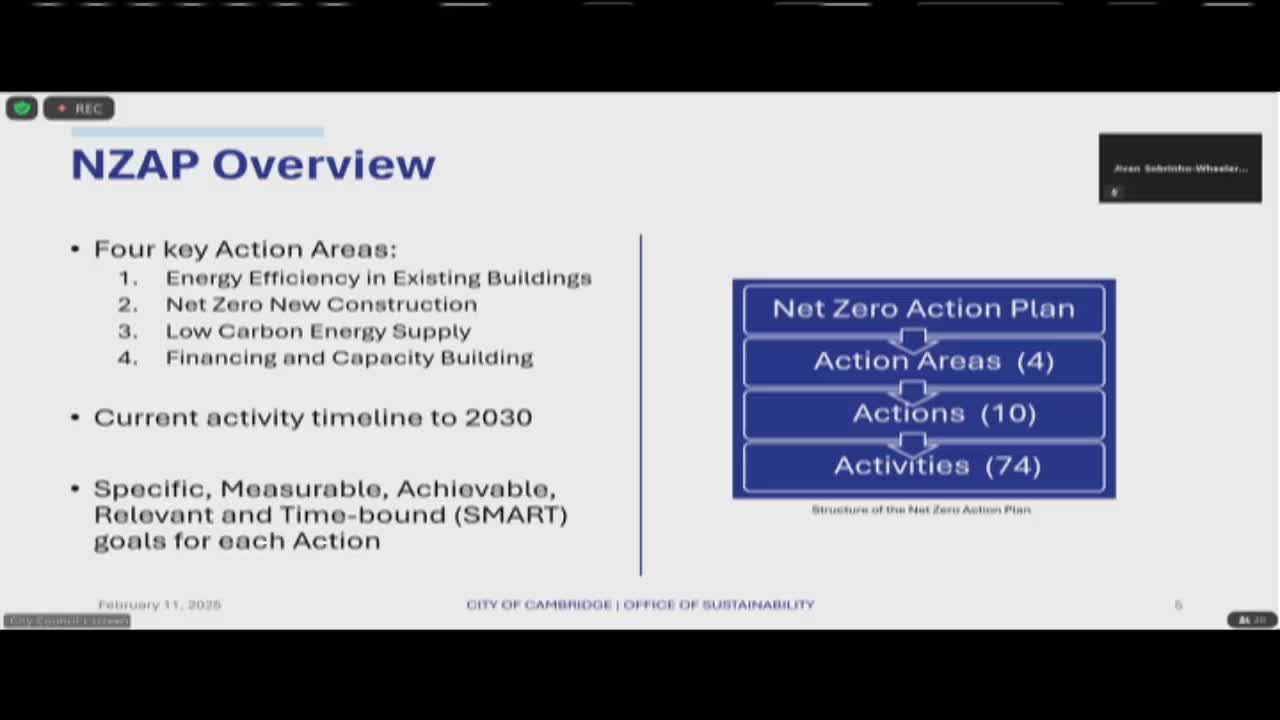
Cambridge city staff and the Cambridge Climate Committee reviewed the city's fiscal year 2024 progress on the Net‑Zero Action Plan for buildings, reporting adoption and implementation steps for building emissions regulations, a community renewable energy purchase agreement and new financing pilots while committee members and residents pressed for expanded residential financing and clearer outcome metrics.
The presentation from Office of Sustainability staff summarized accomplishments in FY24, including adoption of BUDO (the building emissions ordinance) amendments and a fossil‑fuel‑free ordinance for new construction; launch of Electrify Cambridge, which provided advisory services to hundreds of housing units; and a December announcement of a virtual power purchase agreement (VPPA) to bring new renewable generation and renewable energy credits to Cambridge customers. "These require large nonresidential buildings to get to net‑zero emissions over time," said Nikhil (Office of Sustainability staff), describing how regulations will move from ordinance to enforceable requirements.
The climate committee and several committee members praised the regulatory steps but urged the city to focus on financing and outcomes. Mallory (Cambridge Climate Committee member) told the committee the panel's top priority is "dedicating staff resources and council attention to solving the financial barrier for residential retrofits." David Rabkin (Cambridge Climate Committee member) and Steven Nutter, executive director of Green Cambridge and vice chair of the committee, also called for tracking actual emissions results and adjusting supports where needed.
Why it matters: Cambridge's building stock and large institutional facilities account for a large share of local greenhouse gas emissions. The city's combination of regulations, incentives, renewable procurement and pilot infrastructure projects will shape whether the city meets its 2030 and 2050 goals. The committee recommended shifting toward outcome‑based targets (emissions reduced, buildings retrofitted) rather than only process measures.
Key details reported
- Regulations and compliance timeline: Staff said the first phase of BUDO performance regulations (for large nonresidential buildings) was promulgated in December and will require those building owners to begin cutting emissions starting in 2026. Staff said they will produce a data analysis in April that reviews outcomes from buildings that have consistently reported to date and will publish an annual dashboard. "In April... we're going to be issuing a much more comprehensive look at all the data," Julie Wormser, chief climate officer, said.
- Renewable procurement: The city announced two VPPAs in December and expanded the Cambridge Community Electricity aggregation default to 50% renewable for participating accounts; staff said the VPPA was the first U.S. renewable contract structured to decarbonize a community aggregation.
- Electrify Cambridge and financing pilots: The Electrify Cambridge program exceeded its first‑year goal by advising roughly 837 residential units and launched a multifamily financing pilot with BlockPower; staff said the BlockPower partnership has concluded because of changes in that company's operations, and the city is continuing to engage interested buildings through its Electrify Cambridge assistance and other incentives.
- Grants and programs: Staff listed major funding lines and programs: a conditional $20,000,000 Department of Energy grant awarded in collaboration with Boston and the state (project status subject to external processes), a $1,000,000 ARPA-funded green equipment program for small businesses and nonprofits, and an anticipated $2,000,000 technical assistance program for midsize BUDO buildings. The city also adopted commercial and multifamily PACE (property assessed clean energy) financing in FY24.
- Pilot infrastructure: The city has started a feasibility study for thermal energy networks (a broad term that can include geothermal and other heat sources) and kicked off a community geothermal/thermal pilot and a community solar administrator program to increase solar access, particularly for income‑qualified residents. Staff described a planned resilience upgrade at the Cambridge Community Center that includes solar, battery storage and an electrical service upgrade.
Public and committee concerns
Climate Committee members and public commenters pressed the city to close financing gaps for residential retrofits and to provide clear one‑stop resources. Mallory said awareness and cost are common barriers; Helen Walker, a Cambridge resident, told the committee a 1920s masonry building she consulted on had an estimated $53,000 per unit cost for heat pumps alone and roughly $75,000 per unit once electrical upgrades and hot water work were included. Walker said her single building's retrofit estimate approached $5,000,000.
Committee members also urged Cambridge to make program results and implementation steps easily replicable for other communities. David Rabkin and others highlighted the VPPA and aggregation as central to reducing electricity emissions quickly, while cautioning that emissions reductions from large buildings depend on whether owners implement upgrades or purchase cleaner electricity.
What the city will do next
Staff said they will publish an initial emissions snapshot for consistently reporting BUDO buildings in the next several weeks and a comprehensive data analysis in April, timed with the Sustainable Cambridge public launch. The city plans to use FY25 to refine financing studies (including reviewing state tools such as the Massachusetts Climate Bank and Mass Save offerings), to staff a dedicated BUDO position supported by grant funds, and to begin the next five‑year top‑to‑bottom update of the Net‑Zero Action Plan with public engagement.
Meeting outcome
The committee did not vote on new ordinances or rules at the meeting. The only formal vote recorded in the transcript was the committee's procedural adjournment (4 yes votes; one member absent).