Get Full Government Meeting Transcripts, Videos, & Alerts Forever!
Get email alerts on the Urban Trees Tree Fee topic
No spam. Unsubscribe anytime.
Shoreline council weighs lower tree‑removal fees, delays final vote until March
Summary
Council held a public hearing on interim rules banning removal of very large trees in two town‑center zones and discussed multiple fee options for permitted removal of canopy trees 24 inches DBH and larger; no ordinance or fee change was adopted and staff will return March 3 with a recommendation.
Shoreline City Council held a public hearing and extended discussion on Feb. 10 over interim rules and a proposed fee schedule intended to slow loss of large trees while the city completes a longer tree code update.
The council opened a public hearing on Ordinance No. 1031, interim regulations prohibiting removal of nonhazardous trees measuring 60 inches diameter at breast height or greater in Town Center 3 and Town Center 4 zoning districts. Sierra Carson, senior planner, told the council the interim rules were adopted Jan. 27 under state authority for interim zoning regulations and must be the subject of a public hearing within 60 days; the interim rules are effective for six months.
Why it matters: Council members and residents said the city must balance preserving mature canopy trees, which the city’s urban forestry plan and comp plan tie to climate and habitat goals, with the council’s stated priority of adding housing. Staff and residents disagreed over what fee levels would discourage unnecessary removals without blocking small-scale housing projects or home repairs for residents on fixed incomes.
Residents and advocates urged different approaches. Kathleen Russell, speaking for the Tree Preservation Code team, said Shoreline’s tree canopy is about 37 percent and urged a higher fee in lieu for removal of large private trees, proposing Option 5 (a $3,325 starting fee for trees 24 inches DBH and greater plus per‑inch charges). “If large trees, 24 inches diameter and greater, have to be cut down, then a fee in lieu is needed for these big canopy trees,” Russell said.
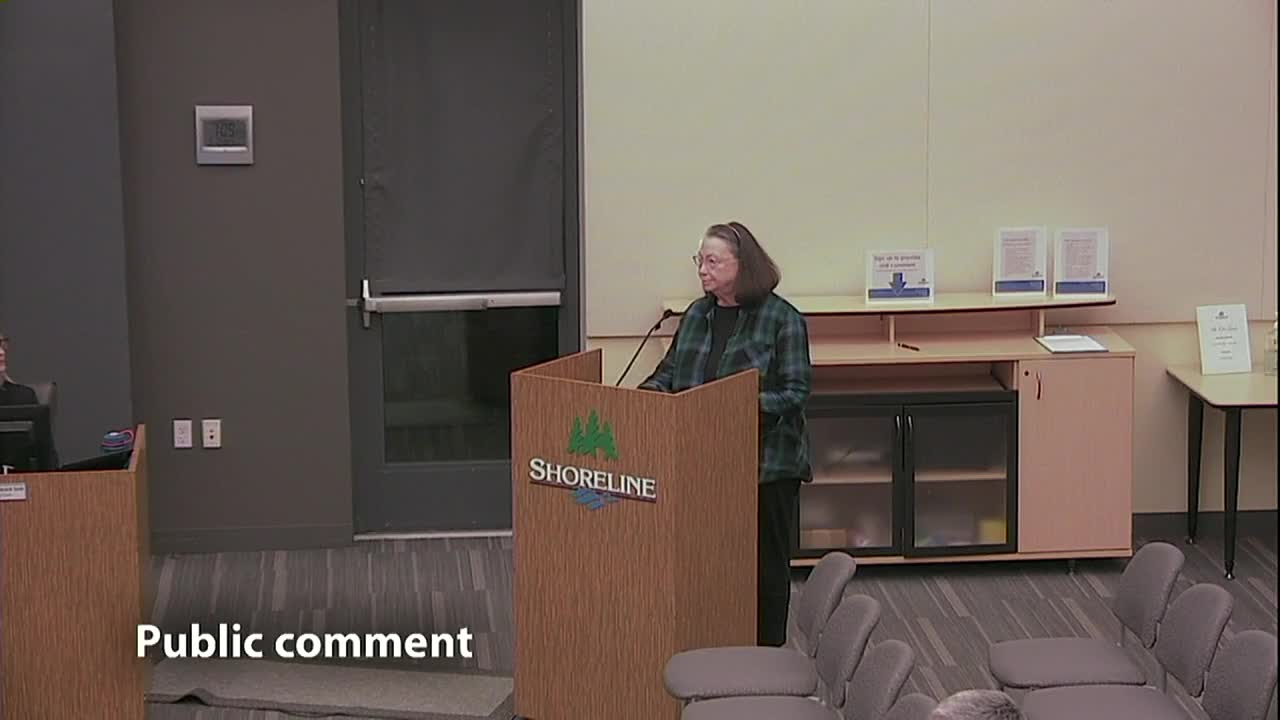
Other members of the public and some councilmembers warned against setting fees so high they would deter modest infill or upgrades. Matthew DeAngelis, a Shoreline resident, told council that excessive removal fees could make small housing projects financially infeasible and push development outward. “Please consider making housing affordable,” DeAngelis said during public comment.
Staff outlined a menu of fee options for council consideration. The options included: (1) no change to the recently adopted high fee levels ($9,000 for 24–30 inch trees and $15,000 for trees larger than 30 inches); (2) a lower fee modeled on peer cities (roughly $120–$700 depending on size, per staff’s initial survey); (3) staff’s recommendation using i‑Tree ecological‑value estimates (about $900–$1,500 for a 24–30 inch tree with size‑scaling); (4) a fee‑in‑lieu equal to the city’s cost to plant and maintain a replacement tree for three years (the number cited in public comment for a public tree was $33,325); and (5) a councilmember‑proposed hybrid (labeled 3A in the presentation) that starts at about $2,500 and increases by $200 per inch in diameter.
Councilmembers voiced a range of positions in the discussion. Councilmember Scully described the interim regulation as a “stopgap” to protect the city’s truly large trees while the long‑term tree code is developed. Councilmember Ademasu (who presented the hybrid option labeled 3A) said she favored a lower initial fee with a $200 per‑inch increment and suggested waivers for seniors on King County assessor programs and for projects that deliver a high share of affordable units. “Start at 2,500 and then $200 an inch increments,” Ademasu said.
Deputy Mayor Mark and other councilmembers asked staff clarifying questions about how the fee would interact with other permit fees and replacement tree standards. Staff explained replacement requirements: permitted removals over 6 inches require replacement plantings (one replacement for 6‑inch trees, two for 9‑inch, three for 12‑inch or greater), and typical replacement stock is a 1.5‑inch caliper deciduous tree or a 6‑foot conifer.
Council direction and next steps: Council did not take a final vote on the fee schedule or on Ordinance No. 1031. Members asked staff to return March 3 with a refined menu of options that reflects the discussion, removing the most extreme fee levels from consideration. Staff advised that the interim ordinance requires no additional action tonight but that the fee schedule must be updated to align with the development code amendment council adopted Jan. 13, which expanded application of the 24‑inch removal fee beyond cottage housing. The council also asked staff to clarify in the fee schedule language where the fee applies (staff said the code structure limits application to residential zones, not town‑center or mixed‑use zoning).
Votes and formal actions during the meeting: The consent calendar was moved and seconded and then approved unanimously before the tree items. The council will continue the tree‑fee discussion and take action on a fee schedule at a future meeting scheduled for March 3.
Community context: Residents and advocates framed the debate around competing public priorities: preserving urban canopy for climate, air‑quality and biodiversity benefits, and enabling more housing density to address affordability and reduce sprawl. Several residents urged design approaches that build around trees; others emphasized the need for exemptions or waivers to avoid forcing seniors or low‑income homeowners from their homes.
The council’s staff report and the public comments show councilmembers are searching for a middle path between fees high enough to disincentivize removal of large trees and low enough not to block small infill projects. Staff will return with a refined set of options for council action on March 3.