Get Full Government Meeting Transcripts, Videos, & Alerts Forever!
Get email alerts on the Housing Policy topic
No spam. Unsubscribe anytime.
Commissioners table public hearing on Chatham Park affordable housing element after concerns about "project" definition and density credits
Summary
The Board of Commissioners opened a public hearing on proposed revisions to the Chatham Park affordable-housing additional element, discussed new density-credit language and financial incentives, and voted to table further action until clarifications are provided.
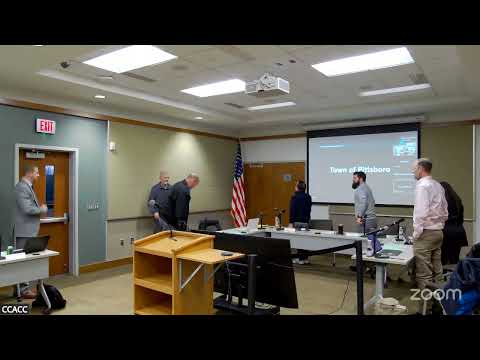
The Town of Pittsboro Board of Commissioners on Feb. 10 opened a public hearing on revisions to the Chatham Park affordable-housing additional element, discussed detailed changes to density credits and financial incentives, raised concerns about the draft’s definition of “project” and its potential to expand developable units, and voted to table the item for clarification.
Staff summarized the primary changes in the draft. The town manager, Jonathan, said the document was revised so that the affordable-housing unit requirement is triggered at certificate of occupancy rather than lot platting, that 60%-area median income (AMI) units would be required at a 20% share (an increase from 15%), and that incentives include a $5,000 payment tied to a 15-year restriction for certain low-income units and a $10,000 payment tied to a 30-year restriction on 60% AMI units. He also said Chatham Park agreed to build a greenway — up to $650,000 including design — and would receive a credit of 52 multifamily unit equivalents for that work. Staff said the revised language reduces a previously estimated town financial liability from roughly $25 million to about $5 million.
A central concern raised by several commissioners focused on the draft’s definition of “project” and the related density-credit provisions. Commissioner Bonitz (who identified himself as a long-time critic of earlier versions of the element) outlined his reading of the density-credit formula and concluded that, under the draft’s language, Chatham Park Investors could gain up to an eight-to-one density credit for each affordable unit if specific proximity conditions were met (proximity to a grocery store, a public school, and a transit stop or employment center). He characterized the possible outcome as meaning the town could see many thousands of additional residential units accrue to Chatham Park’s build-out: “We're no longer talking about a 22,000 unit residential project. We're talking about potentially a 35,000 unit residential project,” Bonitz said in the meeting.
Staff and commissioners debated whether the proximity tests should reference the boundary of a specific lot/site plan or a larger “project” area that might include multiple phases or a multi-parcel transaction. Commissioners asked staff to seek clarifying language from the applicant and counsel explaining intent and consequences. Staff noted that if federal subsidies such as Low-Income Housing Tax Credit (LIHTC) programs were to be used, those programs carry their own proximity requirements; commissioners said the draft appears more permissive than federal rules because it measures proximity to a project boundary rather than to a single tax-credit site.
Other substantive details in staff’s summary included: the 60% AMI unit share requirement rising to 20%; an incentive structure tied to unit affordability terms; a requirement that Chatham Park show the impact of public funding in redacted settlement statements; and procedural changes to unit-count timing and accounting. Staff said town payments for incentives would be due within a year of account creation and that Chatham Park could receive multifamily unit credits for certain public improvements.
After extended discussion, including requests for clarification from staff and applicant counsel, the board voted to table the item and asked staff to return with clarified language — particularly on the definition of “project” and the scope and application of density credits — before the board takes further action.