Get Full Government Meeting Transcripts, Videos, & Alerts Forever!
Get email alerts on the Permeable Driveway Variance topic
No spam. Unsubscribe anytime.
Motion to approve single‑car garage at 328 Caroline St fails after board raises questions about permeable driveway
Summary
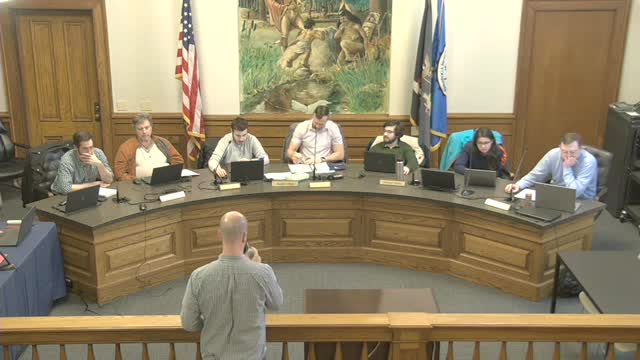
The Saratoga Springs Zoning Board of Appeals on Feb. 10 discussed an appeal by Dan and Tracy Zanata seeking area variances to construct a single‑car garage and driveway at 328 Caroline St.
The Saratoga Springs Zoning Board of Appeals on Feb. 10 discussed an appeal by Dan and Tracy Zanata seeking area variances to construct a single‑car garage and driveway at 328 Caroline St. The application sought relief for increased principal coverage, reduced rear and side setbacks and other dimensional variances. The board spent substantial time on whether a proposed permeable driveway could be treated as pervious for zoning calculations.
City staff told the board that permeable pavement may be counted as impervious unless the applicant can “materially demonstrate that the effective infiltration rate of the surface meets or exceeds 1.1 inches per hour.” The building and zoning inspector said the applicant’s recent submittal lacked sufficient manufacturer or installer documentation proving an infiltration rate at that level.
“Permeable pavement is permitted but will be calculated as impervious surface unless it can be materially demonstrated that the effective infiltration rate of the surface meets or exceeds 1.1 inches per hour,” a city staff member said, describing the UDO standard staff relied upon.
Board members debated options. Some said a condition requiring the building department to verify permeability before issuing a permit would be adequate; others wanted the proof in hand before voting. Multiple board members said they were wary of relying on a future owner’s choice (for example, applying a seal coat) that could negate permeability over time.
After deliberation, a motion that would have approved the requested variances — with a condition that the driveway be permeable as agreed with the applicant — failed. The roll call recorded three board members voting in favor (Shaffer Gaston, Otis Maxwell and Gage Simpson), three opposed (Christopher LaPointe, Jonah Cohen and Bridal Dailey) and one abstention (Amanda Dema). The chair noted that a motion not carrying within the statutory period results in an automatic denial but the applicant may submit revised materials or an amended resolution during the allowable post‑hearing window.
What this means: the board indicated it would be inclined to approve the project if the permeability question were resolved to staff and board satisfaction before a decision, or if the applicant returned with clearer specifications and documentation. Staff and board discussed conditioning an approval on submission of manufacturer and installer specifications demonstrating the required infiltration rate; the board also discussed whether to require a named installer or a manufacturer warranty.
Public comment included a neighbor’s attorney asking for time to review a late architectural revision; the board kept the public hearing open in other pending matters and discussed procedural options for the applicant to provide additional information within the statutory timeline.
The applicant may submit the requested permeability documentation (manufacturer specs, installer procedures and infiltration testing or other proof) for review; if the evidence meets UDO standards, the board indicated it could consider an amended motion within the allowed period or reopen the public hearing for a vote.