Get Full Government Meeting Transcripts, Videos, & Alerts Forever!
Get email alerts on the Education Policy topic
No spam. Unsubscribe anytime.
Senate Education Committee tables bill to allow "educational bankruptcy" for failing school districts
Summary
The Wyoming Senate Education Committee on Feb. 7, 2025 heard testimony on Senate File 173, the "Educational Bankruptcy Act," a proposal that would allow state intervention and court‑appointed trustees to assume authority over chronically low‑performing school districts, then voted to table the bill for interim study.
The Wyoming Senate Education Committee on Feb. 7, 2025 heard testimony on Senate File 173, the "Educational Bankruptcy Act," a proposal that would allow state intervention and court‑appointed trustees to assume authority over chronically low‑performing school districts, then voted to table the bill for interim study.
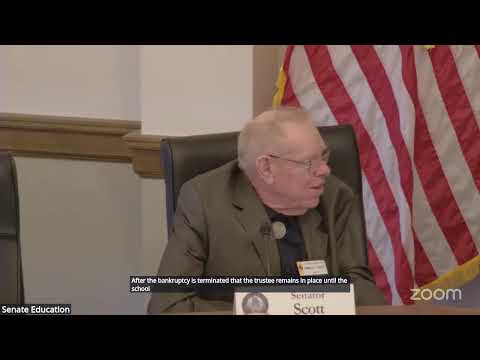
Senator Scott, sponsor of the measure, told the committee the bill is aimed at "the very worst, of the school districts out there," citing third‑grade English language arts and other grade‑level performance triggers in the draft. "There are some real problems out there, Madam Chairman," he said, and described a multiyear eligibility structure and a role for the state superintendent to select districts that meet the bill's criteria.
The bill would authorize a court to appoint a trustee who could remove the district superintendent and suspend the board's authority while implementing corrective actions. The text includes eligibility triggers tied to multiple grade‑level assessments, a provision allowing parents to petition for bankruptcy if the state superintendent does not, and an exception intended for tribal councils and reservation districts.
Committee members and public witnesses raised practical and policy concerns. Senator Wilson asked about a cap in the bill (page 11) intended to limit the number of districts the state could place into "educational bankruptcy." Senator Scott said the cap is meant to reflect limited Department of Education resources and the intensive attention trustees and the superintendent would need, calling the numeric limit "arbitrary" but necessary.
Witnesses urged caution and clarification on operational details. Diana Clapp, coordinator for the Wyoming State Board of Education, told the committee that state standards are reviewed every nine years and that changes to standards affect state assessments. She also described the state's accreditation process and recent counts of districts and schools requiring support: "In the 2023‑24 school year, there were two districts identified for accreditation with support as well as 22 schools," she said, and added that the department is presenting supports to the State Board.
Brian Farmer, executive director of the Wyoming School Boards Association, asked repeatedly about how a trustee would be identified and qualified, potential conflicts of interest and how statutory board duties and liabilities would be handled while a trustee was in charge. "Who is this trustee appointed by the district court? How does one become qualified to become a trustee?" he asked. Farmer also raised transition concerns, including the timing of superintendent searches and whether policies adopted by a suspended board would remain in force.
Researchers and educators warned that takeovers have mixed evidence. "They showed that there was no improved academic achievement from those takeovers," said Dr. Brown, referencing studies of state takeovers reported in research literature. Dr. Brown said Wyoming should examine that research before adopting a takeover model.
Parents, local residents and teachers described local consequences of low performance and of potential state intervention. Bill Winnie of Sublette County, calling parental action "bubbling under the surface," said families have been leaving public schools for charters, private schools and homeschooling. Jennifer Pasquale, a tenth‑grade teacher in Laramie County School District No. 1 who also teaches students with significant reading deficits, said the proposal appeared to focus accountability on districts and staff but not on supports for absent or struggling students: "Some of my students read at the second‑grade level," she said, and asked how the bill would account for growth and for high‑achieving students who remain in a low‑performing district.
Senator Scott told the committee he had compiled a list of deficiencies in the draft that he wanted to address and said he intended the bill chiefly to begin a public conversation and an interim review. After public testimony and committee discussion, Senator Olson moved to table Senate File 173. The committee approved the motion by voice vote; committee leadership said the measure will be studied during the legislative interim rather than advanced this session.
Committee members and witnesses flagged several issues for revision if the bill is revisited: clearer definitions and testing of the trigger criteria against state data, a statutory process for identifying and vetting trustees, clarifications on the legal status of suspended boards and the handling of superintendent transitions, explicit treatment of tribal districts, and review of evidence about the effectiveness of takeovers.
The committee did not advance the bill; members directed that the proposal be an interim study topic to allow further work on the operational, legal and research questions raised in testimony.