Get Full Government Meeting Transcripts, Videos, & Alerts Forever!
Get email alerts on the Police Satisfaction Survey topic
No spam. Unsubscribe anytime.
Neighborhood Analytics: 2024 Milwaukee police satisfaction survey shows mixed trends across groups
Summary
Neighborhood Analytics presented the 2024 City of Milwaukee Police Satisfaction Survey to the Fire and Police Commission, reporting stable overall satisfaction but notable shifts across racial, age and socioeconomic groups, declines in perceived police visibility and increased non‑reporting of crimes.
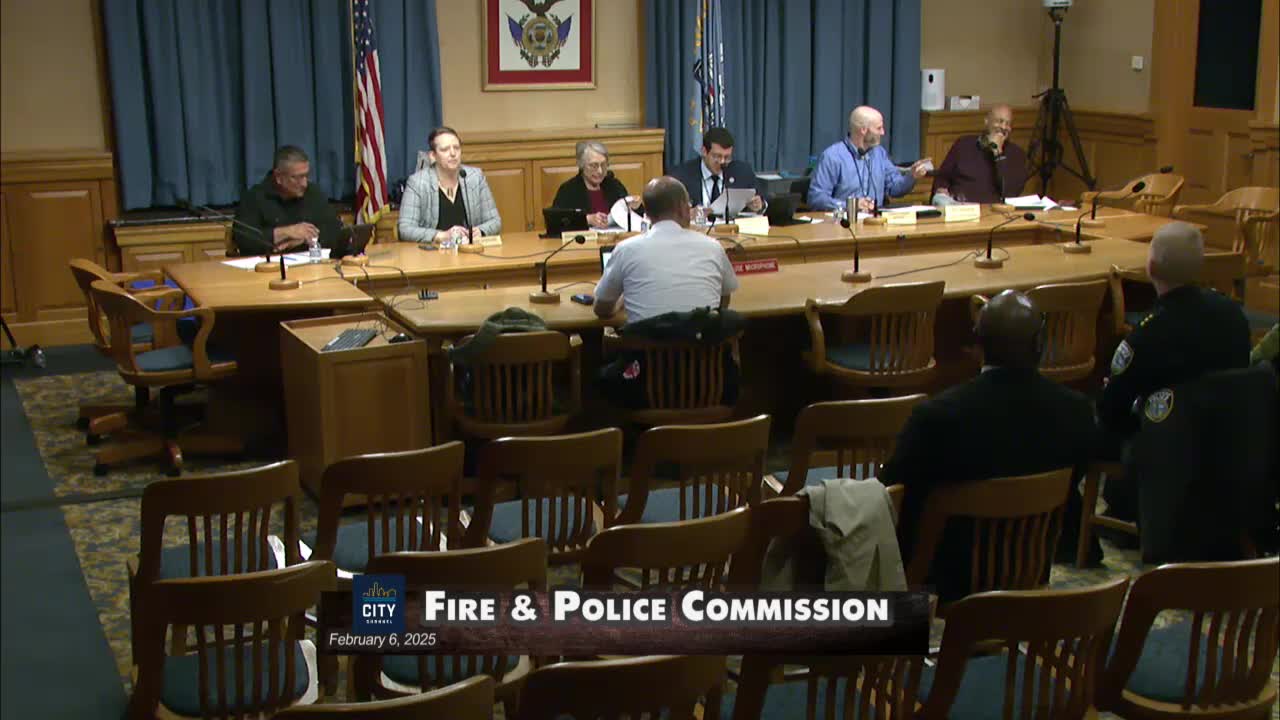
Neighborhood Analytics presented results of the 2024 Milwaukee Police Satisfaction Survey to the Fire and Police Commission on Feb. 6, 2025, reporting that overall resident satisfaction with the Milwaukee Police Department was largely unchanged since 2022, but that the aggregate masks meaningful shifts across demographic and experiential groups.
Joseph Serra, research director with Neighborhood Analytics, said the survey used mixed-mode sampling (telephone and mailed postcards linking to an online survey) and included 1,110 completed interviews collected July 27–Nov. 18, 2024. He noted a roughly 2.9 percentage-point margin of error and that results were weighted to Census figures. Serra highlighted that while statistical significance was flagged where appropriate, not all statistically significant changes are substantively large.
Key findings presented included: overall satisfaction remained between “somewhat satisfied” and “not very satisfied”; white residents showed declining satisfaction while satisfaction increased among Black and other nonwhite residents; younger residents reported rising satisfaction while older residents reported declines; perceived police visibility in neighborhoods fell from 22% in 2019 to 18% in 2024 for those saying police are “very visible”; and 91% of residents continue to prefer police be somewhat or very visible in their neighborhoods. Serra also reported a substantial rise in self-reported non-reporting of crimes: among residents who experienced one crime in the prior year, 33% said they did not report it in 2024, up from 13% in 2022.
Commissioners asked for clarifications. One commissioner requested additional breakdowns of reasons residents did not report crimes; Serra said the full report already includes closed-ended items asking whether respondents believed police would not or could not help, whether reporting would be too much hassle, or whether they expected discourtesy or unfair treatment. He said the largest (but not statistically significant) reason in absolute terms was belief that police could not or would not help, followed by perceived hassle. Another commissioner asked whether comparable datasets existed elsewhere; Serra said Milwaukee’s repeated survey is among the stronger longitudinal municipal datasets and cited older surveys in New Orleans and Austin as partial comparators.
Commissioners and staff discussed possible factors affecting trends, including changing patterns of police contact and department staffing levels. A department representative noted a decline in sworn officers since 2018 (from around 1,900 to the high 1,500s), which commissioners observed could affect visibility metrics.
Serra closed by summarizing: changes in satisfaction differ across subgroups even as the overall figure remains stable; police visibility has decreased while preference for visibility remains high; perceptions of police courtesy and respect during stops have improved; and non-reporting of crime increased substantially between 2022 and 2024.