Get Full Government Meeting Transcripts, Videos, & Alerts Forever!
Get email alerts on the Planning Commission Appointments topic
No spam. Unsubscribe anytime.
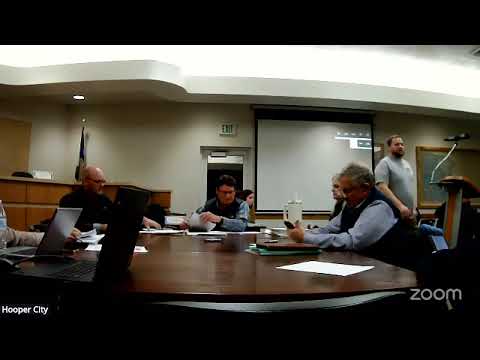
Hooper City Council debates clearer rules for planning commission appointments
Summary
City council members discussed proposed changes to the municipal ordinance that would clarify how planning commission candidates are nominated, how staggered terms are assigned and whether the mayor or the council should separately recommend candidates; no final vote was taken and the item will return for further refinement.
Hooper City Council members spent an extended discussion on proposed ordinance language that would change how planning commission members are nominated and how staggered terms are assigned, with councilors and staff disagreeing about whether the phrase “city council shall separately recommend” refers to the council as a body or to individual council members.
The matter drew attention because of how planning commission approvals affect subdivision review; one council member said the change was prompted by a perceived lack of “check and balance” in subdivision approvals and cited Utah state code 1098301 during the discussion. Several councilors urged clearer ordinance wording and more time to refine the process before adopting changes that could affect appointments for up to a year.
Council discussion and stakes Council members and staff described three connected issues: (1) who may recommend nominees to the planning commission (the mayor, the council as a body, or each council member individually); (2) how interviews and a recommending panel would be conducted; and (3) how to stagger terms so not all seats turn over at once.
Several participants said the draft language — which uses the phrase “the mayor and the city council shall separately recommend” — is ambiguous. Some councilors read that as meaning the body of the council (a single recommendation from the council), while others raised procedural concerns about how the council would meet or deliberate without creating an unlawful serial meeting if individual members seek to “recommend” names.
Councilors referenced other cities’ ordinances during the discussion. One councilor pointed to Far West’s ordinance as an example, saying that city’s language is more detailed: it establishes a panel, lists standard interview questions, requires ranking of candidates and directs how a recommended name should be determined. Multiple speakers said they wanted Hooper’s ordinance to be clearer in the same way.
Staggering terms and a suggested lottery Councilors discussed two example staggering options: a 2-2-2-1 pattern (two seats expiring, two, two, then one) or a 1-2-2-2 pattern that yields a seat every year. One proposal for implementing the chosen staggering was to have the planning commission draw names by lot at its meeting to assign initial short and long terms so staggered expirations would begin immediately; the commission meeting approach was proposed to avoid making the initial distribution a council-only decision.
Interviews, panels and timing Speakers debated whether the council should interview candidates as a body or whether the mayor’s interview and a separate council recommendation process would suffice. One person urged not to rush: passing the ordinance without clarifying how interviews, panels and joint recommendations would work could leave the city with no new planning commission appointments for up to a year under the current appointment schedule. Several councilors recommended taking additional time to draft precise language and return the item to a future meeting.
Next steps and related items No formal vote was taken on the ordinance during this session. Council members indicated the item will return for additional discussion and that staff should bring refined language and options back to the council. The planning commission will address staggering and term assignment at its next meeting, when members will also be asked to draw term lengths if the council approves that approach.
Separately, staff announced that next week’s planning commission meeting will start at 5:30 p.m. to allow a 6:00 p.m. land-use training by Rob Terry of the State Ombudsman’s Office. Council staff also said a fiscal analysis of the Terra Strada project — including a possible grocery store anchor — has been completed and will be presented to the city council on Feb. 20; planning commission members were invited to attend that presentation.
Other matters mentioned briefly during the discussion included a resident complaint about speeding on 5500 North, the VIPS/public-safety volunteer program (limited local interest and equipment signout rules with the sheriff’s office), and a request from the Western Weaver CTC for an additional city representative.