Get Full Government Meeting Transcripts, Videos, & Alerts Forever!
Get email alerts on the Community Survey topic
No spam. Unsubscribe anytime.
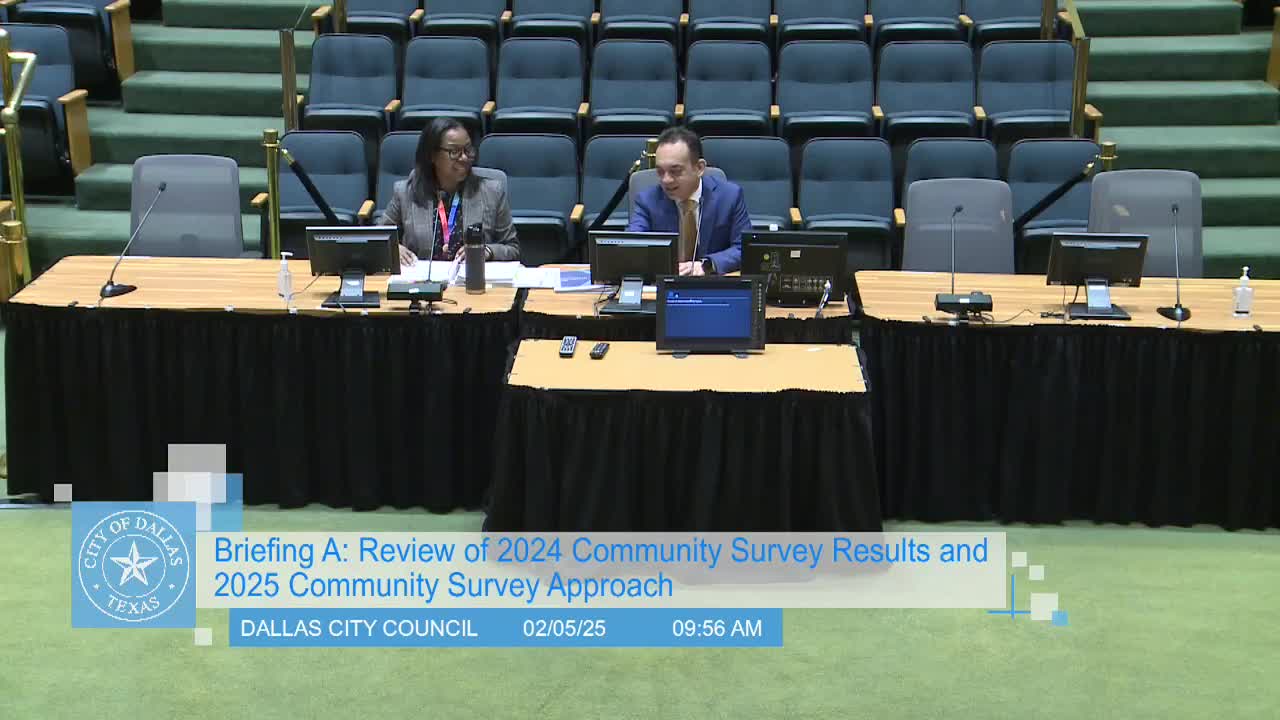
Dallas presents 2024 community survey results and unveils 2025 outreach plan
Summary
City staff and consultant ETC Institute told the City Council that Dallas residents rated the city positively overall, identified maintenance of infrastructure and police services as top priorities, and recommended a 2025 survey approach that adds an open online instrument to broaden outreach while preserving a statistically valid core sample.
The Dallas City Council heard a briefing on the results of the city's 2024 community survey and a proposed approach for the 2025 survey, with staff saying the results show broadly positive resident perceptions and clear priorities to guide budgeting and outreach.
The 2024 survey was conducted for the city by ETC Institute and yielded 2,118 completed responses, with a reported margin of error of 2.1 percentage points at the 95% confidence level. Jason Marotta, vice president and director of community research at ETC Institute, said the sample met the project goal of at least 150 completed surveys in each City Council district and was administered via mail, phone and online in multiple languages.
City staff and the consultant said major findings included generally favorable ratings for a range of city services; the highest satisfaction scores were for Love Field, public libraries and fire services, while lower satisfaction clustered around maintenance of infrastructure and police services. When asked which services should be the city's top priorities, respondents placed maintenance of infrastructure and police services at the top, followed by traffic management, social services and neighborhood code enforcement. The survey also found that access to affordable, quality housing was the single most important community characteristic residents wanted the city to address.
City staff emphasized that the survey's core advantages are trend-tracking and benchmarking. "We conducted the 2024 community survey in April-May 2024 and presented results to council in June; the survey is designed to be repeated so we can measure trends over time," Jeanette Wheaton, director of budget and management services, told council.
Council members used the presentation to probe methodology and implications for policy. Questions focused on how responses vary by district, how multi-lingual outreach was handled (the survey was offered in English, Spanish and Vietnamese), and how the city should weigh satisfaction results against the share of the city budget devoted to those services. Several members asked whether some questions reflect "importance" or "need for improvement," and ETC responded that the survey differentiates satisfaction from importance and that an "important-satisfaction" cross-tab identifies areas where low satisfaction and high importance overlap (maintenance of infrastructure and police services).
For 2025, staff proposed retaining the statistically valid random-sample instrument (the 2,100+ core sample) while adding a separate, optional online version available to any Dallas resident. Staff said the online version will not be included in the core statistics or benchmark comparisons but will be made available as a broader public input tool and will allow the city to display and analyze additional verbatim comments from residents who are not randomly selected. The 2025 timeline presented called for the main survey administration in February'March, draft results in May and a public briefing to council in June.
City staff said the online option would be used to expand outreach to equity-priority ZIP codes, busy parents, youth and immigrant communities, and that the city will distribute the instrument at libraries, recreation centers, cultural festivals and community events and through nonprofit partners. Staff also said they plan additional communications material and a short explanatory video to increase participation.
City leaders and staff agreed the statistically valid core will remain the decision-grade data that informs budget and performance benchmarking, while the open online instrument will provide broader qualitative input and additional context for outreach. Councilmembers asked staff to provide cross-tab reports by district, language used to complete the survey, and the redline of any question changes from prior years before the 2025 fielding.
Staff said they will return with final survey language for 2025 and that results will again be benchmarked against peer cities and compared to prior-year trends.