Get Full Government Meeting Transcripts, Videos, & Alerts Forever!
Get email alerts on the Bulk Water Wastewater Agreement topic
No spam. Unsubscribe anytime.
Fort Pierce Utilities seeks direction as St. Lucie County pursues own plants; bulk contract due 2028
Summary
FPUA staff updated the board on the bulk water and wastewater agreement with St. Lucie County, explaining the financial stakes if the county does not renew a wholesale contract that expires in 2028 and outlining options including marginalizing costs or negotiating a discounted wholesale rate.
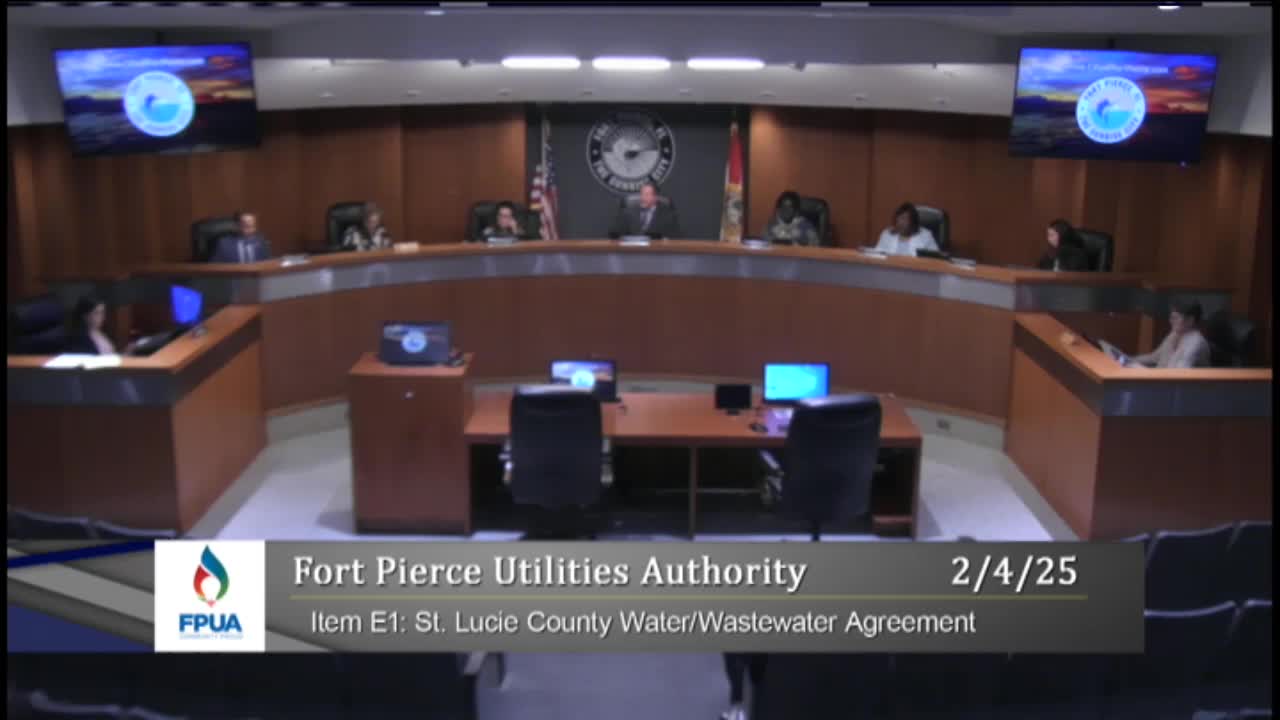
FORT PIERCE, Fla. — Fort Pierce Utilities Authority staff told the FPUA board Feb. 4 that the authority’s bulk water and wastewater contract with St. Lucie County, the utility’s largest single customer, expires in 2028 and that the county is pursuing its own treatment plants and seeking lower wholesale rates.
The update presented by FPUA Director Carlos Cisneros, water/wastewater Director Beau Hutchinson and rate consultant Murray Hamilton reviewed the contract’s history, described the “no loss/no gain” methodology used to set bulk rates in the 2019 amendment, and outlined staff’s current negotiating position as county officials consider building treatment facilities of their own.
The contract, originally executed in February 2004 and amended in 2019, established boundaries for water and wastewater service and set a negotiated wholesale rate designed to cover FPUA’s system costs allocable to the county, Hamilton said. Under the current arrangement St. Lucie County purchased about 390 million gallons of potable water in fiscal 2024, producing roughly $3 million in annual revenue, Hamilton said. If the county departs, that revenue would reduce FPUA’s total receipts by roughly $3.2 million per year, or about 6 percent of current revenues, he said.
Why this matters: FPUA staff told the board the lost revenue could constrain borrowing for major infrastructure or expansion projects, though the authority expects a bond payoff timing around 2028 that will partially offset the loss. Staff said keeping the county as a wholesale customer remains a priority but that St. Lucie County’s leadership has signaled a desire both for lower bulk rates and for greater control or representation over any regional utility governance.
Staff and consultants detailed three key elements of past negotiations: how capital-improvement or capacity charges were handled for developments that failed to materialize after the 2008 downturn; a joint feasibility study into a regional Mainland Water Reclamation Facility (MWRF) that was not enacted because of governance disputes; and the jointly developed “no loss/no gain” bulk rate methodology adopted in the 2019 amendment.
Beau Hutchinson, FPUA director of water and wastewater systems, described the capacity-charge compromise in the 2019 amendment: the parties calculated previously reserved capacity credits and split those credits rather than allowing one side to claim the full amount. Hutchinson also summarized a deferred-payment approach in the amendment that delayed collection of FPUA’s share of capacity charges until water was seen at the meter, a mechanism intended to encourage system extension rather than early cash collection.
Murray Hamilton, the authority’s long-time rate consultant, summarized the no-loss methodology used to allocate systemwide water and wastewater costs to retail and wholesale customers. In an updated test-year analysis requested by staff, Hamilton reported the current wholesale water charge would decrease from $6.02 to $5.73 per 1,000 gallons while the wastewater charge would rise to $8.08 per 1,000 gallons under the updated allocations; overall revenue to FPUA from the county is roughly $3.1–3.2 million annually under current rates.
Board members pressed staff about details. Commissioner (board member) Gibbons asked whether the county had returned financial information requested by FPUA; staff said St. Lucie County had not provided the financial data despite repeated requests dating to 2022. Several board members expressed frustration that the county both seeks lower wholesale rates and is simultaneously pursuing construction of its own plants; commissioners noted the county recently authorized about $10 million toward a 2 million-gallon-per-day water plant on airport property.
Board discussion also touched on operational cooperation: Hutchinson and staff described examples of on-the-ground collaboration, including automated flushing and meter adjustments in areas where the county manages distribution mains, and said operations-level coordination had generally been cooperative.
Board direction and next steps: Board members gave staff guidance to continue negotiations but repeatedly asked FPUA to obtain the county’s financial figures before proposing any specific discount. Staff said they will meet with St. Lucie County leadership later in the week to continue talks and that, absent county financials, they could perform independent analyses or pursue public-record requests to obtain the needed information.
No formal action was taken; the board provided direction to staff to continue discussions and return with recommended options and numbers for any proposed marginalization or discount. The board also asked staff to seek written assurances that any discount would be passed through to county ratepayers if a concession were granted.
“Our customers should not be subsidizing county customers without evidence the county will pass savings through and/or provide reciprocal value,” Chair Fee said during the discussion.
What remains uncertain: St. Lucie County’s final decision on renewal, the county’s internal costs and borrowing plans for its proposed plants, and whether any negotiated modified agreement would be adopted before the 2028 expiration date. FPUA staff said they will continue to request financial information and will bring an analysis back to the board once they have it.
Ending: Staff said the authority will continue scheduled meetings with county leadership and will report back to the board with any new financial information or specific proposals; the board signaled it is open to negotiation but unwilling to approve additional discounts without evidence of public benefit for county ratepayers.