Get Full Government Meeting Transcripts, Videos, & Alerts Forever!
Get email alerts on the Sidewalk Vending topic
No spam. Unsubscribe anytime.
Board moves to adopt sidewalk vending rules, sets Feb. 4 adoption hearing after months of outreach
Summary
The Board of Supervisors introduced ordinances governing sidewalk vending in unincorporated Sacramento County, including a low-cost business license, new health standards for compact mobile food operations (CMFOs), and revised park rules. The board continued adoption to Feb. 4 and directed an education-first implementation.
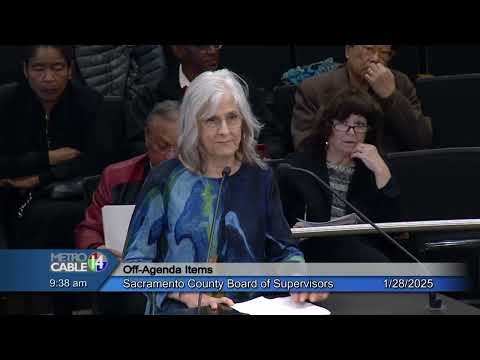
The Sacramento County Board of Supervisors on Jan. 28 approved introduction of a suite of ordinances to regulate sidewalk vending countywide and continued final adoption to a Feb. 4 hearing. The package includes a business-license chapter, countywide public-health standards for compact mobile food operations (CMFOs), and amendments to regional park rules.
Why this matters: California law requires local governments to allow sidewalk vending but permits narrowly tailored time, place and manner restrictions. The county's proposed rules aim to balance small-business opportunity, public health and safety, and protection of regional park resources.
Key points of the proposed ordinances
Business licensing: The new county business-license chapter would require sidewalk vendors to obtain an annual license (proposed administrative fee to cover processing is $61). Licensed vendors would display their license and, for stationary vendors, register an intended location.
Health and food-safety standards (CMFO): Environmental Management proposed a new countywide chapter aligning county code with the state retail food code's CMFO category. CMFOs would require a health permit, annual EMD inspection, an approved commissary/kitchen, overhead protection integral to the cart or stand, potable water and soap for handwashing, utensil wash capability, and temperature control for potentially hazardous foods. A limited exemption applies for small displays (25 sq ft or less) that only sell prepackaged, non-potentially hazardous items.
Parks and the American River Parkway: Regional Parks' code changes would permit sidewalk vending within developed recreation areas where health, safety and resource protection constraints are met, and would preserve the power to limit or exclude vending through concession agreements in areas served by existing concessions. Regional Parks staff will pursue an RFP/concession approach for some Parkway locations and formed a staff-subcommittee that includes advisory-committee representation.
Enforcement, education and limits
Staff emphasized an "education first" approach. Enforcement mechanisms are defined by state law and include graduated administrative fines for unlicensed activity and for violations of license or CMFO permit conditions; staff said impoundment of unsafe food remains available under the retail food code. County staff warned that enforcement capacity is limited by current budgets and that a more robust enforcement program would require additional funding.
Public comment and stakeholders
The board heard public comment from environmental and park advocates urging Parkway protections, and from the California Restaurant Association and other business groups seeking clarity on private-property rules. Betsy Weiland of the American River Association urged a Parkway-specific consistency check and completion of the parks subcommittee work before final adoption. Marlon Lara of the California Restaurant Association said restaurants and vendors can coexist and encouraged clearer cross-jurisdictional standards.
Formal action and next steps
The Board voted unanimously to introduce the ordinances and continue adoption to Feb. 4. Staff will proceed with targeted outreach and education, coordinate with incorporated cities and EMD to harmonize enforcement countywide, and return for adoption on Feb. 4.
Ending note
The announced approach emphasizes vendor outreach and permitting assistance while acknowledging enforcement limitations and the need to protect sensitive park resources and public health.