Get Full Government Meeting Transcripts, Videos, & Alerts Forever!
Get email alerts on the Mental Health Response topic
No spam. Unsubscribe anytime.
Residents, advocates and county leaders press for clarity after sheriff alters mental-health dispatch policy
Summary
Public commenters and County leaders raised alarm at a newly publicized Sacramento County Sheriff's policy limiting deputy response to many mental-health calls. Speakers urged shifting sheriff funding to civilian crisis teams, improving 911/988 dispatch coordination, and expanding the Community Wellness Response Team (CWRT).
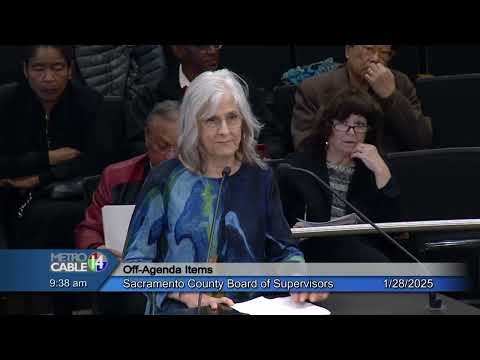
Public testimony at the Jan. 28 Sacramento County Board of Supervisors meeting focused on a recently announced change in the Sheriff's Office approach to mental-health calls, prompting supervisors to ask county staff for additional briefings and to pursue coordination options with behavioral-health providers.
Several speakers from mental-health advocacy groups and local service providers told the board they have grave concerns that reduced sheriff response to behavioral-health incidents will lead to worse outcomes and greater criminalization of people with mental illness. "The sheriff's office's policy to stop answering most mental health calls and to treat the ones they do respond to as criminal major events," Patricia Wenzel said during public comment, adding that funding no longer used for sheriff response should be transferred to behavioral-health response teams.
Board and staff reaction
County Executive David Villanueva told the board staff had been made aware of the policy change the prior week and that county leaders had engaged with the Sheriff's Office. "We continue to work with them, but as you know, we have no control over the policies of the sheriff's department and the only thing we do have control of is their budget," Villanueva told the board, asking Deputy County Executive Eric Jones to add details on coordination.
Advocates urged immediate reallocation of funds and administrative action. Patricia Wenzel, who identified herself as NAMI Sacramento helpline coordinator, said the civilian Community Wellness Response Team (CWRT) answers roughly 100 calls per month but that 988-based transfers and delays can produce 10- to 40-minute handoffs; she estimated some 1,000 calls per month could be routed to 988 under the new approach and warned of increased mortality and jailings if timely civilian response is not funded and staffed.
Board directions and next steps
Supervisors expressed concern and asked staff to bring back more detailed information. The County Executive's office said it would continue to work with the Sheriff's Office, Behavioral Health Services and the CWRT, and reminded the board that an annual update from the Community Review Commission is scheduled for the next week. No formal board action was required or taken regarding the sheriff's policy during the meeting; supervisors requested follow-up briefings and additional coordination across dispatch systems.
Voices at the meeting
"The Sheriff's department funding that they no longer need to respond to these mental health calls should be transferred immediately to behavioral health services," said Patricia Wenzel, NAMI Sacramento helpline coordinator. "We were aware of the policy change last week...we continue to work with them," County Executive David Villanueva.
Clarifying details raised in public comment and staff discussion
- CWRT currently answers about 100 calls per month (public comment estimate). - A public commenter estimated up to 1,000 calls per month could be routed to 988 under some scenarios. - County Executive staff said the sheriff presented the change to its Community Review Commission and county staff are assessing options.
What the county will do next
Supervisors asked county staff to brief the board further and directed county leadership to continue to coordinate with the Sheriff's Office, Behavioral Health Services, CWRT leadership and dispatch agencies to clarify handoff and funding responsibilities. The board also noted a Community Review Commission update is scheduled for the next board meeting.
Ending note
The exchange revealed a gap between a sheriff's operational policy and county behavioral-health and dispatch capacity. Board members asked staff to return with concrete options for funding and dispatch coordination; no ordinance or budget action was taken on Jan. 28.