Get Full Government Meeting Transcripts, Videos, & Alerts Forever!
Get email alerts on the Agricultural Burning Biomass topic
No spam. Unsubscribe anytime.
Sac Metro Air District presses for biomass funding as agricultural burning rises
Summary
Staff warned the board that agricultural burning increased during the last fall season and described regional work to convert biomass to fuel, citing state bond dollars and federal hydrogen hub money as potential funding sources.
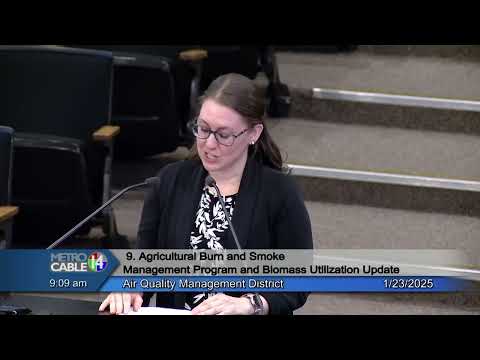
The Sacramento Metropolitan Air Quality Management District board on Jan. 23 heard an update on agricultural burning and regional biomass-utilization efforts and was urged to continue advocacy for state funding to support alternatives to open burning.
District program supervisor Ashley Reynolds said the district issues about 100 agricultural burn permits annually and typically oversees roughly 1,000 acres of burning each year, though activity rose this past fall largely because of vineyard removals. "This past fall burn season, we saw an increase in burning due to favorable conditions," Reynolds said, adding that Sacramento County accounted for about 3 percent of the acres burned in the Sacramento Valley basin this season.
The presentation framed agricultural burning as a coordinated, basin-wide activity managed under the Sacramento Valley Basinwide Smoke Management Plan, which was implemented in 2001 and restricts rice-straw burning and acreage by district. The Basinwide Council (BCC), which includes nine air districts and 11 counties, and a Technical Advisory Committee support daily coordination with meteorologists, California Air Resources Board (CARB) staff and district staff.
Reynolds and board members described funding and policy work aimed at converting agricultural and forest residues into useful products rather than burning them. The district highlighted several initiatives: Eco Motive, a proposed biomass-to-hydrogen facility near I-5 and Twin Cities Road; ARCHES, a public–private clean-hydrogen hub effort that the presentation said has received about $1.2 billion in federal infrastructure funding; and recent allocations from California’s Prop 4 climate bond, which the district said included $50 million to the Department of Conservation with a portion available to biomass projects.
Director John Dickinson asked about the source and size of the $50 million the district is seeking this year; Alberto Ayala, the district’s Air Pollution Control Officer, said staff are requesting an allocation in the state budget and are pursuing a mix of funds including Prop 4, the Greenhouse Gas Reduction Fund (GGRF) and, potentially, General Fund appropriations. "We are looking for a specific amount of $50,000,000 to scale up some of the projects like the Eco Motive that you heard about," Ayala said.
Board members emphasized that transitioning away from open burning will be difficult and costly. Director Guerra, who represents the district on basinwide efforts, said the nine-district coalition pushed for a larger Prop 4 allocation during the bond negotiations; the district’s advocacy helped secure the $50 million line in the final bond package, he said. Guerra also announced BCC plans for a networking session and a day at the state capitol this year to continue funding advocacy.
Staff and board members cautioned that alternatives are not one-size-fits-all. The San Joaquin Valley example was cited: that region received about $180 million to pilot shipping, composting and air-curtain burners but still found the transition challenging and costly. Reynolds noted technological advances and small-scale biomass plants that can be sited near biomass sources to minimize transport and associated emissions, but said capital and operational costs remain a barrier without subsidies or incentives.
The board was also told the district is working with partners on a legislative approach to quantify benefits from using biomass for clean energy. Ayala said the district is working with Senator Anna Caballero on draft bill language that would develop a methodology to quantify and monetize the air‑quality and wildfire-risk benefits of diverting biomass into clean energy uses; the language was included in the board packet for review.
Why it matters: converting agricultural and forest residues into fuels or energy could reduce smoke exposure, lower climate emissions and support local jobs, but doing so requires state and federal funding or incentives to cover added costs and spur facility development. Board members asked staff to continue advocacy and to pursue funding opportunities this year.
The board received the update; no formal action was required.