Get Full Government Meeting Transcripts, Videos, & Alerts Forever!
Get email alerts on the Student Discipline topic
No spam. Unsubscribe anytime.
Salem schools shift discipline tracking to ‘risk ratio,’ pursue restorative approaches
Summary
District officials presented new data using risk ratios to track disproportionality in discipline and outlined steps — including training, grants and targeted supports — to reduce exclusionary practices affecting students of color, students with disabilities, multilingual learners and low‑income students.
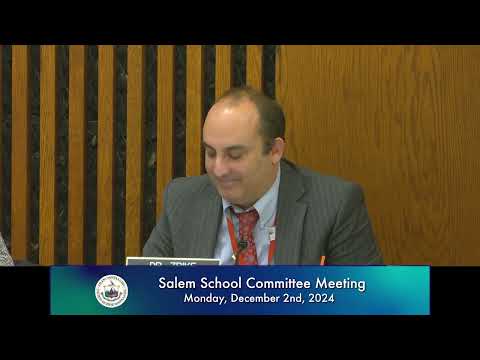
Ellen Wingard, executive director of student services for Salem Public Schools, told the School Committee on Dec. 2 that the district is using a metric called risk ratio to measure disproportionality in disciplinary outcomes and is directing resources toward restorative and preventive approaches.
The change matters because exclusionary discipline — suspensions, expulsions or any administrator‑managed removal from instruction — disproportionately affects marginalized groups, Wingard said. "A risk ratio of 1.0 equals equal representation," she told the committee, and the district’s strategic plan sets a target of lowering subgroup risk ratios toward 1.2 by the end of next school year.
Wingard said the district is tracking incidents recorded in the Aspen student information system (not only formal suspensions) and is seeing concerning overrepresentation for students with disabilities and for male students in out‑of‑school suspensions. She added that multilingual learners’ risk ratio was increasing in recent snapshots, even as the district trends “in a good direction” overall.
To address the disparities, the district plans to expand restorative practices, strengthen social‑emotional learning (SEL), audit and align discipline policies, and provide targeted school supports. Wingard said the district will continue monthly district leadership team training for principals and special education administrators and tailor professional development for specific schools. She noted the district received "another hundred thousand dollar grant" to extend restorative training, including work with community partners such as Raw Arts and the Suffolk Center for Restorative Justice.
Superintendent Steve Zrike framed the work as part of prevention: "By the time it gets to suspensions, it's way too late," he said, urging the committee to focus on proactive supports and smaller transitional classrooms for young students who need more intensive services. He also noted a legal requirement that suspensions for kindergarten through third grade require superintendent approval and that his designee for that review is Wingard.
Committee members asked about family engagement and gender disproportionality. Wingard said broader community engagement is a next step after internal alignment, and she emphasized prevention — building inclusive classroom communities so students do not reach crisis points that require exclusionary action.
The presentation referenced national and state data sources; Wingard pointed committee members to a recent U.S. Department of Education discipline report and cited a CDC study on harms associated with exclusionary discipline. The committee did not take a formal vote on discipline policy changes at the meeting but directed staff to continue the work and return with updates.
District officials said they will monitor risk ratios by school and grade on the district dashboard and use those data in school improvement planning and targeted supports.
Looking ahead, staff asked the committee to review student‑handbook language and district policies to ensure they align with the stated commitment to “instructive, restorative, developmentally appropriate, and equitably enforced” discipline practices.