Get Full Government Meeting Transcripts, Videos, & Alerts Forever!
Get email alerts on the Municipal Budget topic
No spam. Unsubscribe anytime.
Roy City council considers modest annual property-tax increases, service cuts and personnel options to close FY26 budget gap
Summary
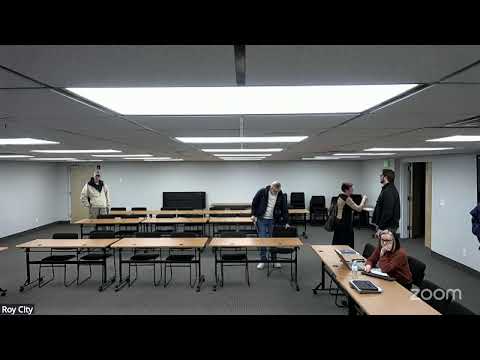
Roy City leaders met in a special work session on Jan. 21 to review a projected shortfall in the city’s fiscal 2026 budget and identify options for closing the gap, including modest annual property-tax increases, further service cuts, early retirement buyouts and use of one-time reserves.
Roy City leaders met in a special work session on Jan. 21 to review a projected shortfall in the city’s fiscal 2026 budget and identify options for closing the gap, including modest annual property-tax increases, further service cuts, early retirement buyouts and use of one-time reserves.
At the start of the session, the presiding Mayor summarized the problem bluntly: “There is no new sales tax revenue coming anytime soon to pay for employee salary increases, operating expenses, or anything else.” The mayor said the city will need roughly $1,100,000 in new recurring revenue each year just to cover merit and cost-of-living increases for staff, and asked council members to give the city manager guidance so a draft budget can be ready by the statutory deadline in May.
Why it matters: Sales and use tax is the city’s primary general-fund revenue source. Staff presented figures from Utah Tax Commission reports and the city’s CAFR showing Roy/Royce City generated about $8,100,000 in sales and use tax in 2024 and about $4,500,000 in property-tax revenue that year. Meeting presenters and department heads said taxable sales have stopped growing since late 2022 and that the state-derived population estimate used to allocate some tax distributions has fallen (from about 39,544 in 2020 to 38,591 in 2024, with a 2025 projection near 38,216 in the packet discussed). That population shift reduces the city’s share of statewide distributions and therefore the revenue available to run city services.
What council discussed
- Revenue drivers and limits: The mayor and staff reviewed charts from the city’s Comprehensive Annual Financial Report (CAFR) and Utah Tax Commission tax reports showing a flattening of sales-tax receipts since about December 2022 and a quarterly high in gross taxable sales of about $132,000,000 in a quarter in the historical data presented. Staff emphasized that local leaders have limited control over sales tax receipts aside from economic development, zoning to increase population and “buy local” efforts.
- Property-tax mechanics and truth in taxation: Staff explained that state law requires the city to set budgets based on prior-year revenue unless the city proceeds through the truth-in-taxation process or benefits from growth tied to new development. The mayor told the council that, absent other changes, the city manager will likely have to present a draft budget in May that could include a 20 to 25 percent property-tax increase to cover recurring personnel costs if the council does not provide alternative direction.
- Personnel and operating costs: Staff said personnel costs rose substantially over recent years. The packet shows about 163 full-time employees and roughly 229 part-time/seasonal workers; the mayor and staff highlighted that part-time seasonal labor costs equal about $1,400,000. Council and department heads described difficulty retaining mid-career employees (roughly 1–5 or 5–6 years of service) because neighboring cities and agencies frequently recruit lateral hires with higher pay or signing bonuses.
- Prior actions and one-time measures: The council recalled previous actions that used one-time funds: a 2022 decision to use approximately $1,500,000 from fund balance to pay salary increases, and an 11.2 percent property-tax increase approved last year to pay COLA. Staff reminded the council that one-time revenue (land sales, fund balance) can bridge a year or two but does not solve a recurring structural shortfall.
- Options on the table: Speakers suggested a mix of approaches rather than a single solution. Those included modest annual truth-in-taxation increases, targeted service reductions, not granting COLAs or merit increases (with clear trade-offs), early-retirement buyouts to reduce long-term salary costs and selling city properties to provide short-term cash. Department heads warned that some 7.5 percent operational cuts made in the prior year were largely one-time and that deeper or permanent cuts would meaningfully reduce services (for example, park maintenance, training, and complex/aquatic center operations).
Department-level impacts and examples
- Parks & Recreation: Michelle (Parks & Recreation director, staff) said the aquatic center admitted about 95,000 people during the summer season cited in the CAFR and that some prior cuts affected chemicals and operating decisions. She cautioned that cutting pool operations could leave the city unable to meet safety and health requirements.
- Public safety and police: Chief Williams (Police Chief) told the council the department has lost mid-career officers to other municipalities that pay more or offer signing incentives. He warned that training and equipment cuts are not sustainable and that increases in violent crime require more staff time per incident. The chief and other public-safety speakers said retaining experienced personnel is essential to response quality.
- Public works and seasonal staff: Department heads such as Brandon (Public Works department head, staff) said their biggest challenge is keeping experienced staff in the 5–6 year range; they noted that operational cuts and reduced training amplify turnover risks.
Council direction and next steps
Council members asked staff to run specific scenarios and bring back data: itemized lists of prior-year operational cuts, estimates of yield from early-retirement buyouts, the revenue that could be realized from specific land sales or development projects, and department-level impacts of additional reductions. The mayor asked council members to identify questions for individual department heads and to meet with staff 1-on-1 if needed so the city manager can incorporate council direction into a draft budget.
The mayor also put the council on record saying the city will likely need “modest property tax increase[s] every year” unless a combination of other solutions produces permanent new revenue. Several council members publicly stated they expect the city will go through truth-in-taxation and that gradual increases are preferable to large, catch-up jumps.
Votes at a glance
- Motion: Adjourn meeting. Outcome: Approved by voice vote; exact counts not specified in the record.
Ending
Council members and staff agreed to reconvene for additional work sessions. Staff will produce the requested analyses—cost estimates for buyouts, lists of prior operational cuts, revenue projections tied to potential development, and department-specific impacts—so the council can give firmer direction before the city manager assembles a draft budget for the May statutory submission.