Get Full Government Meeting Transcripts, Videos, & Alerts Forever!
Get email alerts on the Climate Action topic
No spam. Unsubscribe anytime.
Pima County outlines enterprisewide climate plan and next steps for Pima CAN
Summary
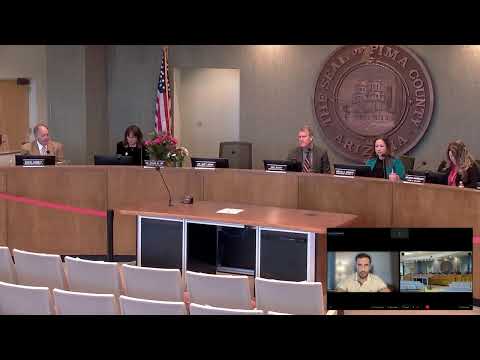
Pima County officials told the Board of Supervisors on Dec. 17 that the county has met or exceeded many of its near‑term carbon reduction goals for county operations and will consolidate those efforts into a countywide Climate Action Plan for County Operations (CAPCO).
Pima County officials told the Board of Supervisors on Dec. 17 that the county has met or exceeded many of its near-term carbon reduction goals for county operations and will consolidate those efforts into a countywide Climate Action Plan for County Operations (CAPCO).
Sherri Davis, speaking for the county climate team, told the board that a 24‑department Climate Action Executive Team and an interdisciplinary advisory committee have driven the work and that the county is “well ahead of schedule” in some areas, including emissions reductions at county facilities, fleet services and regional wastewater. Davis noted the county received a $1,000,000 EPA planning grant that supported earlier work and said CAPCO will be presented to the board in 2025 as the county aligns climate projects with Pima Prosper and the capital improvement plan.
The update emphasized five priorities for 2025–2030: carbon reduction and renewables, water supply and conservation, resilience to extreme heat, invasive species and wildfire mitigation, and transportation/air quality. Davis said staff will brand the effort publicly as “Pima CAN” (Pima Climate Action Now) to create a single public hub for resources and emergency information such as heat‑season guidance.
Supervisor Steve Scott praised the enterprise approach and asked staff to emphasize interjurisdictional coordination — for example, on water (where the county supplies sewer but not water), and on invasive species and wildfire where county lands border state and federal lands. Davis said working groups for invasives/wildfire and water already include multiple departments and that a broad interdisciplinary report would arrive early in 2025.
Jan Lesher, County Administrator, and directors on the executive team framed the CAPCO work as an effort to make projects “malleable, scalable, and data driven” and to integrate workforce development and equity into implementation. Board members asked that community engagement and materially measurable deliverables be part of the upcoming plan. Chair Adelita Grijalva and others directed staff to return with the CAPCO deliverable and noted staff will provide climate updates about every two months.
The presentation produced no public vote but established board direction to continue interdisciplinary planning, to integrate CAPCO with existing county infrastructure and prosperity plans, and to increase public access to the county’s climate resources via the Pima CAN hub. Staff identified near‑term technical deliverables (reports from 11‑ and 9‑department working groups) and a public launch of the branded climate hub in early 2025.
Staff will return with a formal CAPCO and related implementation items for board consideration in 2025.