Get Full Government Meeting Transcripts, Videos, & Alerts Forever!
Get email alerts on the Child Protection topic
No spam. Unsubscribe anytime.
Utah Children’s Justice Centers seek to hold FY26 funding steady as demand grows
Summary
The Utah Children’s Justice Centers (CJCs) told the Legislature’s appropriations subcommittee they seek to maintain current ongoing state funding and retain remaining one‑time and nonlapsing balances through FY26 as they manage caseload growth, multi‑year cases and a mix of state, federal and local funding streams.
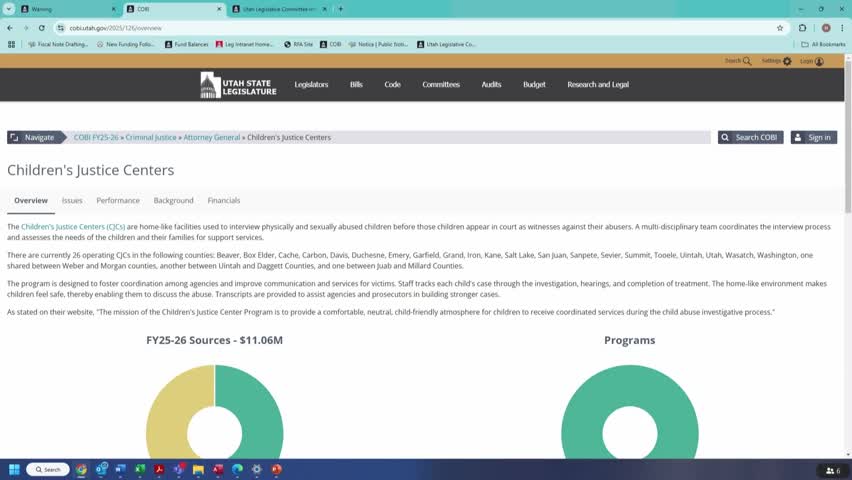
Tracy Tabith, director of the Utah Children’s Justice Centers, told the Executive Offices and Criminal Justice Appropriations Subcommittee that the statewide network — 25 centers serving all 29 counties — needs the Legislature to maintain existing ongoing funding so centers can sustain forensic‑interview specialists, medical assessments and trauma‑informed mental‑health screening services.
Tabith described the CJC model as a government‑based, multidisciplinary approach that co‑locates law enforcement, child protective services, medical providers and victim advocates so that children 17 and younger who are victims or witnesses can be interviewed and supported in one “child‑centered” setting. She said the state program, housed in the attorney general’s office, provides training, quality assurance and contracting support to county‑operated centers and partners with Primary Children’s Hospital and the University of Utah for forensic medical exams and trauma screening.
The CJCs served more than 20,000 people in fiscal 2024 and opened about 6,700 new cases, Tabith said. She said about 75% of children now receive interviews by forensic‑interview specialists (33 specialists statewide) and that program expansion has increased the percentage of specialist interviews from earlier years. Tabith said trauma screening finds about one in two children showing high trauma symptoms and one in eight screen high for suicide risk.
Tabith said CJCs juggle multiple fiscal timelines — state appropriation cycles, federal grants and calendar‑year programs — and rely on a mix of state, local and federal funding plus private‑sector support. She emphasized the centers’ reliance on the 2023 state funding increase and multi‑year one‑time appropriations, which she described as a “lifeline” after reductions in federal VOCA (Victims of Crime Act) funding. FY26 is the final year of a three‑year one‑time appropriation that funded facility improvements and expanded services in multiple counties, and Tabith asked the committee to maintain those funds and nonlapsing authority where possible so CJCs can complete locally planned projects and manage timing mismatches across funding streams.
Committee members asked for follow‑up on related processes: Representative Burton asked for clarification about thresholds used by Child Protective Services to remove children from homes; Tabith said that is outside the CJCs’ statutory role and offered to coordinate a response from DCFS. Representative Acton and others praised CJCs’ multidisciplinary model and urged continued funding.
Tabith said the attorney general’s office and counties are jointly responsible by statute for CJC functions, that she has seven full‑time staff providing statewide support, and that three of those positions are partially or wholly funded by federal grants. She said state support includes training (including a statewide conference), forensic interviewing instruction for law enforcement and CPS employees, and evaluation and peer review.
Tabith said CJCs do not accept direct self‑referrals; law enforcement and CPS must bring cases. She asked the committee to preserve ongoing funding in the FY26 budget and to allow nonlapsing balances for practical reasons related to staggered grant and contract cycles.