Lifetime Citizen Portal Access — AI Briefings, Alerts & Unlimited Follows
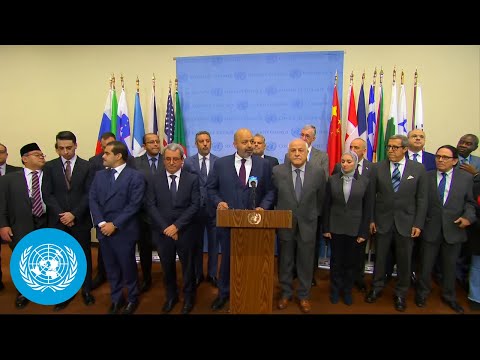
Arab group, Palestinian representative urge immediate ceasefire and reject forced displacement in Gaza
Loading...
Summary
Speakers at a United Nations meeting called for immediate implementation of a Security Council ceasefire resolution, condemned forcible displacement of Palestinians in Gaza as a violation of international law and outlined plans for post‑conflict reconstruction and statehood steps.
Tarek, chairperson of the Arab Group at the United Nations, and Riyad Mansour, Permanent Observer of the State of Palestine to the United Nations, urged immediate action to stop violence in Gaza, called for full implementation of a recent Security Council ceasefire resolution and condemned any attempt to forcibly displace Palestinians.
"The displacement of Palestinians in Gaza must be unequivocally rejected," Tarek said, citing Article 49 of the Fourth Geneva Convention of 1949. He said a united, unequivocal rejection by member states is imperative and called the proposed transfers "a clear violation" of international law.
Mansour reiterated those calls, saying the Security Council resolution "was a glimmer of hope" and urging the council to "uphold and enforce the principles of the resolution which calls for an immediate and full and complete ceasefire, the return of Palestinian civilians to their homes and neighborhoods in all areas of Gaza, [and] safe distribution of humanitarian assistance at scale." He added that Arab delegations had met with Security Council and European Union members to press for implementation.
The two speakers framed the crisis as an existential and legal issue. Tarek said the actions in the West Bank "are a clear violation of international law and must stop immediately," and Mansour invoked the International Court of Justice and General Assembly language calling for an end to what he described as an illegal occupation.
Both speakers described diplomatic activity underway. Tarek thanked Qatar, Egypt and the United States for work on a ceasefire arrangement; Mansour said Arab delegations met with the Security Council and European Union ambassadors and that the Arab states plan further consultations in Riyadh and an OIC ministerial meeting in Jeddah. Mansour said those processes aim to produce practical commitments ahead of an international conference co‑chaired, he said, by Saudi Arabia and France and requested by the General Assembly.
On reconstruction and future governance, Mansour said the Palestinian leadership circulated plans for rebuilding Gaza and urged member states to declare specific commitments. "We are in the beginning stages of asking countries to declare commitments of what exactly they will do in order to contribute to putting an end to this illegal occupation," he said, adding that commitments could include support for the Palestinian government, measures against settlements and recognition of the State of Palestine.
The speakers also delivered casualty and displacement figures and timelines as part of their appeals. Mansour said the conflict has lasted about 15 months and stated a death toll "more than 50,000," with additional numbers he described as "perhaps more than 10,000" killed in related fighting and more than 10,000 injured; he presented those figures as the Palestinian side's characterization of losses. The transcript records those numbers as approximate and provided by Mansour during his remarks.
During a short question-and-answer exchange, a questioner asked about long-term reconstruction and whether displaced Palestinians would emigrate. Mansour emphasized that Palestinians want to return home: "There is no place like home," he said, and warned against forced transfers, starvation or denial of medical care.
No formal vote or Security Council action was recorded in the transcript of this meeting excerpt. The statements represent diplomatic appeals and public positions delivered in the United Nations plenary context.
Looking ahead, both speakers said they will continue diplomatic outreach at the Security Council, General Assembly and with regional partners to press for immediate ceasefire implementation, humanitarian access and commitments for reconstruction and eventual Palestinian membership in the United Nations.