Get Full Government Meeting Transcripts, Videos, & Alerts Forever!
Get email alerts on the Commercial Drivers topic
No spam. Unsubscribe anytime.
Committee advances bill tightening commercial driver rules, adds youth DUI disqualification and military test waivers
Summary
The Transportation, Highways & Military Affairs Committee voted 4–1 to recommend passage of House Bill 28, which updates Wyoming’s commercial driver license statutes to match federal Motor Carrier Safety Administration rules, adds additional serious traffic violations and creates a disqualification for under‑21 CDL or CLP holders convicted with a BAC of 0.02 or greater.
The Transportation, Highways & Military Affairs Committee voted 4–1 to recommend passage of House Bill 28, a measure that updates Wyoming’s commercial driver license (CDL) statutes to align with Federal Motor Carrier Safety Administration (FMCSA) rules and adds new disqualification criteria for some young drivers.
The bill modernizes definitions and testing rules and adds specific traffic violations to the list of "serious traffic violations." Committee members were told the bill also allows the state to waive both knowledge and skills CDL tests for certain military members under a federal program known in the hearing as the "Even Exchange" program.
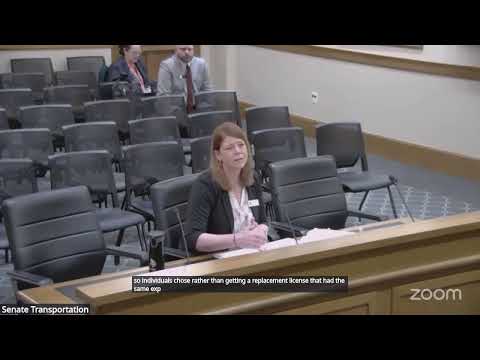
Misty Zimmerman, program manager for Wyoming Driver Services, told the committee the draft comes from the agency’s modernization project and from federal regulation changes. She said the bill updates the definition of "serious traffic violation" to add language such as "improper erratic lane change," explicitly includes commercial learner permits (CLPs) in the definition, and adds texting-while-driving and use of a handheld electronic device while operating a commercial motor vehicle to the serious-violation list.
Zimmerman also described a new youth-disqualification provision: a person under 21 who holds a CDL or CLP and is convicted of driving with a blood-alcohol concentration (BAC) of 0.02 or greater would be subject to disqualification consistent with federal rules. That disqualification, she said, would not be expunged merely because the offense occurred before the driver’s 21st birthday if the person held a CDL or CLP at the time. The bill also gives the department authority to require retesting and to disqualify CDL holders who obtained credentials by fraudulent means; those persons could face a one‑year disqualification if they do not retest successfully, the department told the committee.
Several senators pressed the department on details and potential unintended effects. Senator Cole and others expressed concern about broad rulemaking authority and language that could allow future rule changes without explicit legislative detail. Committee members asked whether the bill’s federal alignment could jeopardize state grant funds tied to the state motor carrier safety program; Zimmerman said some intrastate variances have, in other contexts, affected grant eligibility and that the department must review such issues case by case.
Public comment came from Mark Aronowitz, chair of the legislative committee of the Wyoming Trial Lawyers Association. He said his organization supported recognizing distracted-driving violations but urged caution about broad waivers of knowledge testing. Aronowitz told the committee that Wyoming’s interstate highways and mountain passes create driving conditions that, in his view, can make federal waivers insufficient for safety and asked whether the waiver language could be narrowed or clarified to specify who would qualify.
Committee debate before the vote touched on the knowledge-and-skills waiver for military CDL applicants. Zimmerman said the provision applies only to Wyoming-licensed applicants and generally to those qualifying under federal military occupational classifications identified in the FMCSA program; the department said it intends to require commanding-officer verification and other safeguards before waiving testing. Senators who opposed broad waiver language voiced concerns about non‑Wyoming drivers and about drivers trained under other jurisdictions’ rules operating on Wyoming roads.
On a roll call the committee recorded four ayes and one no; the committee chair volunteered to carry the bill to the floor.