Get Full Government Meeting Transcripts, Videos, & Alerts Forever!
Get email alerts on the Active Transportation Programs topic
No spam. Unsubscribe anytime.
MaineDOT outlines programs, new speed‑management and quick‑build plans for active transportation
Summary
Maine Department of Transportation planner Dakota Hewlett described current grant and cost‑share programs for bicycle and pedestrian projects, a new five‑class roadway context mapping and capped speed‑setting methodology, and upcoming state-funded quick‑build and small safety grant opportunities for municipalities.
Dakota Hewlett, active transportation planner and bicycle‑pedestrian coordinator at the Maine Department of Transportation, told regional partners that MaineDOT offers multiple programs to help municipalities plan and build bicycle and pedestrian infrastructure and that the agency is updating how it sets speed limits and implements “quick‑build” pilot projects.
Hewlett said the department’s Planning Partnership Initiative lets municipalities hire consultants with state cost‑share for planning studies such as active‑transportation plans, traffic and feasibility studies, and village or downtown conceptual work. He described a Village Partnership Initiative to scope “transformative” downtown projects and a Municipal Partnership Initiative for core road network work such as repaving or drainage improvements.
“These could be town‑wide or slightly regional, where we’re planning for network‑level connections when it comes to bicycle and pedestrian infrastructure,” Hewlett said. “It’s a great opportunity for a municipality to partner with the state.”
The story: why it matters
The programs Hewlett described provide planning and construction funding pathways for municipalities that want to improve sidewalks, crossings, bike lanes and other pedestrian and bicycle facilities. Hewlett also outlined a new speed‑setting process and a planned state program to cost‑share temporary demonstration projects, which could allow towns to test treatments before committing to permanent construction.
Key program details and timelines
- Planning Partnership Initiative (PPI): locally initiated cost‑sharing program for planning studies and conceptual designs. Hewlett said the local match is set on a three‑tiered scale based on municipal valuation. (Match tier details were discussed as a three‑tier approach; exact percentages by tier were not specified.)
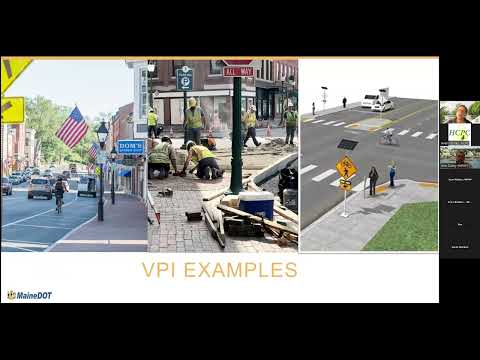
- Village Partnership Initiative (VPI): focuses on downtown and village center projects that aim for “transformative” results; Hewlett said projects in that program often fall into federal grant ranges and may cost roughly $5 million to $25–30 million to implement if taken through design and construction.
- Municipal Partnership Initiative (MPI): cost sharing for core road network work (paving, drainage) often coordinated through MaineDOT’s five regional offices.
- Maine bicycle and pedestrian funding program (state administration of the federal Transportation Alternatives program): Hewlett said the program now operates on an 80/20 cost share — MaineDOT typically provides 80% federal funds and the municipality provides 20% — and that applications are due each year on July 15. He added that applicants should expect roughly a three‑year timeline from application to construction in most cases because of design, right‑of‑way and federal requirements.
New speed management and complete‑streets practices
Hewlett described an agency effort to map the entire roadway network on a five‑class context continuum — rural, rural town, village, suburban and urban — and to tie a new speed‑setting methodology to that context mapping. The methodology will consider not only observed driving speeds but also roadway features such as the presence of sidewalks, driveway density and pedestrian activity.
“What we mean by that is we really want to try to find a better way for actual speeds on our roadways to be the speeds that we want operating on those roadways,” Hewlett said. He added that MaineDOT will set capped maximum posted speeds by context to prevent a long‑term drift upward in posted limits based only on observed speeds.
Hewlett said MaineDOT is creating a speed management toolbox of traffic calming measures and testing which tools work best in which contexts. He also said MaineDOT is updating its Complete Streets policy (originally issued around 2014) to include an early‑stage checklist for projects and to tie recommended complete‑streets elements to the five context classes.
Demonstration (quick‑build) projects and small active‑transportation safety funding
Hewlett described plans for demonstration or quick‑build pilot projects using temporary materials — paint channelization, flexible delineators, planters, rubber curb, or bollards — to test designs for speed reduction and safer pedestrian crossings. He said those pilots can help identify locations where permanent changes should be made later.
He also said MaineDOT expects to propose a community‑based initiatives cost‑share program in its next work plan to help fund demonstration projects, and a separate small active‑transportation safety fund targeted at measurable safety improvements (examples: rectangular rapid‑flashing beacons, bump‑outs, raised crossings). He emphasized that funding for the proposed small safety program would likely come from state funds rather than federal Highway Safety Improvement Program funds to preserve flexibility for quick builds and avoid additional federal environmental or NEPA steps.
Questions and clarifications from attendees
When asked where the context mapping idea came from, Hewlett said MaineDOT’s internal team reviewed other state DOT work and research, and he specifically cited a 2021 National Cooperative Highway Research Program (NCHRP) paper recommending expanded roadway classification tied to context‑specific measures.
On whether demonstration designs would need Federally approved interim tools, Hewlett said the department expects to implement treatments approved in the Federal Highway Administration’s Manual on Uniform Traffic Control Devices (MUTCD) and that other experimental treatments would be considered case by case. On whether data‑collection equipment such as Miovision would be eligible under upcoming programs, Hewlett said data is important and that the department is open to working with municipalities on options — whether lending equipment or funding purchase is still to be determined.
Contacts and next steps
Hewlett closed by sharing three regional planning contacts — Steve Cole, Matt Dross and Jared Fargollet — and invited municipalities to contact him or regional planners to discuss projects and applications. He said the department will post the context‑mapping information on its public website in the fall and that slides and a short video explaining the speed‑setting process would be shared with meeting organizers.
Ending
Hewlett thanked attendees and encouraged municipalities and partner organizations to reach out as MaineDOT develops the new programs and work plan for the coming year.