Get AI Briefings, Transcripts & Alerts on Local & National Government Meetings — Forever.
Advocates urge proactive wage-theft enforcement and better language access from Department of Employment Services
Loading...
Summary
Workers’ advocates told the Committee on Executive Administration and Labor that the District’s Department of Employment Services has been largely reactive to wage-theft complaints and should pursue proactive audits of industries with high violation rates while improving language access for immigrant workers.
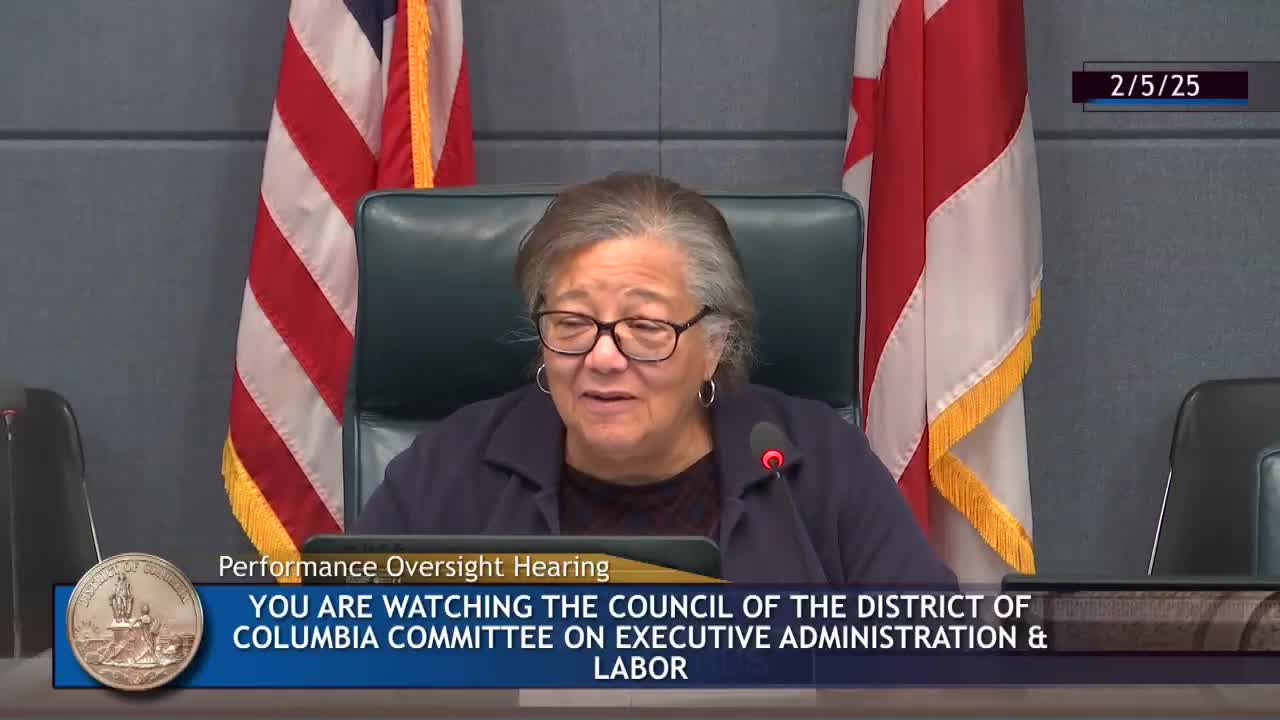
Advocates at a Feb. 5 Committee on Executive Administration and Labor oversight hearing urged the District’s Department of Employment Services to move from a reactive posture to proactive enforcement of wage‑theft laws, and to expand language access and outreach to immigrant workers.
The testimony centered on how fear of immigration enforcement discourages undocumented workers from reporting stolen wages and how that dynamic enables some employers to underpay staff. Alex Samuels of DC Jobs with Justice told the committee that the recent end of a federal program he identified as Deferred Action for Labor Enforcement ‘‘has helped create a culture of silence’’ and that direct agency action is needed: ‘‘No one should have to decide whether they’re willing to risk deportation to report that their employer is stealing the wages they earn through hard work,’’ Samuels said.
The advocates explained why they want DOES to pursue proactive, industry‑targeted audits rather than waiting for individual complaints. Samuels recommended ‘‘strategic enforcement’’—audits focused on sectors with documented high violation rates such as construction, restaurants and hospitality—arguing that public investigations of larger or higher‑profile employers can reduce violations across the sector.
Trippi Patel, chair emeritus of ANC 2A and a longtime tipped worker and organizer, urged stronger implementation of wage‑transparency requirements and said many tipped workers do not receive clear written explanations showing how tips and base pay are combined. Patel said that where employers refuse to provide pay‑calculation records employees are left with no way to verify compliance, and that undocumented workers often quit rather than risk retaliation by asking. "The agency needs to stop being reactive and it needs to be proactive," Patel said.
Committee members pressed the witnesses on what ‘‘proactive’’ enforcement would look like. Samuels suggested random audits, quarterly industry sweeps, and targeted enforcement against larger employers or top‑tier firms in supply chains to induce broader compliance. Patel suggested quarterly reviews for industries with known problems and monthly oversight for establishments with prior, proven wage‑theft findings.
The committee chairperson said the panel will follow up with DOES during the oversight cycle and suggested a posting requirement for pay‑calculation information in multiple languages, a step advocates and council members agreed could improve transparency.
Clarifying details recorded at the hearing: witnesses asked DOES to clarify which industries it would target, how often audits would run, and what language‑access supports the agency can guarantee. No formal agency commitments were announced at the hearing; the committee said it will examine DOES when agency staff appear later in the oversight schedule.
Ending — next steps: The committee chair told witnesses the hearing record will remain open for 10 business days for written submissions and said DOES will be invited back during the oversight cycle to respond to the concerns raised. Advocates asked the council to press DOES for quarterly reporting on enforcement actions and to consider requirements that pay‑calculation disclosures be posted in workplaces and in multiple languages.