Get Full Government Meeting Transcripts, Videos, & Alerts Forever!
Get email alerts on the Public Utilities Budget topic
No spam. Unsubscribe anytime.
Columbus Department of Public Utilities proposes $866 million operating budget, highlights rate-funded capital and low-income aid
Summary
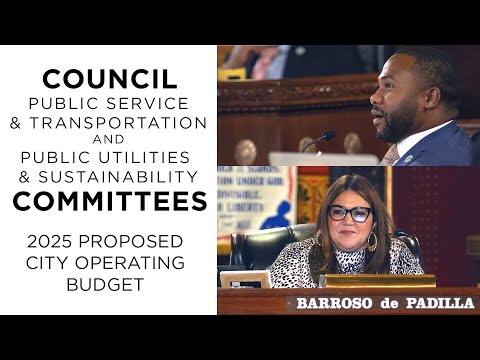
Deputy Director John Lee told Columbus City Council’s budget hearing the Department of Public Utilities’ 2025 operating budget is $866 million — a 6% increase — funding water, sewers and drains, stormwater and power operations while expanding customer assistance and capital planning tied to a $6 billion capital program.
Deputy Director John Lee presented the Department of Public Utilities’ proposed 2025 operating budget to the Columbus City Council’s budget hearing, saying the plan totals $866,000,000 and is about 6% higher than the 2024 budget. The budget, Lee said, funds four divisions — water, sewers and drains, stormwater and power — and pays debt service tied to a multiyear capital plan.
“These operating dollars will allow us to continue fulfilling DPU’s mission of providing essential utility services to residents and businesses in the Columbus region,” Lee said during the presentation. He told council members the department’s capital plan totals about $6,000,000,000 and that debt service accounts for a significant share of operating costs in several divisions.
Why it matters: The budget balances near-term operating needs with ongoing, large capital projects that will increase future debt service costs and influence utility rates. Council members pressed the department on affordability, sustainability and the timeline for projects such as the city’s fourth water plant.
Key budget details and priorities
- Total DPU operating budget for 2025: $866,000,000 (6% above 2024). Lee said the department budgets more than 1,400 full-time positions across divisions and is adding personnel in several areas.
- Director’s Office: $62,000,000 (reported as a 307% increase above 2024 in the presentation); Lee said personnel are the largest expense in that office and the budget includes support for a new customer billing system, a GIS-based work and asset management system, and expanded service-contract spending related to those migrations.
- Division of Water: $287,000,000 (about a 17% increase). Lee said operations-and-maintenance costs are up about 28% while debt service is about 40% of the division budget. The division will continue installing AMI (smart) meters, finalize design of the fourth water plant and transmission lines, expand the water regulatory compliance and lead service line replacement teams, and build a turnkey water residuals processing facility. Lee identified a $25,000,000 operating expense for residuals processing that he said is not capital-eligible. He also said the chemical budget is planned at $31,500,000 (about a 15.6% increase).
- Division of Sewers and Drains: $350,000,000 (a 6% decrease overall from 2024). Lee attributed the program to EPA regulatory requirements and ongoing consent orders; he said the Blueprint Columbus work to eliminate sewer overflows and basement backups will continue and the division will study nonpotable “purple pipe” water reuse for commercial customers.
- Division of Power: $121,000,000 (about 10% above 2024). Lee said purchase-power costs are increasing roughly 12% to about $67,000,000, and that a new low‑income power program has been established. Planned investments include distribution-line, transformer and substation upgrades and an $800,000 improvement to outage-management systems.
- Division of Stormwater: $44,000,000 (about 3% lower than 2024) supporting 25 full‑time positions; 70% of that budget is operations and 30% debt service, Lee said.
Customer assistance and rate changes
Lee said several utility rate increases already approved by council are supplying revenue for the capital program: water rates increased 7% for 2025, sewer rates 6%, and stormwater rates 1%. He described expanded customer assistance: eligibility for low‑income discounts has been increased from 150% to 200% of the federal poverty level, the discount rate rose from 20% to 25%, and one-time bill credits for 2025 include a $65 credit for water and sewer low‑income customers and a $50 credit for low‑income power customers. Lee also said the department is rolling out a new billing portal and other technology to simplify enrollment.
On outreach and enrollment, Lee said the department’s analysis suggests up to 100,000 residents could qualify at the 200% threshold, but currently about 7,000 are enrolled. He estimated the budgeted impact of the assistance programs at roughly $800,000 to $1,000,000 for 2025 and said the department plans targeted outreach, translation services and staff dedicated to enrollment work.
Debt management and capital timing
Lee told council the department commonly uses low-interest, state-level loans through Ohio EPA and the Ohio Water Development Authority to smooth debt-service timing — in part by delaying principal-and-interest payments until projects are complete — and that modeling of multi‑year projects (including a multi‑hundred‑million‑dollar fourth water‑plant project) drives rate and timing decisions.
Questions from council members
Council members asked about the water-reuse study (Lee described “purple pipe” nonpotable reuse targeted largely to commercial customers such as data centers), the department’s sustainability role (Lee said approximately $1,000,000 in general‑fund support is included for the Office of Sustainability), and the effects of debt on future rates. On low‑income enrollment, Lee said the department expects outreach through partners including the Central Ohio Area Agency on Aging (COAAA) will increase sign-ups.
What’s next
Lee said departments will continue to refine budgets and that many capital projects will require construction timelines that will increase debt service in coming years. Council members signaled continued interest in affordability measures and in the department’s outreach and prioritization for capital work such as the fourth water plant and lead service line replacements.
Ending note
Council members thanked the department for the presentation and for planned customer-assistance expansions.