Get Full Government Meeting Transcripts, Videos, & Alerts Forever!
Get email alerts on the Behavioral Health topic
No spam. Unsubscribe anytime.
Ventura County outlines roll‑out of Care Court, Prop 1 and behavioral‑health integration
Summary
County Behavioral Health described local preparations for Care Court and implementation steps for Proposition 1 and related 2024 state laws, saying launches will be phased and funding remains limited.
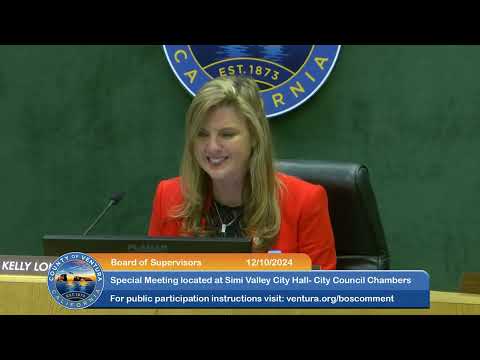
Ventura County behavioral‑health leaders told the Board of Supervisors on Dec. 10 that the county has launched planning and early operations for the state’s Care Court program and is preparing to implement major 2024 behavioral‑health laws, including Proposition 1 and changes tied to Senate Bill 43 and the BH Connect initiative.
County Behavioral Health Director Loretta Denering said Care Court is intended “to assist people with untreated schizophrenia and other psychotic disorders” and stressed that the court pathway “is not the only way, but it is one of many tools” the county will use to connect people to care. She said Ventura County has completed a mock trial and other preparations and officially launched its Care Court process on Dec. 2; county staff expect “upwards of 30 petitions” in the first year.
Denering said Proposition 1—passed statewide in March 2024 and incorporating provisions of SB 326 and AB 531—will alter how Mental Health Services Act funds are organized and spent, renaming it the Behavioral Health Services Act (BHSA) and adding new funding categories and infrastructure grants (B‑CHIP). County staff are preparing an 18‑month transition plan and said an application for B‑CHIP bond funding, including for an East County Psychiatric Health Facility and a proposed Lewis Road Mental Health Rehabilitation Center, was near completion and due to the state this week.
The county’s lead for behavioral operations described a departmental reorganization carried out this year to create a standalone managed‑care operations division and to consolidate clinic and crisis/housing functions so the county can meet new program and reporting requirements tied to the state’s BH Connect (part of the federal/state 11‑15 waiver) and CalAIM administrative integration. Denering said much state guidance is still pending and that many of the new laws and programs currently have “no ongoing programmatic funds” attached—forcing the county to launch with planning and internal reprioritization.
Supervisors asked about network capacity and access to specialized care. Denering said Ventura meets current state network‑adequacy standards; for some rare, highly specialized services (for example, geriatric psychiatric inpatient units) the county relies on out‑of‑county providers. She said the county is actively pursuing infrastructure funding and local partnerships to expand capacity.
The public defender’s office asked the board to authorize acceptance of a State Bar grant to represent respondents in Care Court proceedings; the board approved the staff recommendation to sign the grant. County staff said no reportable fiscal commitments beyond planning funds have yet been provided by the state for many of these mandates and that the county will continue to press for clearer funding pathways.
County leaders said they will expand community outreach and stakeholder engagement during the BHSA transition period, including public information and city‑level briefings, to explain what the changes mean for residents and providers.