Get Full Government Meeting Transcripts, Videos, & Alerts Forever!
Get email alerts on the Comprehensive Plan Update topic
No spam. Unsubscribe anytime.
Cochise County supervisors hear progress report on comprehensive plan update, urge broader outreach
Summary
County planning staff outlined a draft update to Cochise County's comprehensive plan on Jan. 29, describing outreach so far and highlighting housing, transportation, water and renewable-energy issues; supervisors asked for continued coordination with cities, state agencies and local stakeholders and quarterly updates.
Cochise County planning staff presented a progress update on a proposed revision to the county's comprehensive plan during a Jan. 29 Board of Supervisors work session, outlining public outreach to date and identifying housing, transportation, water resources, renewable energy and economic development as focus areas.
"This is our comprehensive plan," Christine McLaughlin, planning manager with Cochise County Development Services, told the board as she opened the presentation. McLaughlin said the plan will guide county land-use decisions and assist the Planning and Zoning Commission, the Board of Supervisors and the Board of Adjustments in performing their duties.
The comprehensive plan, McLaughlin said, is intended to reflect population and infrastructure needs for up to 10 years from adoption; the county's current plan was adopted in May 2015 and staff is proposing a summer 2025 adoption date for the update. McLaughlin reported outreach metrics including roughly 140 survey responses (later noted at one point as 170), a dedicated project website that has received more than 2,146 visits, nine community meetings, a county-fair booth and targeted social-media and employee outreach.
McLaughlin said survey questions are intended to fill gaps not covered by census or American Community Survey data, for example residents' experiences accessing local roads in different weather conditions, and that respondents provided ZIP codes so staff can map geographic response patterns.
Why it matters: countywide guidance and required reviews
McLaughlin emphasized that the comprehensive plan is a policy document that the county will use to direct land-use designations, allowable zoning, densities and minimum lot sizes in a growth-areas table and corresponding map. She noted the plan will be transmitted to required external reviewers under state open-meeting and planning statutes (as cited during the meeting) and that the plan's policies will guide future rezonings and capital investments.
Key issues highlighted during the session
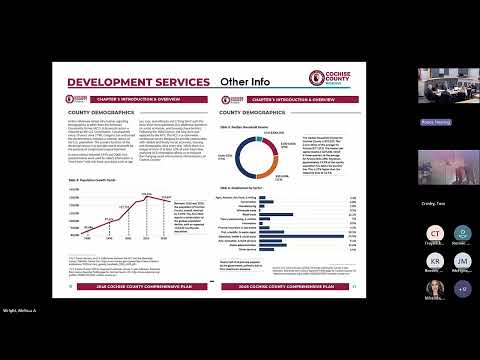
- Housing and demographics: McLaughlin said Cochise County's median household income is notably below the Arizona average (she cited roughly $52,000 county median versus about $77,000 statewide) and that owner-occupied home values run substantially below state and national averages (she cited national median value near $330,000 and Cochise at about $235,000). She said the county has a relatively high share of residents age 55 and older, and that 18.6% of residents are veterans. Staff plans a dedicated housing element and a forthcoming housing needs assessment supported by a grant and outside contractor.
- Transportation and the new port of entry: Staff and board members discussed anticipated freight and truck traffic related to a proposed port of entry near Douglas and the need to coordinate with the Arizona Department of Transportation and state legislators for funding and design. McLaughlin noted that the transportation element must address highways, railroads, airports and pedestrian and bicycle facilities; supervisors raised concerns about existing two-lane roads in places that could receive significant truck volume and discussed rail spurs and truck-rail transfer facilities as possible options.
- Water resources and cross-border issues: The board discussed watershed boundaries and groundwater basins that cross political boundaries. Supervisor Crosby (District 1) warned against water exportation and urged protecting local groundwater, and other supervisors suggested including watershed maps and clarifying where management responsibility lies.
- Renewable energy and siting concerns: McLaughlin summarized prior studies showing significant acreage with solar potential and said the plan could recommend developing overlays or zoning tools to steer large-scale projects away from sensitive areas and concentrate solar on already developed sites or parking lots. Supervisors and staff discussed community opposition to some large-scale projects, wildfire risk at utility-scale solar sites, and incentives for rooftop and small-scale solar.
- Economic development and state trust land: Board members and staff discussed opportunities to encourage commercial and light-industrial development near Benson and the port corridor. Staff explained state trust land is sold or leased by the state and that counties may seek to coordinate with the State Land Department but cannot unilaterally acquire trust land outside the established processes. Board members proposed a strategy of directing growth to areas with infrastructure and pursuing partnerships, leases or auctions for land near transportation corridors.
Board direction and next steps
Supervisors asked staff to continue community outreach and to provide updates at regular intervals. McLaughlin said staff can deliver draft plan elements for review by the Planning and Zoning Commission and the board and asked how frequently the board would like status updates; supervisors agreed on roughly quarterly updates and encouraged targeted outreach in underrepresented communities (examples discussed included Douglas, McNeil and other rural areas).
McLaughlin said the department will provide a draft growth-area map, a land-use table with land-use designations and allowable zoning, and a housing study to inform the housing element. She also said staff will transmit the plan to required external reviewers and coordinate with cities so county and municipal growth boundaries align where appropriate.
No formal actions were taken during the work session; the board did not vote on plan adoption or approvals during this meeting. Supervisors asked staff to return in about three months with follow-up materials and expanded outreach results.
"We were to lead this and just adopt it the way it is, then we've got the 700,000, you know, whatever it is, 1,400,000 acres that we say, hey, yeah, come and build solar panels on," McLaughlin said, urging careful mapping and clear policy language. Supervisor Crosby added, "We need to protect our own water from the state and the federal government. We need to prevent exportation of water," describing local water protection as a priority for the board.
Taper: Staff said additional public-review drafts and Planning and Zoning Commission hearings will be scheduled; staff also described grant-funded studies and a contractor-hired housing needs assessment to provide more detailed data for the housing element. The board set an expectation for continued engagement with state agencies, federal partners where relevant, local cities and rail operators to align plan recommendations with funding and infrastructure timelines.