Get Full Government Meeting Transcripts, Videos, & Alerts Forever!
Get email alerts on the Legislative Conduct topic
No spam. Unsubscribe anytime.
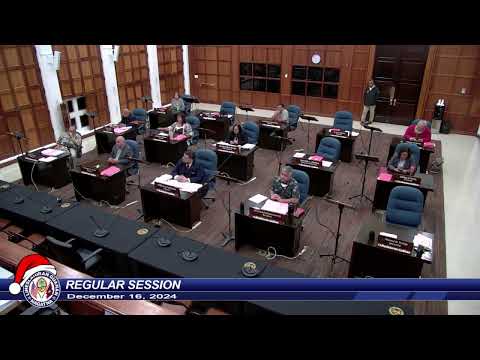
Guam Legislature Censures Senator William A. Parkinson for Disorderly Gesture
Summary
The Guam Legislature adopted Resolution 579-37 COR censuring Senator William A. Parkinson for an explicit hand gesture directed at Senator Joanne Brown during an Oct. 22, 2024 emergency session; the measure passed on a roll call vote after extended debate.
The Guam Legislature on the floor adopted Resolution 579-37 COR censuring Senator William A. Parkinson for a “disorderly” and explicit hand gesture directed at Senator Joanne M. Brown during the Oct. 22, 2024 emergency legislative session.
Speaker Therese M. Terlahi, who introduced the resolution, said she brought the censure motion reluctantly. “This bringing this resolution to the floor brings me no joy,” Terlahi said as she moved the measure to third reading. She cited a letter from Jesse L. G. Allick, president of the Mayor’s Council of Guam, saying visiting mayors and staff who attended the emergency session were “appalled, outraged, and insulted” by the senator’s conduct.
The resolution’s nut graf: supporters said the gesture — described in the measure as a lewd hand motion made while Senator Brown was recognized — created a hostile environment and violated the legislature’s standards for decorum and respect. The text of the resolution, as read on the floor, states the action “can reasonably be construed as disorderly, explicit conduct specifically directed against a female colleague,” and calls for formal censure.
Debate on the floor included multiple sponsors and supporters. Minority Leader Frank Blas Jr. said the body must uphold decorum and professionalism and voiced support. “We are now under a bigger microscope. The expectation of our actions is greater,” Blas said during remarks urging passage.
Senator Joanne M. Brown, the member identified in the resolution as the target of the gesture, described the effect on her and on women generally: “I have to tell you, I’ve never been so disrespected on the floor of this legislature,” Brown said. She criticized what she called both the act and the senator’s subsequent public denial: “What’s worse is lying about it.”
A number of senators cited the Mayor’s Council letter and other correspondence read into the record; Senator Chris Barnett read excerpts urging immediate action to preserve professionalism in public hearings.
Opposition on the floor was limited but vocal. Senator Duane T. D. San Nicolas said he did not support the resolution and characterized the measure as a “witch hunt,” urging colleagues to weigh the senator’s record alongside the accusation. “I’m not gonna stand here or sit here and listen to this witch hunt,” San Nicolas said.
Senator William A. Parkinson removed himself from the vote, stating he had not been afforded due process; the body excused him before the roll call. The resolution passed on a roll call with nine ayes, two nays and four excused. The two recorded nays were Senator Roy A. B. Kanata and Senator Duane T. D. San Nicolas; excused members included Senator Parkinson and others recorded as excused during the roll call.
The resolution resolves that the committee on rules “does hereby censure Senator William A. Parkinson” and directs the Speaker and the chairperson of the Committee on Rules to attest and transmit copies of the resolution to Senator Parkinson and the committee chair.
The vote formally places censure on the legislative record; supporters on the floor said the action is intended to reaffirm expectations for conduct in the chamber and to send a message that similar behavior will not be tolerated. The resolution cites the Oct. 22, 2024 emergency session and the Mayor’s Council of Guam letter as the factual basis for its findings.
The legislature did not, during the floor debate recorded here, impose other sanctions beyond the formal censure contained in the adopted resolution. The resolution directs internal certification and transmission of the censure as described in the resolved clauses.
Proponents said the measure aims to protect the ability of women — including those who hold or seek public office — to participate without harassment. Opponents said the body should be cautious about punitive steps without further process.
The body moved the resolution through procedural steps (placement on third reading and a vote without engrossment) before the final roll call. Copies of the resolution and the Mayor’s Council letter were entered into the record.