Get Full Government Meeting Transcripts, Videos, & Alerts Forever!
Get email alerts on the Homelessness Strategy topic
No spam. Unsubscribe anytime.
Sedona Council Holds Regional Homelessness Work Session, Seeks Resource Mapping and Next Steps
Summary
A council work session convened regional partners, Catholic Charities, Arizona Department of Housing and service providers to discuss a strategic, regionally coordinated homelessness response; council directed staff to pursue resource mapping and return with a proposed scope and budget for further planning.
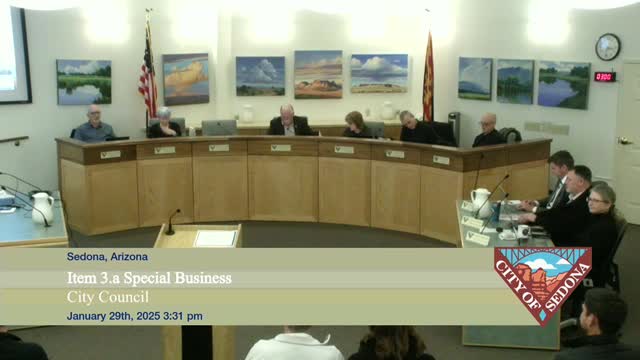
City council held an extended work session on developing a strategic plan to address homelessness in Sedona and the Verde Valley, hearing presentations from consultants, state housing officials, Catholic Charities, health care providers, law enforcement and other local stakeholders.
Consultants from VM Advising summarized a needs assessment that estimates roughly 600 unique individuals experience homelessness in the Verde Valley annually. The consultants described three utilization cohorts: transitional homelessness (about 360 people annually, typically short‑term and triggered by a one‑time crisis), episodic homelessness (about 180 people, multiple spells and longer stays) and chronic homelessness (about 60 people, long‑term needs requiring intensive services). The presentation emphasized that each group requires a different mix of responses — basic crisis intervention and service navigation for transitional cases, housing‑focused case management for episodic cases, and permanent supportive housing paired with long‑term services for chronic cases.
Cammie Rasband of Catholic Charities explained the role of coordinated entry, the Local Coalition to End Homelessness (LCEH) and HMIS (the Homeless Management Information System). David Bridge, special needs administrator with the Arizona Department of Housing, described funding streams the state can provide, including HUD Continuum of Care funds, Emergency Solutions Grants, development funds and the state housing trust fund; he noted Sedona has an active but paused application to the Homeless Shelter and Services Fund that remains available. Arizona Complete Health and Spectrum Healthcare outlined crisis response options, including a statewide crisis line and locally based mobile crisis teams. The U.S. Forest Service and local law enforcement discussed impacts and limits: forest closures have shifted off‑road camping patterns and officers emphasized the need for a single point of referral and local follow‑up capacity.
Multiple direct‑service organizations described existing local activity: Saint Vincent de Paul operates rental assistance making up about half its budget and serves roughly 15–20 clients per month in Sedona; the Sedona Community Food Bank reported 364 unique homeless clients in 2024; Palara Health, Spectrum and Arizona Complete Health described crisis stabilization, mobile crisis and behavioral health services. Cottonwood police and other law enforcement representatives described outreach officer programs that combine enforcement, case management and alternatives to jail; those programs also rely on prosecutor and court cooperation to provide diversion and deferred prosecution and were cited as a local model councilors wanted to study.
Council discussion at the end of the session focused on a practical next step: consultants were asked about a resource mapping exercise that would inventory current services, geographic coverage, provider capacity and funding sources and identify gaps. Council members signaled support for staff to pursue a scope and cost for that mapping and related strategy work and to bring a proposal back for consideration; the city manager said staff would work with the consultants to prepare a proposed scope and schedule for council review. Several councilors also urged coordination with neighboring jurisdictions and Yavapai County and emphasized the need for fast start actions — for example, adding a police outreach/resource officer position — that could be considered in the budget process. No formal vote was taken on a strategic plan during the meeting.