Get Full Government Meeting Transcripts, Videos, & Alerts Forever!
Get email alerts on the Constitutional Amendments Term Limits topic
No spam. Unsubscribe anytime.
Wyoming Judiciary Committee declines joint resolution calling for Article V term‑limits convention
Summary
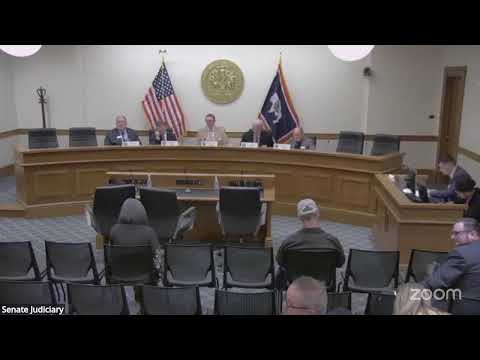
The Senate Judiciary Committee considered Senate Joint Resolution 5, which would call for an Article V convention to propose congressional term limits, heard testimony both for and against, and rejected the resolution in a roll‑call vote.
The Senate Judiciary Committee on an unspecified date debated Senate Joint Resolution 5, which would call for an Article V convention limited to proposing an amendment setting term limits for members of the U.S. House and Senate.
Senator Cole, presenting the measure, told the committee, "Before us is Senate Joint Resolution number 5. And it, speaks specifically to congressional term limits." He said the resolution would be one of the state’s proposed resolutions if the legislature chooses to pursue an Article V convention.
Supporters from advocacy organizations said the resolution is intended to pressure Congress to act or, if necessary, provide the states a path to propose an amendment. Keith Kennedy of US Term Limits told the committee that proponents “do not believe that Congress will let this get to the point where it becomes an article 5 convention, and that they will send something to the states.” Constantine, a US Term Limits staffer, argued federal elections are skewed in favor of incumbents and said, “Federal races are effectively rigged in favor of the incumbents,” citing fundraising and name‑recognition advantages as reasons advocates favor term limits.
Opponents warned that an Article V convention raises legal and practical risks. Carl Allred, introduced as “Former secretary of state,” said states’ role under Article V is limited to petitioning Congress and warned that Congress controls key procedural decisions: “The only part of the state's involvement in article 5 is to petition congress to call a convention. That's it.” Eldon Stahl, testifying in opposition, reviewed historical examples and argued that past practice shows Congress retains discretion in calling and shaping conventions and that a convention could exceed its intended limits.
Committee members asked whether the resolution differs from prior measures and whether it specifies particular term lengths; Senator Cole said the resolution is intended to launch a conversation and does not set a specific numeric limit. Senator Pregga asked how this proposal differs from measures previously passed by the Senate; the committee noted the point for further public testimony and consideration.
After public testimony and discussion, the committee took a roll‑call vote on Senate Joint Resolution 5. The committee reported the tally as 2 ayes and 3 noes; the resolution did not advance.
The debate illustrated the split among witnesses and legislators over whether seeking an Article V convention is a safe mechanism to achieve congressional term limits or whether it poses unacceptable risks to the Constitution and state authority. The committee record shows proponents emphasized preventing entrenched incumbency, while opponents emphasized procedural control by Congress and the risk of unintended constitutional changes.
The committee then moved on to other business, including consideration of Senate File 77 on compelled speech.